

QS 11 |
Katalog-Nr.GC17251
 One-Click Copy Product Info
|

QS 11 ist ein Inhibitor von ARFGAP1 (ADP-Ribosylierungsfaktor GTPase-aktivierendes Protein 1) mit einem EC50-Wert von 1,5 µM. QS 11 moduliert die Wnt/β-Catenin-Signalgebung durch eine Wirkung auf den Proteintransport. QS 11 hemmt die Migration von ARFGAP-überexprimierenden Brustkrebszellen.
Products are for research use only. Not for human use. We do not sell to patients.
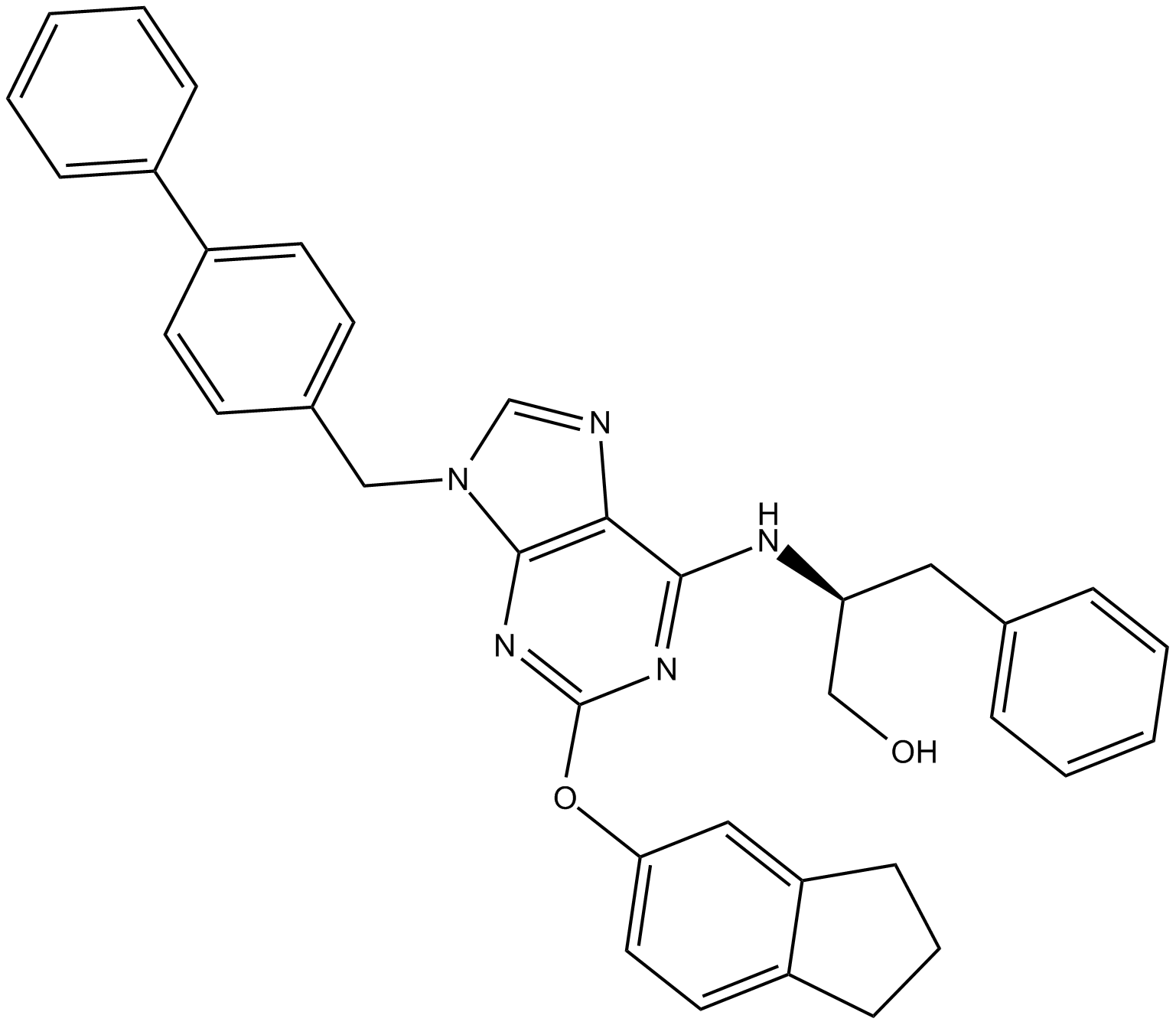
Cas No.: 944328-88-5
Sample solution is provided at 25 µL, 10mM.
_1-3.$$$39978408@51.jpg');)
_1-9.$$$38538795@65.jpg');)
_1-9.$$$39112701@51.jpg');)
_1-7.$$$37316672@70.jpg');)
_366-372.$$$36198801@70.jpg');)
.$$$38565142@65.jpg');)
_1867-1883.$$$33248023@67.jpg');)
_eads6055.$$$39977546@45.jpg');)
_eadm9805.$$$40080571@45.jpg');)
_eadj3020.$$$39666821@45.jpg');)
_1-20.$$$39757301@28.jpg');)
_1-24.$$$38898113@28.jpg');)
_273-287.$$$36806353@46.jpg');)
_1-16.$$$37156877@44.jpg');)
_1-19.$$$37460805@44.jpg');)
_1291-1307.$$$34518654@46.jpg');)
EC50: 1.5 μM for ARFGAP1 enzymatic assay [1] and 0.5 μM for Wnt synergist [2]
Purine derivative QS11 is a Wnt synergistic agonist by inhibiting the GTPase activating protein of ADP-ribosylation factor 1 (ARFGAP1). ARFGAP1 promotes hydrolysis of ARF1-bound GTP and is required in membrane trafficking and /or vesicle transport.
In vitro: QS11 showed potent Wnt Synergist activity with little cytotoxicity in HEK293 cells (EC50 = 0.5 μM) and human primary fibroblast cells (EC50 ≥ 10 μM). QS11 at 2.5 μM activated the Super(8X)TOPFlash reporter ~200-fold in the presence of Wnt-3a conditioned medium. Synergistic effect was also observed when QS11 was combined with recombinant Wnt-3a protein (10–200 ng/ml) [2].
In vivo: In Wnt signaling test model, embryos were injected with QS11, XWnt-8 RNA or a combination of QS11and XWnt-8 RNA. Compared with QS11 alone and XWnt-8 RNA alone, injection of a combination of XWnt-8 RNA and QS11 induced significantly more full (20.9%) and partial (30.2%) double axis formation [2]..
Clinical trial: So far, no clinical study has been conducted.
References:
[1] Singh MK1, Gao H1, Sun W1, Song Z1, Schmalzigaug R2, Premont RT2, Zhang Q3. Structure-activity relationship studies of QS11, a small molecule Wnt synergistic agonist. Bioorg Med Chem Lett. 2015 Nov 1;25(21):4838-42.
[2] Zhang Q1, Major MB, Takanashi S, Camp ND, Nishiya N, Peters EC, Ginsberg MH, Jian X, Randazzo PA, Schultz PG, Moon RT, Ding S. Small-molecule synergist of the Wnt/beta-catenin signaling pathway. Proc Natl Acad Sci U S A. 2007 May 1;104(18):7444-8. Epub 2007 Apr 25.
Cell experiment: | ARF-GTP levels are measured by using the GGA binding assay. NIH 3T3 cells are treated with QS11 or QS11-NC at the indicated concentrations for 36 h. Cells are lysed in ARF assay lysis buffer [50 mM Tris·HCl (pH 7.5), 100 mM NaCl, 2 mM MgCl2, 0.1% SDS, 0.5% sodium deoxycholate, 1% Triton X-100, 10% glycerol, and protease inhibitors]. GTP-bound ARF is assayed by its binding to a GST fusion protein, which contains the VHS domain to the GAT region of an ARF effector GGA3[1]. |
References: [1]. Zhang Q, et al. Small-molecule synergist of the Wnt/beta-catenin signaling pathway. Proc Natl Acad Sci U S A. 2007 May 1;104(18):7444-8. | |
| Cas No. | 944328-88-5 | SDF | |
| Chemical Name | (S)-2-((9-([1,1'-biphenyl]-4-ylmethyl)-2-((2,3-dihydro-1H-inden-5-yl)oxy)-9H-purin-6-yl)amino)-3-phenylpropan-1-ol | ||
| Canonical SMILES | OC[C@H](CC1=CC=CC=C1)NC2=NC(OC3=CC=C4CCCC4=C3)=NC5=C2N=CN5CC6=CC=C(C7=CC=CC=C7)C=C6 | ||
| Formula | C36H33N5O2 | M.Wt | 567.68 |
| Löslichkeit | DMSO: <100 mM,Ethanol: <100 mM | Storage | Store at -20°C |
| General tips | Please select the appropriate solvent to prepare the stock solution according to the
solubility of the product in different solvents; once the solution is prepared, please store it in
separate packages to avoid product failure caused by repeated freezing and thawing.Storage method
and period of the stock solution: When stored at -80°C, please use it within 6 months; when stored
at -20°C, please use it within 1 month. To increase solubility, heat the tube to 37°C and then oscillate in an ultrasonic bath for some time. |
||
| Shipping Condition | Evaluation sample solution: shipped with blue ice. All other sizes available: with RT, or with Blue Ice upon request. | ||
| Prepare stock solution | |||

|
1 mg | 5 mg | 10 mg |
| 1 mM | 1.7616 mL | 8.8078 mL | 17.6156 mL |
| 5 mM | 352.3 μL | 1.7616 mL | 3.5231 mL |
| 10 mM | 176.2 μL | 880.8 μL | 1.7616 mL |
Step 1: Enter information below (Recommended: An additional animal making an allowance for loss during the experiment)
 g
μL
g
μL
Step 2: Enter the in vivo formulation (This is only the calculator, not formulation. Please contact us first if there is no in vivo formulation at the solubility Section.)
Calculation results:
Working concentration: mg/ml;
Method for preparing DMSO master liquid: mg drug pre-dissolved in μL DMSO ( Master liquid concentration mg/mL, Please contact us first if the concentration exceeds the DMSO solubility of the batch of drug. )
Method for preparing in vivo formulation: Take μL DMSO master liquid, next addμL PEG300, mix and clarify, next addμL Tween 80, mix and clarify, next add μL saline, mix and clarify.
Method for preparing in vivo formulation: Take μL DMSO master liquid, next add μL Corn oil, mix and clarify.
Note: 1. Please make sure the liquid is clear before adding the next solvent.
2. Be sure to add the solvent(s) in order. You must ensure that the solution obtained, in the previous addition, is a clear solution before proceeding to add the next solvent. Physical methods such as vortex, ultrasound or hot water bath can be used to aid dissolving.
3. All of the above co-solvents are available for purchase on the GlpBio website.
Quality Control & SDS
- View current batch:
- Purity: >99.00% Appearance: A solid
- COA (Certificate of Analysis)
- SDS (Safety Data Sheet)
- Datasheet
Average Rating: 5 (Based on Reviews and 4 reference(s) in Google Scholar.)