

Ectoine (Synonyms: Ectoin, NSC 614616, Pyrostatin B) |
Katalog-Nr.GC39290
 One-Click Copy Product Info
|

Ectoin ist ein natÜrlicher Zellschutz, ein AminosÄurederivat, das von Bakterien produziert wird, die unter extrem rauen Umweltbedingungen leben.
Products are for research use only. Not for human use. We do not sell to patients.
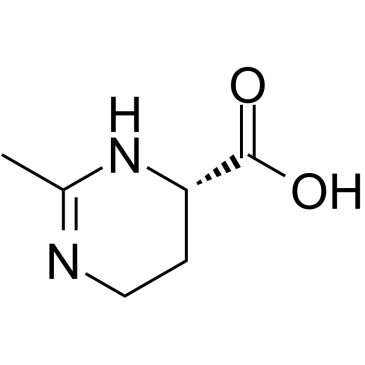
Cas No.: 96702-03-3
Sample solution is provided at 25 µL, 10mM.
_1-3.$$$39978408@51.jpg');)
_1-9.$$$38538795@65.jpg');)
_1-9.$$$39112701@51.jpg');)
_1-7.$$$37316672@70.jpg');)
_366-372.$$$36198801@70.jpg');)
.$$$38565142@65.jpg');)
_1867-1883.$$$33248023@67.jpg');)
_eads6055.$$$39977546@45.jpg');)
_eadm9805.$$$40080571@45.jpg');)
_eadj3020.$$$39666821@45.jpg');)
_1-20.$$$39757301@28.jpg');)
_1-24.$$$38898113@28.jpg');)
_273-287.$$$36806353@46.jpg');)
_1-16.$$$37156877@44.jpg');)
_1-19.$$$37460805@44.jpg');)
_1291-1307.$$$34518654@46.jpg');)
Ectoine is a cyclic amino acid derivative produced by bacteria living in extreme environments, which exerts cytoprotective effects through osmoregulation[1]. By binding to water molecules, ectoine forms a stable protective hydration shell around cellular components, safeguarding cell structures from damage caused by environmental factors and helping maintain the natural folding state of proteins[2]. Ectoine has been widely used in high-end skincare products, anti-allergic agents, and neuroprotection-related fields due to the compound's favorable safety profile and ability to repair cellular barriers[3,4].
In vitro, pretreatment of human red blood cells with ectoine (0-5%) for 1h protected the cells from damage induced by SDS treatment, with higher concentrations of ectoine providing stronger membrane protection[5]. When co-incubated with 25μM amyloid-β peptide (Aβ42) for 72h, ectoine (25μM-100mM) concentration-dependently reduced Thioflavin T (ThT)-induced fluorescence, indicating fewer cross-β-sheet structures. Notably, 100mM ectoine significantly inhibited Aβ42 fibril aggregation[6]. Pretreatment of human neutrophils with 1mM ectoine for 2h, followed by co-incubation with inflammatory mediators such as 300nM leukotriene B4 (LTB4) and 33μg/mL carbon nanoparticles (CNP) for 16h, significantly restored neutrophil apoptosis rates that were suppressed by these stimuli[7].
In vivo, topical administration of ectoine (0.5-2.0%; 5μL/eye; 4 times daily) in a dry eye model in C57BL/6 mice for 5 days improved corneal smoothness in a concentration-dependent manner. Both 1.0% and 2.0% ectoine restored corneal smoothness to near or complete normality[8]. A single co-administration of ectoine (1mM) with CNP (2.5mg/kg) into the lungs of Fisher 344 rats significantly reduced neutrophil counts and cinc-1 levels from 48 to 168h, demonstrating notable and sustained anti-inflammatory effects[7].
References:
[1] WANG K, CUI B, WANG Y, et al. Microbial production of ectoine: a review[J]. ACS Synthetic Biology, 2025, 14(2): 332-342.
[2] NG H S, WAN P K, KONDO A, et al. Production and recovery of ectoine: A review of current state and future prospects[J]. Processes, 2023, 11(2): 339.
[3] KAUTH M, TRUSOVA O V. Topical ectoine application in children and adults to treat inflammatory diseases associated with an impaired skin barrier: a systematic review[J]. Dermatology and Therapy, 2022, 12(2): 295-313.
[4] BUJAK T, ZAGÓRSKA-DZIOK M, NIZIOŁ-ŁUKASZEWSKA Z. Complexes of ectoine with the anionic surfactants as active ingredients of cleansing cosmetics with reduced irritating potential[J]. Molecules, 2020, 25(6): 1433.
[5] GRAF R, ANZALI S, BUENGER J, et al. The multifunctional role of ectoine as a natural cell protectant[J]. Clinics in Dermatology, 2008, 26(4): 326-333.
[6] KANAPATHIPILLAI M, LENTZEN G, SIERKS M, et al. Ectoine and hydroxyectoine inhibit aggregation and neurotoxicity of Alzheimer’s β-amyloid[J]. FEBS Letters, 2005, 579(21): 4775-4780.
[7] SYDLIK U, PEUSCHEL H, PAUNEL-GÖRGÜLÜ A, et al. Recovery of neutrophil apoptosis by ectoine: a new strategy against lung inflammation[J]. European Respiratory Journal, 2013, 41(2): 433-442.
[8] CHEN X, LIN N, LI J M, et al. Ectoine, from a natural bacteria protectant to a new treatment of dry eye disease[J]. Pharmaceutics, 2024, 16(2): 236.
| Cell experiment [1]: | |
Cell lines | Human erythrocytes |
Preparation Method | Human erythrocytes (2 × 10⁸cells/mL) are treated for 1h with 0%, 0.1%, 0.5%, 1%, and 5% ectoine. Then cells are stressed for 10min with 0% to 0.04% SDS solution, and the number of cells in lysis is determined spectroscopically via the content of free hemoglobin. |
Reaction Conditions | 0%, 0.1%, 0.5%, 1%, and 5%; 1h |
Applications | Etoine protects the cells from damage caused by SDS treatment. The erythrocytes pretreated with ectoine are shown to be more resistant to membrane damage by SDS than those of untreated cells. No stabilizing effect was observed in cells without ectoine, in which maximum erythrocyte damage occurred (0% increase of membrane stability). The higher the ectoine concentration, the greater the protective effect against membrane damage. |
| Animal experiment [2]: | |
Animal models | Dry eye model (C57BL/6 mice) |
Preparation Method | An experimental dry eye model was induced via desiccating stress (DS) in female C57BL/6 mice (DS mice). The DS mice were treated with topical administration via instillation of 5µL/eye of ectoine in PBS at different concentrations (0.5, 1.0 and 2.0%), 4 times daily during exposure to desiccation for 5 days. On day 5, clinical signs of dry eye and corneal damage were assessed via a stereo microscopy and Oregon Green dextran fluorescein staining. |
Dosage form | 0.5, 1.0, 2.0%; 5µL/eye; 4 times daily; topical administration via instillation |
Applications | Topical administration of 0.5, 1.0, and 2.0% of ectoine in DS mice improved corneal smoothness in a concentration-dependent manner, and ectoine at 1.0 and 2.0% significantly restored the corneal smoothness to near or completely normal condition, with a corneal smoothness score of 1.80 ± 0.92 and 1.20 ± 1.03, respectively. |
References: | |
| Cas No. | 96702-03-3 | SDF | |
| Überlieferungen | Ectoin, NSC 614616, Pyrostatin B | ||
| Canonical SMILES | O=C([C@H]1NC(C)=NCC1)O | ||
| Formula | C6H10N2O2 | M.Wt | 142.16 |
| Löslichkeit | Water : 250 mg/mL (1758.58 mM) | Storage | 4°C, protect from light |
| General tips | Please select the appropriate solvent to prepare the stock solution according to the
solubility of the product in different solvents; once the solution is prepared, please store it in
separate packages to avoid product failure caused by repeated freezing and thawing.Storage method
and period of the stock solution: When stored at -80°C, please use it within 6 months; when stored
at -20°C, please use it within 1 month. To increase solubility, heat the tube to 37°C and then oscillate in an ultrasonic bath for some time. |
||
| Shipping Condition | Evaluation sample solution: shipped with blue ice. All other sizes available: with RT, or with Blue Ice upon request. | ||
| Prepare stock solution | |||

|
1 mg | 5 mg | 10 mg |
| 1 mM | 7.0343 mL | 35.1716 mL | 70.3433 mL |
| 5 mM | 1.4069 mL | 7.0343 mL | 14.0687 mL |
| 10 mM | 703.4 μL | 3.5172 mL | 7.0343 mL |
Step 1: Enter information below (Recommended: An additional animal making an allowance for loss during the experiment)
 g
μL
g
μL
Step 2: Enter the in vivo formulation (This is only the calculator, not formulation. Please contact us first if there is no in vivo formulation at the solubility Section.)
Calculation results:
Working concentration: mg/ml;
Method for preparing DMSO master liquid: mg drug pre-dissolved in μL DMSO ( Master liquid concentration mg/mL, Please contact us first if the concentration exceeds the DMSO solubility of the batch of drug. )
Method for preparing in vivo formulation: Take μL DMSO master liquid, next addμL PEG300, mix and clarify, next addμL Tween 80, mix and clarify, next add μL saline, mix and clarify.
Method for preparing in vivo formulation: Take μL DMSO master liquid, next add μL Corn oil, mix and clarify.
Note: 1. Please make sure the liquid is clear before adding the next solvent.
2. Be sure to add the solvent(s) in order. You must ensure that the solution obtained, in the previous addition, is a clear solution before proceeding to add the next solvent. Physical methods such as vortex, ultrasound or hot water bath can be used to aid dissolving.
3. All of the above co-solvents are available for purchase on the GlpBio website.
Quality Control & SDS
- View current batch:
- Purity: >99.00% Appearance: A solid
- COA (Certificate of Analysis)
- SDS (Safety Data Sheet)
- Datasheet
Average Rating: 5 (Based on Reviews and 3 reference(s) in Google Scholar.)