

Rotenone (Synonyms: Nicouline, NSC 8505, NSC 26258, Tubatoxin) |
Katalog-Nr.GC16775
 One-Click Copy Product Info
|

Rotenone hemmt den Komplex I der mitochondrialen Elektronen-Transportkette. Rotenone steigert die Entstehung reaktiver Sauerstoff-Spezies in den Mitochondrien und induziert dadurch Apoptose.
Products are for research use only. Not for human use. We do not sell to patients.
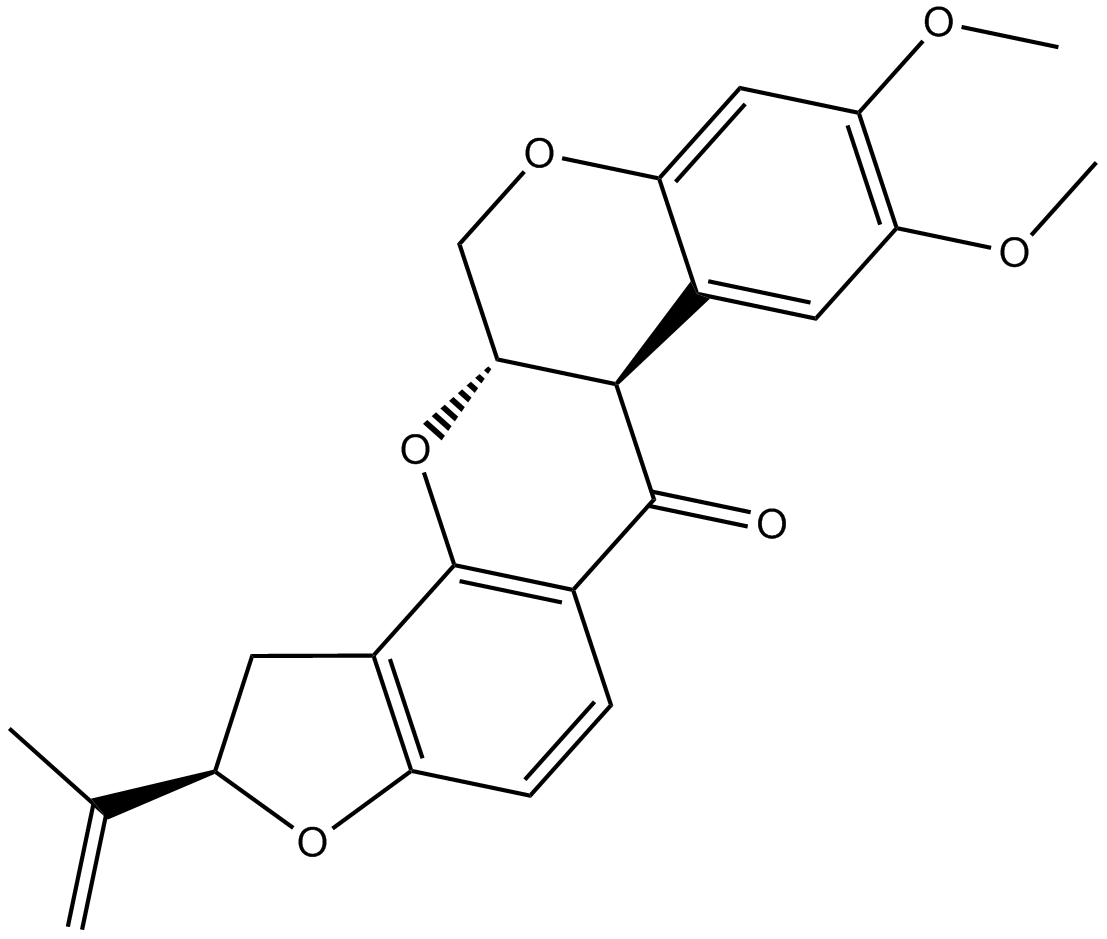
Cas No.: 83-79-4
Sample solution is provided at 25 µL, 10mM.
Rotenone hemmt den Komplex I der mitochondrialen Elektronen-Transportkette. Rotenone steigert die Entstehung reaktiver Sauerstoff-Spezies in den Mitochondrien und induziert dadurch Apoptose.
HL-60-Zellen wurden mit Rotenone (1 μm; 36 Stunden) behandelt. Unter konfokaler Mikroskopie zeigten circa 50% der HL-60-Zellen Chromatin-Kondensation und Kern-Fragmentierung[1]. Rotenone(1 μM/10 nM/100 nM; 24-48 Stunden)führt bei SK-N-MC-Neuroblastomzellen zu einem dosisabhängigen Zelltod[3].
Rotenone(2.5 mg/kg/Tag) wurde 4 Wochen lang verabreicht. Rotenone verringerte die Anzahl Tyrosinhydroxylase(TH)-positiver dopaminerger Neuronen in SNpc sowie die TH-Signalintensität in Striatum[2]. Im Nieren-Ichämie-Reperfusions-Modell wirkt (200 ppm; 3 Wochen) schützend auf die Nierentubuli. Rotenone blockiert Nierenfibrose, reduziert Entzündungen und Apoptose und korrigiert mitochondriale Veränderungen[4].
References:
[1]. Li N, Ragheb K, Lawler G, Sturgis J, Rajwa B, Melendez JA, Robinson JP. Mitochondrial complex I inhibitor rotenone induces apoptosis through enhancing mitochondrial reactive oxygen species production. J Biol Chem. 2003 Mar 7;278(10):8516-25.
[2]. Miyazaki I, Isooka N, Imafuku F, Sun J, Kikuoka R, Furukawa C, Asanuma M. Chronic Systemic Exposure to Low-Dose Rotenone Induced Central and Peripheral Neuropathology and Motor Deficits in Mice: Reproducible Animal Model of Parkinson's Disease. Int J Mol Sci. 2020 May 4;21(9):3254.
[3] Sherer TB, Betarbet R, Testa CM, Seo BB, Richardson JR, Kim JH, Miller GW, Yagi T, Matsuno-Yagi A, Greenamyre JT. Mechanism of toxicity in rotenone models of Parkinson's disease. J Neurosci. 2003 Nov 26;23(34):10756-64.
[4] Zhang W, Sha Y, Wei K, Wu C, Ding D, Yang Y, Zhu C, Zhang Y, Ding G, Zhang A, Jia Z, Huang S. Rotenone ameliorates chronic renal injury caused by acute ischemia/reperfusion. Oncotarget. 2018 May 11;9(36):24199-24208.
| Zellexperiment [1]: | |
Zelllinien | HL-60-Zellen |
Vorbereitungsmethode | HL-60-Zellen wurden 36 Stunden lang mit Rotenone(1 μM) behandelt. |
Reaktionsbedingungen | Rotenone: 1 μM; 36 Stunden |
Anwendungen | HL-60-Zellen wurden mit Rotenone (1 μM; 36 Stunden) behandelt. Unter konfokaler Mikroskopie zeigten circa 50% der HL-60-Zellen Chromatin-Kondensation und Kern-Fragmentierung. |
| Tierversuch [2]: | |
Tiermodelle | PD(Pakanmori)-Modell |
Vorbereitungsmethode | Männliche C57BL/6J-Mäuse erhielten 4 Wochen lang Rotenone(2.5 mg/kg/Tag). Die Verabreichung erfolgte subkutan über eine osmotische Minipumpe. |
Dosierungsform | Rotenone(2.5 mg/kg/Tag); 4 Wochen; sc |
Anwendungen | Die langfristige subkutane Behandlung mit einer niedrigen Dosis Rotenone (2.5 mg/kg/Tag) über 4 Wochen reduzierte die Anzahl TH-positiver dopaminerger Neuronen in SNpc sowie die TH-Signalintensität in Straitum. |
References: | |
| Cas No. | 83-79-4 | SDF | |
| Überlieferungen | Nicouline, NSC 8505, NSC 26258, Tubatoxin | ||
| Chemical Name | (2R,6aR,12aS)-8,9-dimethoxy-2-(prop-1-en-2-yl)-1,2,12,12a-tetrahydrochromeno[3,4-b]furo[2,3-h]chromen-6(6aH)-one | ||
| Canonical SMILES | O=C1[C@H](C2=CC(OC)=C3OC)[C@@H](COC2=C3)OC4=C1C=CC5=C4C[C@H](C(C)=C)O5 | ||
| Formula | C23H22O6 | M.Wt | 394.42 |
| Löslichkeit | ≥ 77.6mg/mL in DMSO | Storage | Store at 4°C, stored under nitrogen |
| General tips | Please select the appropriate solvent to prepare the stock solution according to the
solubility of the product in different solvents; once the solution is prepared, please store it in
separate packages to avoid product failure caused by repeated freezing and thawing.Storage method
and period of the stock solution: When stored at -80°C, please use it within 6 months; when stored
at -20°C, please use it within 1 month. To increase solubility, heat the tube to 37°C and then oscillate in an ultrasonic bath for some time. |
||
| Shipping Condition | Evaluation sample solution: shipped with blue ice. All other sizes available: with RT, or with Blue Ice upon request. | ||
| Prepare stock solution | |||

|
1 mg | 5 mg | 10 mg |
| 1 mM | 2.5354 mL | 12.6768 mL | 25.3537 mL |
| 5 mM | 507.1 μL | 2.5354 mL | 5.0707 mL |
| 10 mM | 253.5 μL | 1.2677 mL | 2.5354 mL |
Step 1: Enter information below (Recommended: An additional animal making an allowance for loss during the experiment)
 g
μL
g
μL
Step 2: Enter the in vivo formulation (This is only the calculator, not formulation. Please contact us first if there is no in vivo formulation at the solubility Section.)
Calculation results:
Working concentration: mg/ml;
Method for preparing DMSO master liquid: mg drug pre-dissolved in μL DMSO ( Master liquid concentration mg/mL, Please contact us first if the concentration exceeds the DMSO solubility of the batch of drug. )
Method for preparing in vivo formulation: Take μL DMSO master liquid, next addμL PEG300, mix and clarify, next addμL Tween 80, mix and clarify, next add μL saline, mix and clarify.
Method for preparing in vivo formulation: Take μL DMSO master liquid, next add μL Corn oil, mix and clarify.
Note: 1. Please make sure the liquid is clear before adding the next solvent.
2. Be sure to add the solvent(s) in order. You must ensure that the solution obtained, in the previous addition, is a clear solution before proceeding to add the next solvent. Physical methods such as vortex, ultrasound or hot water bath can be used to aid dissolving.
3. All of the above co-solvents are available for purchase on the GlpBio website.
Quality Control & SDS
- View current batch:
- Purity: >98.00% Appearance: A solid
- COA (Certificate of Analysis)
- SDS (Safety Data Sheet)
- Datasheet
Average Rating: 5 (Based on Reviews and 38 reference(s) in Google Scholar.)