

Sinigrin |
Katalog-Nr.GC39138
 One-Click Copy Product Info
|

Sinigrin ist ein wichtiges Glucosinolat, das in Pflanzen der Familie Brassicaceae vorkommt, mit antiadipogenen Wirkungen.
Products are for research use only. Not for human use. We do not sell to patients.
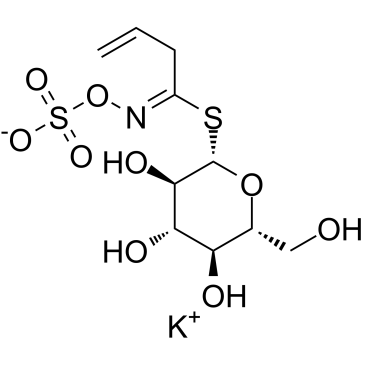
Cas No.: 3952-98-5
Sample solution is provided at 25 µL, 10mM.
Sinigrin is an orally active thioglucoside found in cruciferous plants[1]. Sinigrin exhibits diverse activities, including anticancer, antibacterial, antifungal, anti-inflammatory, antioxidant, and lipogenesis-inhibitory effects[2]. Sinigrin is commonly used in research on tumors, inflammatory, and metabolic diseases[3].
In vitro, Sinigrin (1-100μg/mL; 8 days) dose-dependently inhibits 3T3-L1 adipogenesis, activated AMPK/ACC and suppressing MAPK phosphorylation, and blocked lipid accumulation, PPARγ/C/EBPα expression, and pro-inflammatory cytokine release without cytotoxicity[4]. Sinigrin (20μM; 24-48h) exerts potent cytotoxicity against MCF-7 breast cancer cells, blocked PI3K/AKT/mTOR phosphorylation, triggered S-phase arrest, ROS overload, mitochondrial depolarization, and caspase-9-mediated apoptosis while suppressing cyclin D1, CDK4/6, PCNA and Bcl-2[5].
In vitro, Sinigrin (20mg/kg/d; 28 days; oral gavage) reversed MCAO-induced neuronal apoptosis, oxidative stress and neurological deficits while suppressing TLR4/MyD88 signaling in Sprague–Dawley rats[6]. Sinigrin (30mg/kg; 12 days; oral gavage) reversed DSS-induced colitis in BALB/c mice, suppressed IL-6, IL-1β, TNF-α and IL-17, restored antioxidant enzymes, and inhibited MAPK phosphorylation[7].
References:
[1] Awasthi S, Saraswathi NT. Sinigrin, a major glucosinolate from cruciferous vegetables restrains non-enzymatic glycation of albumin. Int J Biol Macromol. 2016;83:410-415.
[2] Melrose J. The Glucosinolates: A Sulphur Glucoside Family of Mustard Anti-Tumour and Antimicrobial Phytochemicals of Potential Therapeutic Application. Biomedicines. 2019;7(3):62.
[3] Mazumder A, Dwivedi A, du Plessis J. Sinigrin and Its Therapeutic Benefits. Molecules. 2016;21(4):416.
[4] Lee HW, Rhee DK, Kim BO, Pyo S. Inhibitory effect of sinigrin on adipocyte differentiation in 3T3-L1 cells: Involvement of AMPK and MAPK pathways. Biomed Pharmacother. 2018;102:670-680.
[5] Li S, Lin J, Wei J, Zhou L, Wang P. Sinigrin Impedes the Breast Cancer Cell Growth through the Inhibition of PI3K/AKT/mTOR Phosphorylation-Mediated Cell Cycle Arrest. J Environ Pathol Toxicol Oncol. 2022;41(3):33-43.
[6] Guo S, Lei Q, Yang Q, Chen R. Sinigrin improves cerebral ischaemia-reperfusion injury by inhibiting the TLR4 pathway-mediated oxidative stress. Chem Biol Drug Des. 2024;103(2):e14480.
[7] Kotipalli RSS, Tirunavalli SK, Pote AB, et al. Sinigrin Attenuates the Dextran Sulfate Sodium-induced Colitis in Mice by Modulating the MAPK Pathway. Inflammation. 2023;46(3):787-807.
| Cell experiment [1]: | |
Cell lines | MCF-7 human breast cancer cells |
Preparation Method | MCF-7 human breast cancer cells were cultured in a humid environment with 5% CO2 (at 37°C) and kept aseptic conditions in a germ-free and fluid DMEM media with 100U/ml penicillin, 10% FBS, and 100μg/ml streptomycin. The MCF-7 cells attained the predicted confluency before being treated with Sinigrin (20μM) and were incubated in a CO2 incubator for 24 and 48 hours. The cells were extracted after incubation for future study. Sinigrin was dissolved in a molecular grade of 0.5% DMSO. MCF-7 cell viability was estimated through MTT analysis. The ROS and ΔΨm levels were investigated under the inverted fluorescence microscope. cell cycle was analysed by commercial kit according to instruction. Proteins were extracted for Western Blotting analysis. |
Reaction Conditions | 20μM; 24-48h |
Applications | Sinigrin exerts potent cytotoxicity against MCF-7 breast cancer cells, triggered S-phase arrest, ROS overload, mitochondrial depolarization, and caspase-9-mediated apoptosis while suppressing cyclin D1, CDK4/6, PCNA and Bcl-2. |
| Animal experiment [2]: | |
Animal models | Male adult Sprague-Dawley rats |
Preparation Method | Male Sprague–Dawley rats were provided with free access to food and water with a 12h light/dark cycle and environmental conditions of 22±2°C and approximately 60 humidity. The CIR model was established by middle cerebral artery occlusion (MCAO) surgery. The rats were randomly divided into four groups (n=10 per group): Sham, Sinigrin 20mg/mL, MCAO and MCAO+Sinigrin 20mg/kg. The rats in the Sham group underwent surgery without filament insertion. Rats in the Sinigrin 20mg/mL group received Sinigrin 20mg/kg/d via oral gavage for 28 days. The rats in the MCAO group underwent MCAO surgery. Rats in the MCAO+Sinigrin 20mg/kg groups received 20mg/kg/d sinigrin via oral gavage for 28days following MCAO surgery. At the end of the experiments, the rats were anaesthetised with 2% pentobarbital sodium and sacrificed to obtain the brain tissue. The tissues were fixed for H&E and TUNEL staining. Total proteins were extracted for Western Blotting analysis. The Neurological Deficit Score (NDS) was used to evaluate the neurological functional outcomes following Sinigrin treatment. |
Dosage form | 20mg/kg/d; 28 days; oral gavage |
Applications | Sinigrin reversed MCAO-induced neuronal apoptosis, oxidative stress and neurological deficits while suppressing TLR4/MyD88 signaling in Sprague–Dawley rats. |
References: | |
| Cas No. | 3952-98-5 | SDF | |
| Canonical SMILES | O[C@@H]1[C@@H](O)[C@H](S/C(CC=C)=N/OS(=O)([O-])=O)O[C@H](CO)[C@H]1O.[K+] | ||
| Formula | C10H16KNO9S2 | M.Wt | 397.46 |
| Löslichkeit | Water: 125 mg/mL (314.50 mM) | Storage | Store at 2-8°C, protect from light |
| General tips | Please select the appropriate solvent to prepare the stock solution according to the
solubility of the product in different solvents; once the solution is prepared, please store it in
separate packages to avoid product failure caused by repeated freezing and thawing.Storage method
and period of the stock solution: When stored at -80°C, please use it within 6 months; when stored
at -20°C, please use it within 1 month. To increase solubility, heat the tube to 37°C and then oscillate in an ultrasonic bath for some time. |
||
| Shipping Condition | Evaluation sample solution: shipped with blue ice. All other sizes available: with RT, or with Blue Ice upon request. | ||
| Prepare stock solution | |||

|
1 mg | 5 mg | 10 mg |
| 1 mM | 2.516 mL | 12.5799 mL | 25.1598 mL |
| 5 mM | 503.2 μL | 2.516 mL | 5.032 mL |
| 10 mM | 251.6 μL | 1.258 mL | 2.516 mL |
Step 1: Enter information below (Recommended: An additional animal making an allowance for loss during the experiment)
 g
μL
g
μL
Step 2: Enter the in vivo formulation (This is only the calculator, not formulation. Please contact us first if there is no in vivo formulation at the solubility Section.)
Calculation results:
Working concentration: mg/ml;
Method for preparing DMSO master liquid: mg drug pre-dissolved in μL DMSO ( Master liquid concentration mg/mL, Please contact us first if the concentration exceeds the DMSO solubility of the batch of drug. )
Method for preparing in vivo formulation: Take μL DMSO master liquid, next addμL PEG300, mix and clarify, next addμL Tween 80, mix and clarify, next add μL saline, mix and clarify.
Method for preparing in vivo formulation: Take μL DMSO master liquid, next add μL Corn oil, mix and clarify.
Note: 1. Please make sure the liquid is clear before adding the next solvent.
2. Be sure to add the solvent(s) in order. You must ensure that the solution obtained, in the previous addition, is a clear solution before proceeding to add the next solvent. Physical methods such as vortex, ultrasound or hot water bath can be used to aid dissolving.
3. All of the above co-solvents are available for purchase on the GlpBio website.
Quality Control & SDS
- View current batch:
- Purity: >98.00% Appearance: A solid
- COA (Certificate of Analysis)
- SDS (Safety Data Sheet)
- Datasheet
Average Rating: 5 (Based on Reviews and 15 reference(s) in Google Scholar.)