

T0901317 |
Katalog-Nr.GC10596
 One-Click Copy Product Info
|

T0901317 ist ein oral aktiver und hochselektiver LXR-Agonist mit einem EC50-Wert von 20 nM fÜr LXRα.
Products are for research use only. Not for human use. We do not sell to patients.
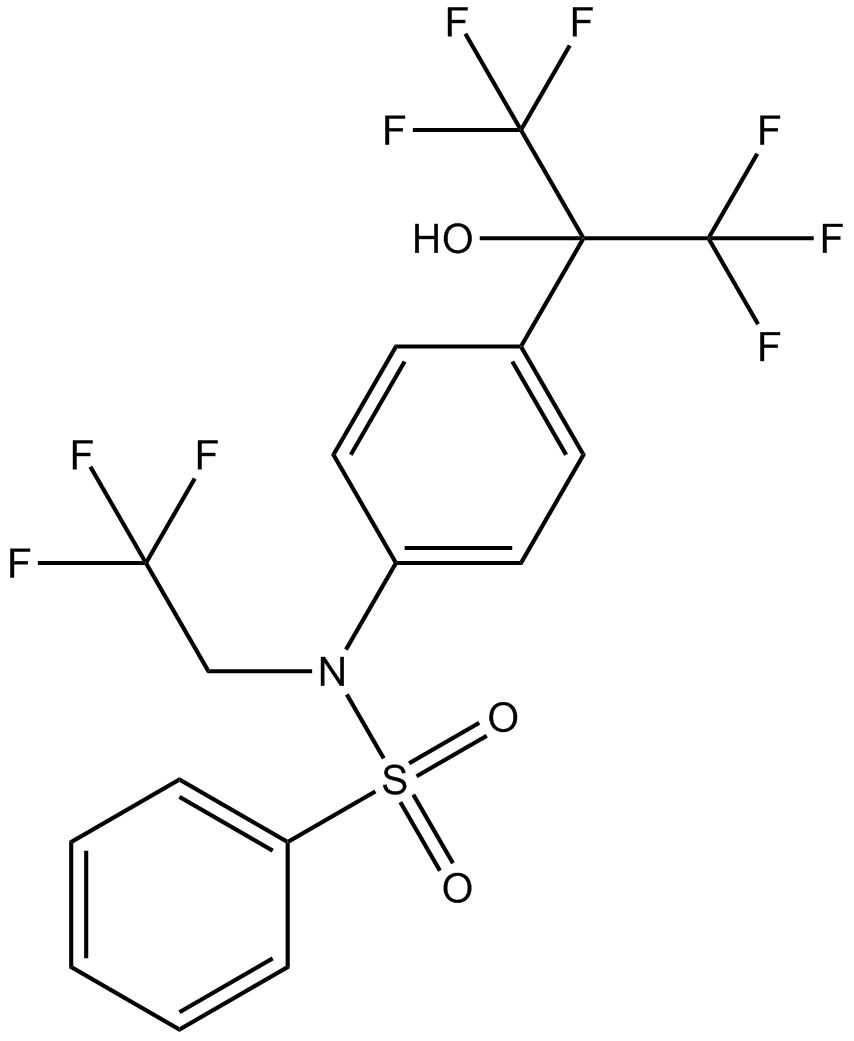
Cas No.: 293754-55-9
Sample solution is provided at 25 µL, 10mM.
T0901317 is an orally active and highly selective LXR agonist with EC50=15nM for LXRα, and activates xenobiotic receptor pregnane X receptor (PXR) with EC50=23nM[1]. T0901317 has been used to regulate liver function and fat metabolism in different models[2].
In vitro, T0901317 treatment at 5μM for 24 hours significantly inhibited the migration and invasion of A549 cells[3]. Treatment with 10µM T0901317 for 30min completely suppressed the fluctuation of cytosolic Ca2+ concentration induced by 15mM glucose and suppressed mitochondrial metabolism in mouse β cells [4]. Treatment of CaOV3 cells with 10μM T0901317 for 24 hours significantly inhibited cell proliferation, significantly increased caspase activity, and increased the number of apoptotic cells[5].
In vivo, T0901317 treatment (50mg/kg/day; p.o.) for 7 weeks alleviated cardiac hypertrophy and improved hemodynamic function after aortic constriction in mice [6]. Intraperitoneal administration of T0901317(50 mg/kg/day) to male db/db mice for 12 days resulted in hypertriglyceridemia and deepened hepatic triglyceride accumulation[7]. Treatment of 11-week-old APP23 mice with T0901317 (50 mg/kg/day) via gastric gavage for 6 days resulted in a significant increase in ABCA1 expression and a decrease in soluble amyloid precursor protein (APP)[8].
References:
[1] Mitro N, Vargas L, Romeo R, et al. T0901317 is a potent PXR ligand: implications for the biology ascribed to LXR[J]. FEBS letters, 2007, 581(9): 1721-1726.
[2] Houck K A, Borchert K M, Hepler C D, et al. T0901317 is a dual LXR/FXR agonist[J]. Molecular genetics and metabolism, 2004, 83(1-2): 184-187.
[3] Lou R, Cao H, Dong S, et al. Liver X receptor agonist T0901317 inhibits the migration and invasion of non-small-cell lung cancer cells in vivo and in vitro[J]. Anti-cancer drugs, 2019, 30(5): 495-500.
[4] Maczewsky J, Sikimic J, Bauer C, et al. The LXR ligand T0901317 acutely inhibits insulin secretion by affecting mitochondrial metabolism[J]. Endocrinology, 2017, 158(7): 2145-2154.
[5] Rough J J, Monroy M A, Yerrum S, et al. Anti-proliferative effect of LXR agonist T0901317 in ovarian carcinoma cells[J]. Journal of ovarian research, 2010, 3(1): 13.
[6] Kuipers I, Li J, Vreeswijk‐Baudoin I, et al. Activation of liver X receptors with T0901317 attenuates cardiac hypertrophy in vivo[J]. European journal of heart failure, 2010, 12(10): 1042-1050.
[7] Chisholm J W, Hong J, Mills S A, et al. The LXR ligand T0901317 induces severe lipogenesis in the db/db diabetic mouse[J]. Journal of lipid research, 2003, 44(11): 2039-2048.
[8] Koldamova R P, Lefterov I M, Staufenbiel M, et al. The liver X receptor ligand T0901317 decreases amyloid β production in vitro and in a mouse model of Alzheimer's disease[J]. Journal of Biological Chemistry, 2005, 280(6): 4079-4088.
| Cell experiment [1]: | |
Cell lines | A549 cell |
Preparation Method | A549 cells were maintained in RPMI-1640 medium supplemented with 10% FBS, 100U/ml penicillin, and 100U/ml streptomycin at 37°C with 5% CO2. Cell migration was assessed by using a scratch assay. Cells were treated with gefitinib (5μM) and T0901317 (5μM) alone or in combination. 24h later, aliquots of the cells were seeded in 6-well plates and covered with the media. The rest of the cells were resuspended (2×10⁵ cells/well) in 200μl of serum-free media, and then added to the upper compartment of transwell chambers. Next, a 200-μl pipette tip was used to scratch the surface of the plates. Cell migration was detected at 0 and 24h by an optical microscope (magnification, ×100). All experiments were performed in triplicate. The invasion ability of A549 cells was detected using transwell migration chambers. The remaining cells were resuspended (2×10⁵ cells/well) in 200μl of serum-free media, and then added to the upper compartment of transwell chambers. The lower chambers were added with 500μl RPMI-1640 and 20% FBS. The cells in the upper chambers were wiped away using cotton wool after 48h, and the migrated cells in the lower chamber were fixed with 4% paraformaldehyde and then stained with a crystal violet solution. Then, the fixed cells were counted using a light microscope at a magnification of ×100. All experiments were repeated 3 times. |
Reaction Conditions | 5μM; 24h |
Applications | T0901317 treatment significantly inhibited the migration and invasion of A549 cells. |
| Animal experiment [2]: | |
Animal models | APP23 mice |
Preparation Method | For pharmacological studies, eleven-week-old APP23 mice were administered by gastric gavage with 50mg/kg/day of T0901317 in propylene glycol/Tween 80 (4/1) for 6 days or vehicle only. At the end of the treatment period, mice were perfused with 100ml of phosphate-buffered saline, pH 7.4, and the brains were removed and immediately placed on dry ice. Brains (150mg/ml of buffer) were homogenized in Tris/sucrose buffer (250mM sucrose, 20mM Tris base, 1mM EDTA, 1mM EGTA, pH 7.4). Protein extracts were prepared by diluting the initial homogenate 1: 1 in RIPA buffer (10mM Tris/HCl, pH 7.3, 1mM MgCl2, 0.25% SDS, and 1% Triton X-100) in the presence of protease inhibitors (10μg/ml leupeptin, 10μg/ml aprotinin, and 10μg/ml AEBSF) and Western blots were performed for ABCA1 and full-length amyloid precursor protein (APP). |
Dosage form | 50mg/kg/day for 6 days; p.o. |
Applications | Treatment with T0901317 significantly increased the expression of ABCA1 and decreased the ratio of soluble APP (sAPP)β to sAPPα cleavage products. |
References: | |
| Cas No. | 293754-55-9 | SDF | |
| Chemical Name | N-[4-(1,1,1,3,3,3-hexafluoro-2-hydroxypropan-2-yl)phenyl]-N-(2,2,2-trifluoroethyl)benzenesulfonamide | ||
| Canonical SMILES | C1=CC=C(C=C1)S(=O)(=O)N(CC(F)(F)F)C2=CC=C(C=C2)C(C(F)(F)F)(C(F)(F)F)O | ||
| Formula | C17H12F9NO3S | M.Wt | 481.33 |
| Löslichkeit | ≥ 24.05mg/mL in DMSO | Storage | Store at -20°C |
| General tips | Please select the appropriate solvent to prepare the stock solution according to the
solubility of the product in different solvents; once the solution is prepared, please store it in
separate packages to avoid product failure caused by repeated freezing and thawing.Storage method
and period of the stock solution: When stored at -80°C, please use it within 6 months; when stored
at -20°C, please use it within 1 month. To increase solubility, heat the tube to 37°C and then oscillate in an ultrasonic bath for some time. |
||
| Shipping Condition | Evaluation sample solution: shipped with blue ice. All other sizes available: with RT, or with Blue Ice upon request. | ||
| Prepare stock solution | |||

|
1 mg | 5 mg | 10 mg |
| 1 mM | 2.0776 mL | 10.3879 mL | 20.7758 mL |
| 5 mM | 415.5 μL | 2.0776 mL | 4.1552 mL |
| 10 mM | 207.8 μL | 1.0388 mL | 2.0776 mL |
Step 1: Enter information below (Recommended: An additional animal making an allowance for loss during the experiment)
 g
μL
g
μL
Step 2: Enter the in vivo formulation (This is only the calculator, not formulation. Please contact us first if there is no in vivo formulation at the solubility Section.)
Calculation results:
Working concentration: mg/ml;
Method for preparing DMSO master liquid: mg drug pre-dissolved in μL DMSO ( Master liquid concentration mg/mL, Please contact us first if the concentration exceeds the DMSO solubility of the batch of drug. )
Method for preparing in vivo formulation: Take μL DMSO master liquid, next addμL PEG300, mix and clarify, next addμL Tween 80, mix and clarify, next add μL saline, mix and clarify.
Method for preparing in vivo formulation: Take μL DMSO master liquid, next add μL Corn oil, mix and clarify.
Note: 1. Please make sure the liquid is clear before adding the next solvent.
2. Be sure to add the solvent(s) in order. You must ensure that the solution obtained, in the previous addition, is a clear solution before proceeding to add the next solvent. Physical methods such as vortex, ultrasound or hot water bath can be used to aid dissolving.
3. All of the above co-solvents are available for purchase on the GlpBio website.
Quality Control & SDS
- View current batch:
- Purity: >99.50% Appearance: A solid
- COA (Certificate of Analysis)
- SDS (Safety Data Sheet)
- Datasheet
Average Rating: 5 (Based on Reviews and 12 reference(s) in Google Scholar.)