

TCPOBOP |
Katalog-Nr.GC10567
 One-Click Copy Product Info
|

TCPOBOP ist ein konstitutiver Androstanrezeptor (CAR)-Agonist, der eine robuste Hepatozytenproliferation und Hepatomegalie ohne LeberschÄdigung oder Gewebeverlust induziert. TCPOBOP dÄmpft Fas-induzierte murine LeberschÄdigung durch VerÄnderung von Bcl-2-Proteinen.
Products are for research use only. Not for human use. We do not sell to patients.
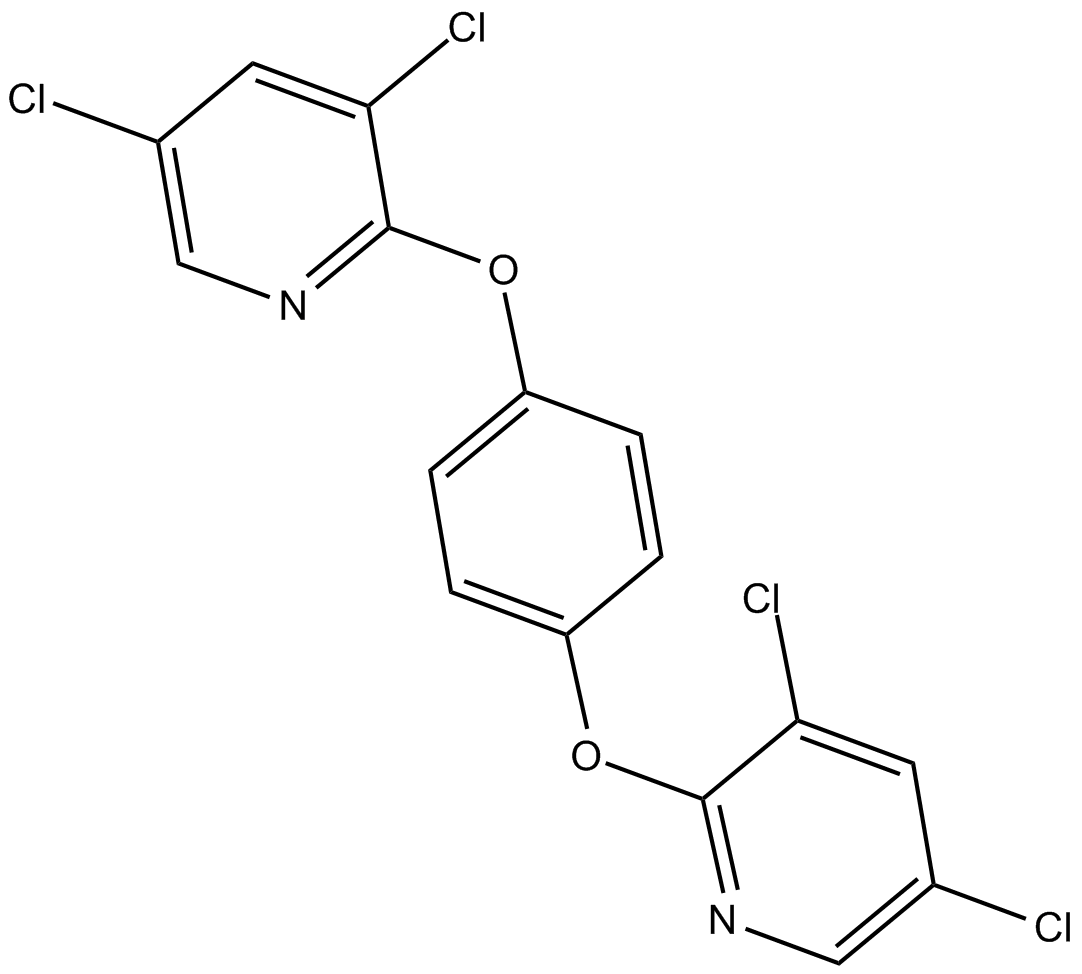
Cas No.: 76150-91-9
Sample solution is provided at 25 µL, 10mM.
_1-3.$$$39978408@51.jpg');)
_1-9.$$$38538795@65.jpg');)
_1-9.$$$39112701@51.jpg');)
_1-7.$$$37316672@70.jpg');)
_366-372.$$$36198801@70.jpg');)
.$$$38565142@65.jpg');)
_1867-1883.$$$33248023@67.jpg');)
_eads6055.$$$39977546@45.jpg');)
_eadm9805.$$$40080571@45.jpg');)
_eadj3020.$$$39666821@45.jpg');)
_1-20.$$$39757301@28.jpg');)
_1-24.$$$38898113@28.jpg');)
_273-287.$$$36806353@46.jpg');)
_1-16.$$$37156877@44.jpg');)
_1-19.$$$37460805@44.jpg');)
_1291-1307.$$$34518654@46.jpg');)
TCPOBOP is a constitutive androgen receptor (CAR) agonist (EC50=0.05µM) that induces hepatocyte proliferation and hepatomegaly in mice without causing liver damage[1, 2]. Constitutive androgen receptor (CAR) is a nuclear receptor that regulates not only drug-metabolizing enzymes but also energy metabolism[3]. TCPOBOP can attenuate Fas-induced liver injury in mice by altering Bcl-2 protein[4]. TCPOBOP can cause non-target lipid metabolism disorders and increase serum and hepatic triglyceride levels in humanized mice[5].
In vivo, oral administration of TCPOBOP (3mg/kg) to wild-type, EGFRi, and MET KO mice induced hepatocyte proliferation and hepatomegaly, and significantly increased the liver-to-body weight ratio (LW/BW)[6].
References:
[1] Gao Y, Cai C, Zheng W, et al. The slow elimination of 1, 4-bis [2-(3, 5-dichloropyridyloxy)] benzene in mice leads to prolonged constitutive androstane receptor activation and hepatomegaly[J]. Drug Metabolism and Disposition, 2025, 53(6): 100092.
[2] Repo S, Jyrkkarinne J, Pulkkinen J T, et al. Ligand specificity of constitutive androstane receptor as probed by induced-fit docking and mutagenesis[J]. Journal of medicinal chemistry, 2008, 51(22): 7119-7131.
[3] Xu P, Hong F, Wang J, et al. The CAR agonist TCPOBOP inhibits lipogenesis and promotes fibrosis in the mammary gland of adolescent female mice[J]. Toxicology Letters, 2018, 290: 29-35.
[4] Baskin-Bey E S, Huang W, Ishimura N, et al. Constitutive androstane receptor (CAR) ligand, TCPOBOP, attenuates Fas-induced murine liver injury by altering Bcl-2 proteins[J]. Hepatology, 2006, 44(1): 252-262.
[5] Skoda J, Dohnalova K, Chalupsky K, et al. Off-target lipid metabolism disruption by the mouse constitutive androstane receptor ligand TCPOBOP in humanized mice[J]. Biochemical Pharmacology, 2022, 197: 114905.
[6] Bhushan B, Stoops J W, Mars W M, et al. TCPOBOP‐induced hepatomegaly and hepatocyte proliferation are attenuated by combined disruption of MET and EGFR signaling[J]. Hepatology, 2019, 69(4): 1702-1718.
| Animal experiment [1]: | |
Animal models | METfl/fl: Tam-Cre+/+ mice with a targeted deletion for exon 16 with MET KO |
Preparation Method | Mice were injected i.p. for five consecutive days with tamoxifen to obtain MET KO mice. Control group consisted of littermates injected with vehicle (corn oil) only. Single dose of TCPOBOP (3mg/kg; prepared in corn oil) was administered by oral gavage at least 5 days after last tamoxifen injection. For EGFR inhibition, Canertinib, an EGFR inhibitor (EGFRi) was administered to mice in diet at 80mg/kg/day. Canertinib diet was initiated one day prior to TCPOBOP injection. For combined inhibition of MET and EGFR [MET KO+EGFRi], Canertinib diet was administered to MET KO mice at least 4 days after tamoxifen injection. For initial studies, mice from control, EGFRi, MET KO and [MET KO+EGFRi] groups were sacrificed at 48h after TCPOBOP administration. For timecourse analysis, mice from control and [MET KO+EGFRi] group were euthanized at various time points (0, 1, 2, 5 and 10 days) after TCPOBOP administration. |
Dosage form | 3mg/kg; p.o. |
Applications | TCPOBOP treated control mice showed remarkable (1.6 fold vs no TCPOBOP control) increase in liver to body weight (LW/BW) ratio at 48h. EGFRi mice had similar increase and MET KO displayed slightly lower increase, but not significantly different compared to control. |
References: | |
| Cas No. | 76150-91-9 | SDF | |
| Chemical Name | 1,4-bis((3,5-dichloropyridin-2-yl)oxy)benzene | ||
| Canonical SMILES | ClC1=CC(Cl)=CN=C1OC(C=C2)=CC=C2OC(C(Cl)=C3)=NC=C3Cl | ||
| Formula | C16H8Cl4N2O2 | M.Wt | 402.06 |
| Löslichkeit | DMF: 3 mg/ml | Storage | Store at -20°C |
| General tips | Please select the appropriate solvent to prepare the stock solution according to the
solubility of the product in different solvents; once the solution is prepared, please store it in
separate packages to avoid product failure caused by repeated freezing and thawing.Storage method
and period of the stock solution: When stored at -80°C, please use it within 6 months; when stored
at -20°C, please use it within 1 month. To increase solubility, heat the tube to 37°C and then oscillate in an ultrasonic bath for some time. |
||
| Shipping Condition | Evaluation sample solution: shipped with blue ice. All other sizes available: with RT, or with Blue Ice upon request. | ||
| Prepare stock solution | |||

|
1 mg | 5 mg | 10 mg |
| 1 mM | 2.4872 mL | 12.436 mL | 24.8719 mL |
| 5 mM | 497.4 μL | 2.4872 mL | 4.9744 mL |
| 10 mM | 248.7 μL | 1.2436 mL | 2.4872 mL |
Step 1: Enter information below (Recommended: An additional animal making an allowance for loss during the experiment)
 g
μL
g
μL
Step 2: Enter the in vivo formulation (This is only the calculator, not formulation. Please contact us first if there is no in vivo formulation at the solubility Section.)
Calculation results:
Working concentration: mg/ml;
Method for preparing DMSO master liquid: mg drug pre-dissolved in μL DMSO ( Master liquid concentration mg/mL, Please contact us first if the concentration exceeds the DMSO solubility of the batch of drug. )
Method for preparing in vivo formulation: Take μL DMSO master liquid, next addμL PEG300, mix and clarify, next addμL Tween 80, mix and clarify, next add μL saline, mix and clarify.
Method for preparing in vivo formulation: Take μL DMSO master liquid, next add μL Corn oil, mix and clarify.
Note: 1. Please make sure the liquid is clear before adding the next solvent.
2. Be sure to add the solvent(s) in order. You must ensure that the solution obtained, in the previous addition, is a clear solution before proceeding to add the next solvent. Physical methods such as vortex, ultrasound or hot water bath can be used to aid dissolving.
3. All of the above co-solvents are available for purchase on the GlpBio website.
Quality Control & SDS
- View current batch:
- Purity: >98.00% Appearance: A solid
- COA (Certificate of Analysis)
- SDS (Safety Data Sheet)
- Datasheet
Average Rating: 5 (Based on Reviews and 26 reference(s) in Google Scholar.)