

ZD-4190 |
Katalog-Nr.GC33171
 One-Click Copy Product Info
|

ZD-4190 ist ein potenter, oral verfÜgbarer Inhibitor des vaskulÄren endothelialen Zellwachstumsfaktor-Rezeptors 2 (VEGFR2) und des epidermalen Wachstumsfaktor-Rezeptors (EGFR), der zur Behandlung von Krebs eingesetzt wird.
Products are for research use only. Not for human use. We do not sell to patients.
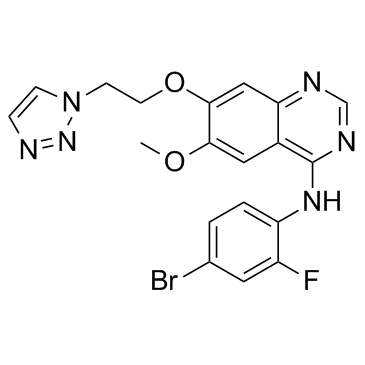
Cas No.: 413599-62-9
Sample solution is provided at 25 µL, 10mM.
_1-3.$$$39978408@51.jpg');)
_1-9.$$$38538795@65.jpg');)
_1-9.$$$39112701@51.jpg');)
_1-7.$$$37316672@70.jpg');)
_366-372.$$$36198801@70.jpg');)
.$$$38565142@65.jpg');)
_1867-1883.$$$33248023@67.jpg');)
_eads6055.$$$39977546@45.jpg');)
_eadm9805.$$$40080571@45.jpg');)
_eadj3020.$$$39666821@45.jpg');)
_1-20.$$$39757301@28.jpg');)
_1-24.$$$38898113@28.jpg');)
_273-287.$$$36806353@46.jpg');)
_1-16.$$$37156877@44.jpg');)
_1-19.$$$37460805@44.jpg');)
_1291-1307.$$$34518654@46.jpg');)
ZD-4190 is a potent, orally available inhibitor of the vascular endothelial cell growth factor receptor 2 (VEGFR2) and of epidermal growth factor receptor (EGFR) signalling, used for the treatment of cancer.
ZD4190 exhibits cytotoxic activity against the tumor cells[2].
ZD4190 (100 mg/kg, p.o.) effectively delays MDA-MB-435 tumor growth in mice. In ZD4190-treated tumors, 18F-FPPRGD2 uptake has decreased significantly relative to baseline by 26.74±8.12% (p<0.05) on day 1 and by 41.19±6.63% (p<0.01) on day 3, then has returned to baseline on day 7. Tumor uptake of 18F-FLT has also decreased on both day 1 and day 3 after initiation of ZD4190 treatment. However, ZD4190 does not significantly change 18F-FDG uptake in tumors, compared with the control group[1]. ZD4190 (50 mg/kg, p.o.) prevents outgrowth of residual tumour in a muscle model of minimal residual carcinoma[2]. ZD4190 (12.5-100 mg/kg, p.o.) produces a dose-dependent reduction in K(trans) in PC-3 prostate tumors. At 100 mg/kg, ZD4190 reduces K(trans) in PC-3 tumors by 31% following 2 doses and by 53% following 8 doses[3].
[1]. Yang M, et al. PET imaging of early response to the tyrosine kinase inhibitor ZD4190. Eur J Nucl Med Mol Imaging. 2011 Jul;38(7):1237-47. doi: 10.1007/s00259-011-1742-z. Epub 2011 Mar 1. [2]. Gaballah K, et al. The antiangiogenic agent ZD4190 prevents tumour outgrowth in a model of minimal residual carcinoma in deep tissues. Br J Cancer. 2009 Aug 4;101(3):418-23. doi: 10.1038/sj.bjc.6605092. Epub 2009 Jul 21. [3]. Checkley D, et al. Dynamic contrast-enhanced MRI of vascular changes induced by the VEGF-signalling inhibitor ZD4190 in human tumour xenografts. Magn Reson Imaging. 2003 Jun;21(5):475-82.
Cell experiment: | The cytotoxicity of ZD4190 for PDVC57B cells is established when 104 cells are exposed to 1-10 μM ZD4190 for 96 h before MTS solution is added and the optical density measured at 490 nm. Cells are also grown to 40% confluence and treated with 1-100 μM ZD4190 for 7 days and the cytopathic effect examined by staining with crystal violet. |
Animal experiment: | ZD4190 is suspended in a 1% (v/v) solution of polyoxyethylene sorbitan mono-oleate in deionized water and administered by oral gavage (0.1 mL/10 g body weight). In each experiment, mice are randomized to receive either vehicle or ZD4190, administered once daily using a 1 day (at 0 and 22 h) or 7 day (at 0, 24, 48, 72, 96, 120, 144, and 166 h) treatment regimen (i.e., daily administration of compound for 1 or 7 days with an additional dose given 2 h prior to the end of the treatment period) followed by DCEMRI under terminal anesthesia. |
References: [1]. Yang M, et al. PET imaging of early response to the tyrosine kinase inhibitor ZD4190. Eur J Nucl Med Mol Imaging. 2011 Jul;38(7):1237-47. doi: 10.1007/s00259-011-1742-z. Epub 2011 Mar 1. | |
| Cas No. | 413599-62-9 | SDF | |
| Canonical SMILES | COC1=CC2=C(NC3=CC=C(Br)C=C3F)N=CN=C2C=C1OCCN4N=NC=C4 | ||
| Formula | C19H16BrFN6O2 | M.Wt | 459.27 |
| Löslichkeit | DMSO : 20.83 mg/mL (45.35 mM);Water : < 0.1 mg/mL (insoluble) | Storage | Store at -20°C |
| General tips | Please select the appropriate solvent to prepare the stock solution according to the
solubility of the product in different solvents; once the solution is prepared, please store it in
separate packages to avoid product failure caused by repeated freezing and thawing.Storage method
and period of the stock solution: When stored at -80°C, please use it within 6 months; when stored
at -20°C, please use it within 1 month. To increase solubility, heat the tube to 37°C and then oscillate in an ultrasonic bath for some time. |
||
| Shipping Condition | Evaluation sample solution: shipped with blue ice. All other sizes available: with RT, or with Blue Ice upon request. | ||
| Prepare stock solution | |||

|
1 mg | 5 mg | 10 mg |
| 1 mM | 2.1774 mL | 10.8868 mL | 21.7737 mL |
| 5 mM | 435.5 μL | 2.1774 mL | 4.3547 mL |
| 10 mM | 217.7 μL | 1.0887 mL | 2.1774 mL |
Step 1: Enter information below (Recommended: An additional animal making an allowance for loss during the experiment)
 g
μL
g
μL
Step 2: Enter the in vivo formulation (This is only the calculator, not formulation. Please contact us first if there is no in vivo formulation at the solubility Section.)
Calculation results:
Working concentration: mg/ml;
Method for preparing DMSO master liquid: mg drug pre-dissolved in μL DMSO ( Master liquid concentration mg/mL, Please contact us first if the concentration exceeds the DMSO solubility of the batch of drug. )
Method for preparing in vivo formulation: Take μL DMSO master liquid, next addμL PEG300, mix and clarify, next addμL Tween 80, mix and clarify, next add μL saline, mix and clarify.
Method for preparing in vivo formulation: Take μL DMSO master liquid, next add μL Corn oil, mix and clarify.
Note: 1. Please make sure the liquid is clear before adding the next solvent.
2. Be sure to add the solvent(s) in order. You must ensure that the solution obtained, in the previous addition, is a clear solution before proceeding to add the next solvent. Physical methods such as vortex, ultrasound or hot water bath can be used to aid dissolving.
3. All of the above co-solvents are available for purchase on the GlpBio website.
Quality Control & SDS
- View current batch:
- Purity: >99.00% Appearance: A solid
- COA (Certificate of Analysis)
- SDS (Safety Data Sheet)
- Datasheet
Average Rating: 5 (Based on Reviews and 8 reference(s) in Google Scholar.)