

Deltamethrin (Synonyms: Decamethrin) |
カタログ番号GC60128
 One-Click Copy Product Info
|

DeltamethrinはタイプIIの合成ピレスロイドであり、世界中に殺虫剤と殺ダニ剤として使われている。
Products are for research use only. Not for human use. We do not sell to patients.
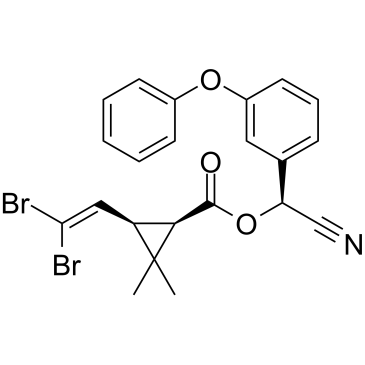
Cas No.: 52918-63-5
Sample solution is provided at 25 µL, 10mM.
DeltamethrinはタイプIIの合成ピレスロイドであり、世界中に殺虫剤と殺ダニ剤として使われている[1]。Deltamethrinは主に電圧感受性のナトリウムチャネルで作用し、活性化と不活性化メカニズムを影響し、よって神経興奮性の伝導障害と神経機能障害を起こした[2]。Deltamethrinは、広い範囲の外部寄生虫(シラミ、ハエ、ダニなど)に対して使われ、陸上と水産養殖産業で、作物、果物、野菜と魚介類を害虫や寄生虫から保護する[3]。
体外で、24時間のDeltamethrinの処理は、SH-SY5Y細胞の生存率を著しく阻害し、IC50値は760μMである[4]。10μMのDeltamethrinの1時間の処理は、PC12細胞におけるNrf2 mRNAの発見を増強し、核におけるNrf2蓄積を促進した[5]。1μM DeltamethrinでJurkat細胞を18時間処理した結果、細胞の生存率を著しく阻害し、細胞内活性酸素種(ROS)のレベルを著しく増やし、同時にカスパーゼ-3の活性を増やした[6]。
体内で、18mg/kg/日のDeltamethrinを15日間経口投与した結果、Swissアルビノの雄マウスの肝臓と腎臓で、抗酸化酵素の活性を著しく減らした[7]。1mg/kgのDeltamethrinの48時間の単回経口投与は、成体マウスの海馬体で、小胞体ストレスを起こし、免疫ニューロンの数を減らした[8]。
References:
[1] Lu Q, Sun Y, Ares I, et al. Deltamethrin toxicity: A review of oxidative stress and metabolism[J]. Environmental research, 2019, 170: 260-281.
[2] Shi T, Zhang Q, Chen X, et al. Overview of deltamethrin residues and toxic effects in the global environment[J]. Environmental Geochemistry and Health, 2024, 46(8): 271.
[3] Pulman D A. Deltamethrin: the cream of the crop[J]. Journal of agricultural and food chemistry, 2011, 59(7): 2770-2772.
[4] Romero A, Ramos E, Castellano V, et al. Cytotoxicity induced by deltamethrin and its metabolites in SH-SY5Y cells can be differentially prevented by selected antioxidants[J]. Toxicology in vitro, 2012, 26(6): 823-830.
[5] Li H Y, Wu S Y, Shi N. Transcription factor Nrf2 activation by deltamethrin in PC12 cells: involvement of ROS[J]. Toxicology letters, 2007, 171(1-2): 87-98.
[6] Sharma N, Banerjee S, Mazumder P M. Evaluation of the mechanism of anticancer activity of deltamethrin in Jurkat-J6 cell line[J]. Pesticide biochemistry and physiology, 2018, 149: 98-103.
[7] Rehman H, Ali M, Atif F, et al. The modulatory effect of deltamethrin on antioxidants in mice[J]. Clinica Chimica Acta, 2006, 369(1): 61-65.
[8] Hossain M M, Belkadi A, Zhou X, et al. Exposure to deltamethrin at the NOAEL causes ER stress and disruption of hippocampal neurogenesis in adult mice[J]. Neurotoxicology, 2022, 93: 233-243.
| 細胞実験[1]: | |
細胞株 | Jurkat-J6細胞 |
準備方法 | 10%のFBS、1%の抗生物質抗真菌溶液を含有する完全RPMI-1640培地でJurkat-J6細胞を培養し、5% CO2を持続的に供給する37℃でインキュベートした。1.0 × 10⁴個の細胞の濃度で、細胞を96ウェルのプレートに播種した。様々な濃度のDeltamethrin (0.01、0.1、0.5、1、10、50と100μM)を添加し、37°C、5% CO2で18時間インキュベートした。培養の終わった4時間後、10μLのMTT (5mg/mL)を各ウェルに添加した。培養後、プレートを遠心分離し、上清を廃棄し、100μLのDMSOを各ウェルに添加した。マイクロプレートリーダーで、570nmで吸光度を測定した。 |
反応条件 | 0.01、0.1、0.5、1、10、50と100μM;18時間 |
アプリケーション | Deltamethrinは、Jurkat-J6細胞の生存率を用量依存的に著しく阻害した。 |
| 動物実験 [2]: | |
動物モデル | 雄のSwissアルビノマウス |
準備方法 | 雄のSwissアルビノマウス(30±2g)を標準の実験室条件で飼育し維持した。市販のペレット飼料と水を自由に摂取させた。マウスを二つのグループに分けた。各グループには、少なくとも6匹のマウスが含まれていた。対照群のマウス(グループI)には溶媒(0.2mlのコーン油)を経口投与した。処理群のマウスには、コーン油に懸濁した18mg/kgのDeltamethrinを経口投与した。全ての用量を15日間、毎日一回投与した。実験の終わりに、マウスを軽度の麻酔化で頸椎脱臼で殺処分し、腎臓と肝臓を除去し、カタラーゼ(CAT)、グルタチオンペルオキシダーゼ(GPx)、グルタチオンS-トランスフェラーゼ(GST)の活性を測定した。 |
投与形態 | 18mg/kg/日、15日間;経口投与 |
アプリケーション | Deltamethrinの処理は、マウスの肝臓で、GST、CAT、GPx、GSTとCATの活性を著しく減らした。 |
References: | |
| Cas No. | 52918-63-5 | SDF | |
| 同義語 | Decamethrin | ||
| Canonical SMILES | O=C([C@H]1C(C)(C)[C@H]1/C=C(Br)\Br)O[C@H](C#N)C2=CC=CC(OC3=CC=CC=C3)=C2 | ||
| Formula | C22H19Br2NO3 | M.Wt | 505.2 |
| 溶解度 | DMSO: ≥ 100 mg/mL (197.94 mM) | Storage | Store at -20°C |
| General tips | Please select the appropriate solvent to prepare the stock solution according to the
solubility of the product in different solvents; once the solution is prepared, please store it in
separate packages to avoid product failure caused by repeated freezing and thawing.Storage method
and period of the stock solution: When stored at -80°C, please use it within 6 months; when stored
at -20°C, please use it within 1 month. To increase solubility, heat the tube to 37°C and then oscillate in an ultrasonic bath for some time. |
||
| Shipping Condition | Evaluation sample solution: shipped with blue ice. All other sizes available: with RT, or with Blue Ice upon request. | ||
| Prepare stock solution | |||

|
1 mg | 5 mg | 10 mg |
| 1 mM | 1.9794 mL | 9.8971 mL | 19.7941 mL |
| 5 mM | 395.9 μL | 1.9794 mL | 3.9588 mL |
| 10 mM | 197.9 μL | 989.7 μL | 1.9794 mL |
Step 1: Enter information below (Recommended: An additional animal making an allowance for loss during the experiment)
 g
μL
g
μL
Step 2: Enter the in vivo formulation (This is only the calculator, not formulation. Please contact us first if there is no in vivo formulation at the solubility Section.)
Calculation results:
Working concentration: mg/ml;
Method for preparing DMSO master liquid: mg drug pre-dissolved in μL DMSO ( Master liquid concentration mg/mL, Please contact us first if the concentration exceeds the DMSO solubility of the batch of drug. )
Method for preparing in vivo formulation: Take μL DMSO master liquid, next addμL PEG300, mix and clarify, next addμL Tween 80, mix and clarify, next add μL saline, mix and clarify.
Method for preparing in vivo formulation: Take μL DMSO master liquid, next add μL Corn oil, mix and clarify.
Note: 1. Please make sure the liquid is clear before adding the next solvent.
2. Be sure to add the solvent(s) in order. You must ensure that the solution obtained, in the previous addition, is a clear solution before proceeding to add the next solvent. Physical methods such as vortex, ultrasound or hot water bath can be used to aid dissolving.
3. All of the above co-solvents are available for purchase on the GlpBio website.
Quality Control & SDS
- View current batch:
- Purity: >98.00% Appearance: A solid
- COA (Certificate of Analysis)
- SDS (Safety Data Sheet)
- Datasheet
Average Rating: 5 (Based on Reviews and 30 reference(s) in Google Scholar.)