

Deltamethrin (Synonyms: Decamethrin) |
Catalog No.GC60128
 One-Click Copy Product Info
|

Deltamethrin is a Type II synthetic pyrethroid that is used as an insecticide and acaricide worldwide.
Products are for research use only. Not for human use. We do not sell to patients.
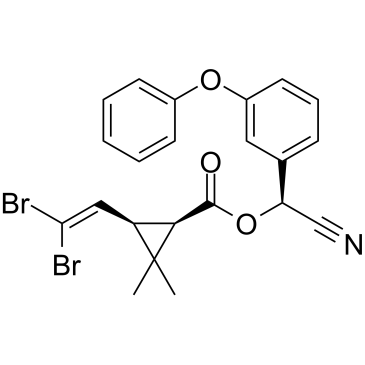
Cas No.: 52918-63-5
Sample solution is provided at 25 µL, 10mM.
Deltamethrin is a type II synthetic pyrethroid that is used as an insecticide and acaricide worldwide [1]. Deltamethrin mainly acts on voltage-sensitive sodium channel, affecting the activation and inactivation mechanism, thereby causing conduction disorders of nerve excitability and neurological dysfunction[2]. Deltamethrin is widely used against a wide range of ectoparasites (i.e. lice, flies and ticks) to protect crops, fruits, vegetables and fish from pests and parasites in terrestrial and aquaculture industries[3].
In vitro, Deltamethrin treatment for 24 hours significantly inhibited the viability of SH-SY5Y cells with an IC50 value of 760μM[4]. Deltamethrin treatment at 10μM for 1 hour enhanced Nrf2 mRNA expression in PC12 cells, and promoted Nrf2 accumulation in the nucleus[5]. Treatment of Jurkat cells with 1μM Deltamethrin for 18 hours significantly inhibited cell viability, resulting in a significant increase in intracellular reactive oxygen species (ROS) levels, accompanied by an increase in caspase-3 activity[6].
In vivo, Deltamethrin treatment via oral administration at a dose of 18mg/kg/day for 15 days can lead to a significant decrease in the antioxidant enzyme activities in the liver and kidneys of Swiss albino male mice[7]. A single oral dose of 1mg/kg Deltamethrin for 48 hours caused endoplasmic reticulum stress in the hippocampus of adult mice, and led to a reduction in the number of immature neurons[8].
References:
[1] Lu Q, Sun Y, Ares I, et al. Deltamethrin toxicity: A review of oxidative stress and metabolism[J]. Environmental research, 2019, 170: 260-281.
[2] Shi T, Zhang Q, Chen X, et al. Overview of deltamethrin residues and toxic effects in the global environment[J]. Environmental Geochemistry and Health, 2024, 46(8): 271.
[3] Pulman D A. Deltamethrin: the cream of the crop[J]. Journal of agricultural and food chemistry, 2011, 59(7): 2770-2772.
[4] Romero A, Ramos E, Castellano V, et al. Cytotoxicity induced by deltamethrin and its metabolites in SH-SY5Y cells can be differentially prevented by selected antioxidants[J]. Toxicology in vitro, 2012, 26(6): 823-830.
[5] Li H Y, Wu S Y, Shi N. Transcription factor Nrf2 activation by deltamethrin in PC12 cells: involvement of ROS[J]. Toxicology letters, 2007, 171(1-2): 87-98.
[6] Sharma N, Banerjee S, Mazumder P M. Evaluation of the mechanism of anticancer activity of deltamethrin in Jurkat-J6 cell line[J]. Pesticide biochemistry and physiology, 2018, 149: 98-103.
[7] Rehman H, Ali M, Atif F, et al. The modulatory effect of deltamethrin on antioxidants in mice[J]. Clinica Chimica Acta, 2006, 369(1): 61-65.
[8] Hossain M M, Belkadi A, Zhou X, et al. Exposure to deltamethrin at the NOAEL causes ER stress and disruption of hippocampal neurogenesis in adult mice[J]. Neurotoxicology, 2022, 93: 233-243.
| Cell experiment [1]: | |
|
Cell lines |
Jurkat-J6 cells |
|
Preparation Method |
Jurkat-J6 cells were cultured in complete RPMI-1640 medium containing 10% FBS, 1% antibiotic-antifungal solution and incubated at 37°C with a continuous supply of 5% CO2. Cells were seeded in 96-well plates at a concentration of 1.0 × 10⁴ cells. Various concentrations of Deltamethrin (0.01, 0.1, 0.5, 1, 10, 50, and 100μM) were added and incubated for 18h at 37°C in 5% CO2. Four hours before the completion of incubation, 10μL of MTT (5mg/mL) was added to each well. After incubation, the plates were centrifuged, the supernatant was discarded, and 100μL of DMSO was added to each well. Absorbance was measured at 570nm in a microplate reader. |
|
Reaction Conditions |
0.01, 0.1, 0.5, 1, 10, 50, and 100μM; 18h |
|
Applications |
Deltamethrin significantly inhibited the viability of Jurkat-J6 cells in a dose-dependent manner. |
| Animal experiment [2]: | |
|
Animal models |
Swiss albino male mice |
|
Preparation Method |
Swiss albino male mice (30±2g) were housed and maintained under standard laboratory conditions. Commercially available pellet feed and water were provided ad libitum. Mice were divided into two groups. At least six mice were included in each group. Control mice (group I) received vehicle (0.2ml corn oil) orally. Mice in the treatment group received Deltamethrin orally at 18mg/kg doses suspended in corn oil. All doses were administered once daily for 15 days. At the end of treatment, mice were sacrificed by cervical dislocation under light anesthesia, and kidneys and livers were removed for the determination of activities of catalase (CAT), glutathione peroxidase (GPx), and glutathione S-transferase (GST). |
|
Dosage form |
18mg/kg/day for 15 days; p.o. |
|
Applications |
Deltamethrin treatment significantly resulted in significant reductions in GST, CAT, GPx, GST, and CAT activities in mouse liver. |
|
References: |
|
| Cas No. | 52918-63-5 | SDF | |
| Synonyms | Decamethrin | ||
| Canonical SMILES | O=C([C@H]1C(C)(C)[C@H]1/C=C(Br)\Br)O[C@H](C#N)C2=CC=CC(OC3=CC=CC=C3)=C2 | ||
| Formula | C22H19Br2NO3 | M.Wt | 505.2 |
| Solubility | DMSO: ≥ 100 mg/mL (197.94 mM) | Storage | Store at -20°C |
| General tips | Please select the appropriate solvent to prepare the stock solution according to the
solubility of the product in different solvents; once the solution is prepared, please store it in
separate packages to avoid product failure caused by repeated freezing and thawing.Storage method
and period of the stock solution: When stored at -80°C, please use it within 6 months; when stored
at -20°C, please use it within 1 month. To increase solubility, heat the tube to 37°C and then oscillate in an ultrasonic bath for some time. |
||
| Shipping Condition | Evaluation sample solution: shipped with blue ice. All other sizes available: with RT, or with Blue Ice upon request. | ||
| Prepare stock solution | |||

|
1 mg | 5 mg | 10 mg |
| 1 mM | 1.9794 mL | 9.8971 mL | 19.7941 mL |
| 5 mM | 395.9 μL | 1.9794 mL | 3.9588 mL |
| 10 mM | 197.9 μL | 989.7 μL | 1.9794 mL |
Step 1: Enter information below (Recommended: An additional animal making an allowance for loss during the experiment)
 g
μL
g
μL
Step 2: Enter the in vivo formulation (This is only the calculator, not formulation. Please contact us first if there is no in vivo formulation at the solubility Section.)
Calculation results:
Working concentration: mg/ml;
Method for preparing DMSO master liquid: mg drug pre-dissolved in μL DMSO ( Master liquid concentration mg/mL, Please contact us first if the concentration exceeds the DMSO solubility of the batch of drug. )
Method for preparing in vivo formulation: Take μL DMSO master liquid, next addμL PEG300, mix and clarify, next addμL Tween 80, mix and clarify, next add μL saline, mix and clarify.
Method for preparing in vivo formulation: Take μL DMSO master liquid, next add μL Corn oil, mix and clarify.
Note: 1. Please make sure the liquid is clear before adding the next solvent.
2. Be sure to add the solvent(s) in order. You must ensure that the solution obtained, in the previous addition, is a clear solution before proceeding to add the next solvent. Physical methods such as vortex, ultrasound or hot water bath can be used to aid dissolving.
3. All of the above co-solvents are available for purchase on the GlpBio website.
Quality Control & SDS
- View current batch:
- Purity: >98.00% Appearance: A solid
- COA (Certificate of Analysis)
- SDS (Safety Data Sheet)
- Datasheet
Average Rating: 5 (Based on Reviews and 30 reference(s) in Google Scholar.)