

Nintedanib esylate (Synonyms: Nintedanib) |
カタログ番号GC36745
 One-Click Copy Product Info
|

Nintedanib esylateは、非小細胞肺癌の治療にキナーゼ阻害剤として使用されるが、初回通過代謝の影響を受け、経口バイオアベイラビリティが低下している(約4.7%)。
Products are for research use only. Not for human use. We do not sell to patients.
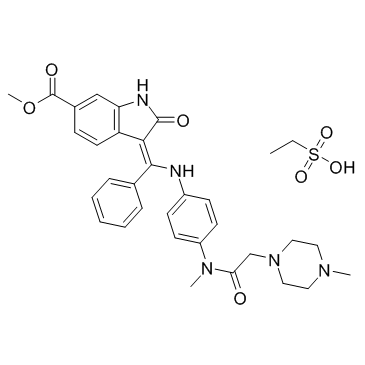
Cas No.: 656247-18-6
Sample solution is provided at 25 µL, 10mM.
_1-3.$$$39978408@51.jpg');)
_1-9.$$$38538795@65.jpg');)
_1-9.$$$39112701@51.jpg');)
_1-7.$$$37316672@70.jpg');)
_366-372.$$$36198801@70.jpg');)
.$$$38565142@65.jpg');)
_1867-1883.$$$33248023@67.jpg');)
_eads6055.$$$39977546@45.jpg');)
_eadm9805.$$$40080571@45.jpg');)
_eadj3020.$$$39666821@45.jpg');)
_1-20.$$$39757301@28.jpg');)
_1-24.$$$38898113@28.jpg');)
_273-287.$$$36806353@46.jpg');)
_1-16.$$$37156877@44.jpg');)
_1-19.$$$37460805@44.jpg');)
_1291-1307.$$$34518654@46.jpg');)
Nintedanib esylateは、非小細胞肺癌の治療にキナーゼ阻害剤として使用されるが、初回通過代謝の影響を受け、経口バイオアベイラビリティが低下している(約4.7%)。Nintedanib esylateは、強力なマルチチロシンキナーゼ受容体阻害剤である。
体外研究では、Nintedanib esylateを1~4 µMの濃度でケロイド線維芽細胞に投与すると、用量依存的に細胞増殖を抑制し、G0/G1期の細胞周期停滞を誘導し、ケロイド線維芽細胞の遊走とと浸潤が抑制された[2]]。体外実験では、1 µMのNintedanib esylateと2.5 mMのPirfenidoneの作用下で、マウスおよびヒトの三次元組織培養(3D-LTCs)および初代肺胞II型細胞(pmATII)における線維化関連遺伝子の発現が減少したことが示されている[3]。特発性肺線維症(IPF)の線維芽細胞において、0.01-1.0 µMのNintedanib esylateは、コラーゲンIおよびV、フィブロネクチンおよびFKBP10の発現を低下させ、コラーゲンIおよびIIIの分泌を抑制した[4]。
体内の有効性試験では、5 mg/mLのNintedanib esylate点眼薬を1日4回投与すると、対照群と比較して血管およびリンパ管の成長が明らかに抑制された[5]。マウスにおいて、3 µMおよび5 µMのNintedanib esylate投与により、肺表面活性タンパク質D(SP-D)のメッセンジャーRNAの発現が上昇した[6]。体内の実験では、Nintedanib esylateを経口投与(50 mg/kgおよび100 mg/kg)することにより、DSSによって引き起こされたマウスの実験的結腸炎に関連する症状(体重減少、病気活動指数(DAI)増加、結腸の長さの短縮、および結腸組織損傷)が明らかに緩和されたことが示された[7]。
Kala SG, et al. Bioavailability enhancement of vitamin E TPGS liposomes of nintedanib esylate: formulation optimization, cytotoxicity and pharmacokinetic studies. Drug Deliv Transl Res. 2022 Nov;12(11):2856-2864.
Zhou BY, et al. Nintedanib inhibits keloid fibroblast functions by blocking the phosphorylation of multiple kinases and enhancing receptor internalization. Acta Pharmacol Sin. 2020 Sep;41(9):1234-1245.
Lehmann M, et al. Differential effects of Nintedanib and Pirfenidone on lung alveolar epithelial cell function in ex vivo murine and human lung tissue cultures of pulmonary fibrosis. Respir Res. 2018 Sep 15;19(1):175.
KnÜppel L, et al. A Novel Antifibrotic Mechanism of Nintedanib and Pirfenidone. Inhibition of Collagen Fibril Assembly. Am J Respir Cell Mol Biol. 2017 Jul;57(1):77-90.
Lin T, et al. Inhibition of lymphangiogenesis in vitro and in vivo by the multikinase inhibitor nintedanib. Drug Des Devel Ther. 2017 Apr 5;11:1147-1158.
Kamio K, et al. Nintedanib modulates surfactant protein-D expression in A549 human lung epithelial cells via the c-Jun N-terminal kinase-activator protein-1 pathway. Pulm Pharmacol Ther. 2015 Jun;32:29-36.
Li H, et al. Nintedanib Alleviates Experimental Colitis by Inhibiting CEBPB/PCK1 and CEBPB/EFNA1 Pathways. Front Pharmacol. 2022 Jul 14;13:904420.
References:
| 細胞実験[1]: | |
細胞株 | HUVECs |
準備方法 | HUVEC(ヒト臍帯静脈内皮細胞)に対して、Nintedanib esylate(1、5、10、25、50、100 µM)を添加した後、細胞の生存率を検出し、最適な培養濃度を決定した。 |
反応条件 | 1、5、10、25、50、100μM;24時間 |
アプリケーション | Nintedanib esylatの濃度が50 µMを超えると、HUVECの生存率が著しく低下することが観察された。 |
| 動物実験 [2]: | |
動物モデル | 雄TRAMPマウス |
準備方法 | 前臨床効果評価では、8週齢および12週齢から開始したの雄TRAMPマウスに、ビヒクル対照(10% Tween 20)またはNintedanib esylat(ビヒクル対照中で10 mg/Kg/日)を4週間経口投与し、4週間の薬物治療後すぐに犠牲にするか、薬物投与を中止してから6〜10週間後に犠牲にした。 |
投与形態 | 10mg/Kg/日;p.o.。 |
アプリケーション | 前臨床TRAMP試験において、Nintedanib esylatはすべての治療群において腫瘍の進行を遅延させた。その効果は、腺病変の発生初期に治療を行い、試験終了まで継続した場合に効果がより顕著であった。 |
参考文献: Li L, et al. Nintedanib ameliorates oxidized low-density lipoprotein -induced inflammation and cellular senescence in vascular endothelial cells. Bioengineered. 2022 Mar;13(3):6196-6207.da Silva RF, et al. Nintedanib antiangiogenic inhibitor effectiveness in delaying adenocarcinoma progression in Transgenic Adenocarcinoma of the Mouse Prostate (TRAMP). J Biomed Sci. 2017 May 12;24(1):31. | |
| Cas No. | 656247-18-6 | SDF | |
| 同義語 | Nintedanib | ||
| Canonical SMILES | O=C(C1=CC(NC/2=O)=C(C=C1)C2=C(NC3=CC=C(N(C)C(CN4CCN(C)CC4)=O)C=C3)/C5=CC=CC=C5)OC.CCS(=O)(O)=O | ||
| Formula | C33H39N5O7S | M.Wt | 649.76 |
| 溶解度 | DMSO: 92.85 mg/mL (142.90 mM and warming) | Storage | Store at -20°C |
| General tips | Please select the appropriate solvent to prepare the stock solution according to the
solubility of the product in different solvents; once the solution is prepared, please store it in
separate packages to avoid product failure caused by repeated freezing and thawing.Storage method
and period of the stock solution: When stored at -80°C, please use it within 6 months; when stored
at -20°C, please use it within 1 month. To increase solubility, heat the tube to 37°C and then oscillate in an ultrasonic bath for some time. |
||
| Shipping Condition | Evaluation sample solution: shipped with blue ice. All other sizes available: with RT, or with Blue Ice upon request. | ||
| Prepare stock solution | |||

|
1 mg | 5 mg | 10 mg |
| 1 mM | 1.539 mL | 7.6951 mL | 15.3903 mL |
| 5 mM | 307.8 μL | 1.539 mL | 3.0781 mL |
| 10 mM | 153.9 μL | 769.5 μL | 1.539 mL |
Step 1: Enter information below (Recommended: An additional animal making an allowance for loss during the experiment)
 g
μL
g
μL
Step 2: Enter the in vivo formulation (This is only the calculator, not formulation. Please contact us first if there is no in vivo formulation at the solubility Section.)
Calculation results:
Working concentration: mg/ml;
Method for preparing DMSO master liquid: mg drug pre-dissolved in μL DMSO ( Master liquid concentration mg/mL, Please contact us first if the concentration exceeds the DMSO solubility of the batch of drug. )
Method for preparing in vivo formulation: Take μL DMSO master liquid, next addμL PEG300, mix and clarify, next addμL Tween 80, mix and clarify, next add μL saline, mix and clarify.
Method for preparing in vivo formulation: Take μL DMSO master liquid, next add μL Corn oil, mix and clarify.
Note: 1. Please make sure the liquid is clear before adding the next solvent.
2. Be sure to add the solvent(s) in order. You must ensure that the solution obtained, in the previous addition, is a clear solution before proceeding to add the next solvent. Physical methods such as vortex, ultrasound or hot water bath can be used to aid dissolving.
3. All of the above co-solvents are available for purchase on the GlpBio website.
Quality Control & SDS
- View current batch:
- Purity: >98.00% Appearance: A solid
- COA (Certificate of Analysis)
- SDS (Safety Data Sheet)
- Datasheet
Average Rating: 5 (Based on Reviews and 20 reference(s) in Google Scholar.)