

Bindarit (Synonyms: AF 2838) |
Catalog No.GC13335
 One-Click Copy Product Info
|

Bindarit는 다양한 모델에서 항염증 활성을 나타내는 인다졸 유도체이다.
Products are for research use only. Not for human use. We do not sell to patients.
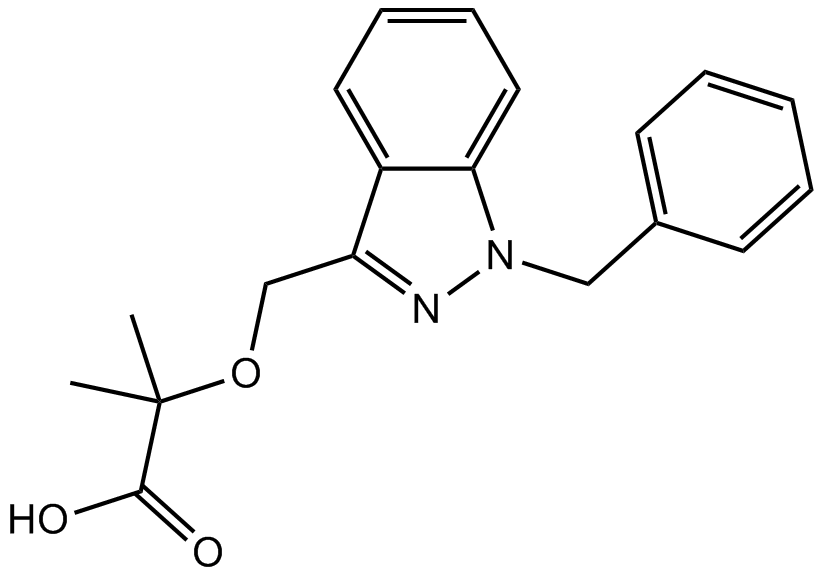
Cas No.: 130641-38-2
Sample solution is provided at 25 µL, 10mM.
_1-3.$$$39978408@51.jpg');)
_1-9.$$$38538795@65.jpg');)
_1-9.$$$39112701@51.jpg');)
_1-7.$$$37316672@70.jpg');)
_366-372.$$$36198801@70.jpg');)
.$$$38565142@65.jpg');)
_1867-1883.$$$33248023@67.jpg');)
_eads6055.$$$39977546@45.jpg');)
_eadm9805.$$$40080571@45.jpg');)
_eadj3020.$$$39666821@45.jpg');)
_1-20.$$$39757301@28.jpg');)
_1-24.$$$38898113@28.jpg');)
_273-287.$$$36806353@46.jpg');)
_1-16.$$$37156877@44.jpg');)
_1-19.$$$37460805@44.jpg');)
_1291-1307.$$$34518654@46.jpg');)
Bindarit는 다양한 모델에서 항염증 활성을 나타내는 인다졸 유도체이다. Bindarit는 p65 및 p65/p50 매개 MCP-1 프로모터 활성화를 특이적으로 억제하고 발현 및 핵 내 국소화를 증가시켜 FABP4와 직접 상호 작용해서 퍼옥시즘 증식활성화수용체 γ(PPARγ) 및 지방다당류(LPS) 의존성 활성효소 신호 전달 경로에 영향을 미친다[2]. Bindarit는 치쿤구니아 바이러스 감염으로 인한 골 손실을 예방하기 위해 사용되고 있다[3].
체외 실험에서 Bindarit (100µM)처리 48시간은 TNF-α (30ng/ml)로 유도된 관상동맥 평활근 세포(CASMCs)의 증식 및 이동을 현저하게 억제하였다[4]. 300µM Bindarit로 1시간 전처리한 후 안지오텐신 II, 엔도텔린-1 및 TGFβ로 유도된 인간 신장 중간엽 세포(HRMCs)의 수축과 빈쿨린 단백질의 인산화를 현저하게 감소시켰다[5].
체내 실험에서 경구 투여를 통해 100mg/kg 용량으로 1일 2회 10일간 Bindarit를 처리한 후 쥐 트리니트로벤젠설포네이트산 (TNBS) 유도 대장염을 현저하게 완화해서 백혈구 침윤을 감소시키고 MCP-1 합성을 하향 조절하였다[6]. 100mg/kg 용량의 Bindarit를 매일 복강 내 투여해서 12주간 처리한 후 PC-3M-Luc2 이종 이식 쥐 모델에서 종양 성장 및 전이를 현저하게 억제하고 생존율을 향상시켰다[7]. 또한 100mg/kg 용량의 Bindarit를 매일 피하 투여하여 28일간 처리한 후 간질 지속 상태 쥐의 뇌 손상을 완화하고 혈액-뇌 장벽의 완전성을 유지해서 신경염증을 감소시켰다[8].
| 세포 실험 [1]: | |
|
세포주 |
인간 관상동맥 평활근 세포 (CASMCs) |
|
준비 방법 |
CASMCs는 0.5mg/ml hEGF, 5mg/ml 인슐린, 1mg/ml hFGF, 50mg/ml 젠타미신/암포테릭린-B, 5% 태아 소 혈청(FBS)이 첨가된 평활근 기초 배양기에서 37°C, 5% CO2/대기 조건에서 배양하였습니다. 배양된 세포를 24웰 판(1.5×10⁴ 세포/웰)에 접종해서 24시간 배양하였습니다. 정지기 유도 후 Bindarit (10, 25, 50, 100, 200 및 300µM)의 유무에 관계없이 TNF-α (30ng/ml) 또는 FBS (5%)로 48시간 동안 세포를 자극하고 세포 증식을 정도를 평가하였습니다. |
|
반응 조건 |
10, 25, 50, 100, 200 및 300µM; 48 시간 동안 |
|
적용 |
Bindarit 처리는 용량 의존적으로 TNF-α로 유도된 CASMCs의 세포 증식을 감소시켰습니다. |
| 동물 실험 [2]: | |
|
동물 모델 |
암컷 BALB/c 쥐 |
|
준비 방법 |
암컷 BALB/c 쥐(6주령)는 제어된 온도(21-23°C), 습도(30-35%) 및 광주기(오전 7:00~오후 7:00) 조건에서 사육되었고 표준 설치류 식이를 제공하였습니다. 100μl PBS당 2.5×10⁵개의 4T1-Luc 세포를 10주령 BALB/c 쥐의 유방 지방 패드에 정위적으로 이식하였습니다. 100mg/kg Bindarit를 경구 관류로 1일 1회, 주당 연속 5일, 2주간 투여 하였습니다. 종양 성장은 생체 발광(BLI)으로 관찰하였습니다. |
|
제형 |
100mg/kg; 매주 5번, 2 주 동안; p.o. |
|
적용 |
Bindarit 처리는 4T1-Luc 이종 이식 쥐의 국소 종양 발생 및 종양 성장을 현저하게 억제하였습니다. |
| Cas No. | 130641-38-2 | SDF | |
| Synonyms | AF 2838 | ||
| Chemical Name | 2-[(1-benzylindazol-3-yl)methoxy]-2-methylpropanoic acid | ||
| Canonical SMILES | CC(C)(C(=O)O)OCC1=NN(C2=CC=CC=C21)CC3=CC=CC=C3 | ||
| Formula | C19H20N2O3 | M.Wt | 324.37 |
| Solubility | ≥ 16.2mg/mL in DMSO | Storage | Store at -20°C |
| Shipping Condition | Evaluation sample solution: shipped with blue ice. All other sizes available: with RT, or with Blue Ice upon request. | ||
| Prepare stock solution | |||

|
1 mg | 5 mg | 10 mg |
| 1 mM | 3.0829 mL | 15.4145 mL | 30.829 mL |
| 5 mM | 616.6 μL | 3.0829 mL | 6.1658 mL |
| 10 mM | 308.3 μL | 1.5414 mL | 3.0829 mL |
Step 1: Enter information below (Recommended: An additional animal making an allowance for loss during the experiment)
 g
μL
g
μL
Step 2: Enter the in vivo formulation (This is only the calculator, not formulation. Please contact us first if there is no in vivo formulation at the solubility Section.)
Calculation results:
Working concentration: mg/ml;
Method for preparing DMSO master liquid: mg drug pre-dissolved in μL DMSO ( Master liquid concentration mg/mL, Please contact us first if the concentration exceeds the DMSO solubility of the batch of drug. )
Method for preparing in vivo formulation: Take μL DMSO master liquid, next addμL PEG300, mix and clarify, next addμL Tween 80, mix and clarify, next add μL saline, mix and clarify.
Method for preparing in vivo formulation: Take μL DMSO master liquid, next add μL Corn oil, mix and clarify.
Note: 1. Please make sure the liquid is clear before adding the next solvent.
2. Be sure to add the solvent(s) in order. You must ensure that the solution obtained, in the previous addition, is a clear solution before proceeding to add the next solvent. Physical methods such as vortex, ultrasound or hot water bath can be used to aid dissolving.
3. All of the above co-solvents are available for purchase on the GlpBio website.
Quality Control & SDS
- View current batch:
- Purity: >98.00% Appearance: A solid
- COA (Certificate of Analysis)
- SDS (Safety Data Sheet)
- Datasheet
Average Rating: 5 (Based on Reviews and 26 reference(s) in Google Scholar.)