

2-APB (Synonyms: 2-Aminoethoxydiphenyl borate, 2-APB, NSC 17107) |
Katalog-Nr.GC17562
 One-Click Copy Product Info
|

2-APB ist ein unspezifischer Calciumkanal-Antagonist. Es wird häufig in Studien zum Calcium-Signalweg verwendet, z.B. bei Apoptose, Muskelkontraktion und neuronaler Übertragung.
Products are for research use only. Not for human use. We do not sell to patients.
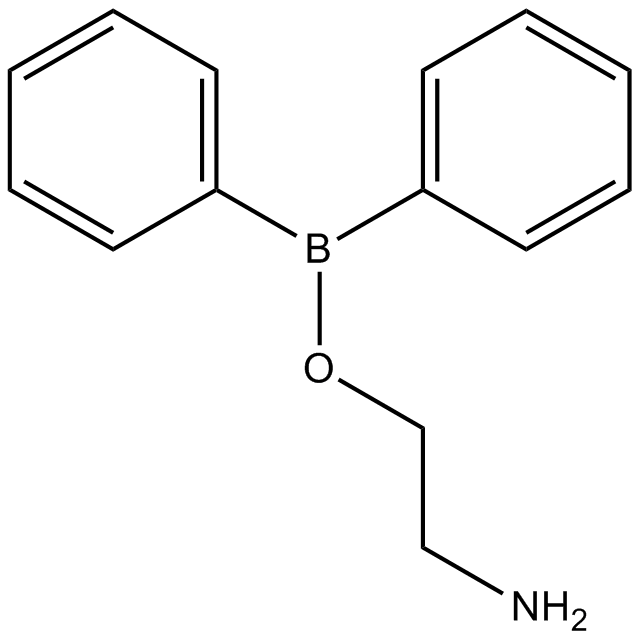
Cas No.: 524-95-8
Sample solution is provided at 25 µL, 10mM.
2-APB ist ein unspezifischer Calciumkanal-Antagonist. Es wird häufig in Studien zum Calcium-Signalweg verwendet, z.B. bei Apoptose, Muskelkontraktion und neuronaler Übertragung. Es ist ein Membran-gängiger Inhibitor der InsP3(inositol-1,4,5-trisphosphate)-sensitiven Ca2+-Kanäle. Der IC50-Wert betrug 42 μM und die InsP3-Konzentration betrug 100 nm[1].
In vitro hemmt 2-APB den durch Thrombin induzierten Anstieg des intrazellulären Ca2+ in humanen Thrombozyten und Neutrophilen. Es hemmt auch die durch Angiotensin II (AII) induzierten Kontraktion von Aorta thoracica[1]. In HEK-293-Zellen blockiert 2-APB den TRPC5-Kanal mit einem IC50-Wert von 20 μM[3]. In pankreatischen Azinuszellen der Maus hemmt niedrig konzentriertes 2-APB erheblich den Calciumspeicher-abhängigen Calcium-Einstrom. Höhere Konzentrationen hemmen die direkt stimulierte und die InsP3-induzierte Ca2+-Freisetzung[4].
In vivo verringert die intravenöse Gabe von 10 mg/kg bei Mäusen in einem I/R-Modell erheblich die Infarktgröße. Zudem sinken die ROS-Spiegel und die Neutrophilen-Infiltration. Das zeigt potenzielle kardioprotektive Effekte[5]. Außerdem erhöht 2-APB bei I/R-Ratten erheblich Superoxiddismutase(SOD), die gesamte antioxidative Kapazität(TAC) und Glutathion(GSH). Es senkt gleichzeitig auch Malondialdehyd(MDA) und DNA-Fragmentierung. Das belegt anti-apoptotische und antioxidative Wirkungen von 2-APB[6].
References:
[1]. Maruyama T, Kanaji T, Nakade S, et al. 2APB, 2-aminoethoxydiphenyl borate, a membrane-penetrable modulator of Ins(1,4,5)P3-induced Ca2+ release. J Biochem, 1997, 122(3): 498-505..
[2]. Togashi K , Inada H , Tominaga M .Inhibition of the transient receptor potential cation channel TRPM2 by 2-aminoethoxydiphenyl borate (2-APB)[J].British Journal of Pharmacology, 2008.
[3].Xu SZ, Zeng F, Boulay G, et al. Block of TRPC5 channels by 2-aminoethoxydiphenyl borate: a differential, extracellular and voltage-dependent effect. Br J Pharmacol, 2005, 145(4): 405-414.
[4]. Choi KJ, Kim KS, Kim SH, et al. Caffeine and 2-Aminoethoxydiphenyl Borate (2-APB) Have Different Ability to Inhibit Intracellular Calcium Mobilization in Pancreatic Acinar Cell. Korean J Physiol Pharmacol, 2010, 14(2): 105-111.
[5]. Hirofumi M , Masanori O , Shota T ,et al.2-aminoethoxydiphenyl borate provides an anti-oxidative effect and mediates cardioprotection during ischemia reperfusion in mice[J].Plos One, 2017, 12(12).
[6]. Sari E, Aksit H, Erken HA, et al. Protective effect of 2-APB on testicular ischemia-reperfusion injury in rats. J Urol, 2015, 193(3): 1036-1041.
| Zellexperiment [1]: | |
Zelllinien | HEK293-Zellen |
Vorbereitungsmethode | HEK293-Zellen wurden in DMEM-F12-Medium mit 10% fötalem Kälberserum, 100 U ml−1 Penicillin und 100 μg ml−1 Streptomycin kultiviert. Die Zellen wurden zuerst 24-72 Stunden lang mit 1 μg ml−1 Tetracycline (Tet+) induziert, um das Expressionsniveau von TRPC5 und TRPM2 zu induzieren. Nicht-induzierte Zellen ohne Tetracycline(Tet−)-Zusatz dienten als Kontrolle. Dann wurden die HEK-293-Zellen 36-72 Stunden lang mit 75 μ m 2-APB inkubiert. |
Reaktionsbedingungen | 75 μm; 36-72 Stunden |
Anwendungen | Der Ganzzellstrom bei −80 mV wird durch 75 μm 2-APB in Tet+ (n=9) und Tet− (n=7) Zellen gehemmt. |
| Tierversuch [2]: | |
Tiermodelle | Männliche C57BL/6-Mäuse(I/R-Modell) |
Vorbereitungsmethode | In einem Experiment mit männlichen C57BL/6-Mäusen(7-9 Wochen alt) wurde Isofluran(1.5%) zur Anästhesie verwendet. Mittels Thorakotomie wurde ein Myokardischämie-Reperfusionsmodell(I/R-Modell) simuliert. Dabei wurde die linke Koronararterie temporär ligiert, um eine Myokardischämie auszulösen. Dann wurde die Ligatur zur Reperfusion gelöst. Vor der Ischämie erhielten die Mäuse der 2-APB-Gruppe eine intravenöse Injektion von 10 mg/kg 2-APB(entsprechend 125 μL Kochsalzlösung/25g Körpergewicht), während die Kontrollgruppe eine entsprechendes Volumen Kochsalzlösung mit dem Vehikel erhielt. Am Ende des Experiments wurden die Myokardinfarktgebiete mittels Evans-Blau-Färbung und 2%iger Triphenyltetrazoliumchlorid-Färbung beurteilt und mit der Software ImageJ analysiert. |
Dosierungsform | 10 mg/kg (angegebene Konzentrationen in 125 μL Kochsalzlösung / 25 g Körpergewicht); i.v. |
Anwendungen | Die Behandlung mit 2-APB führte zu einer erheblichen Reduktion der Infarktgröße nach Ischämie/Reperfusion, begleitet von einer Reduktion der ROS-Werte und der Neutrophileninfiltration. |
References: | |
| Cas No. | 524-95-8 | SDF | |
| Überlieferungen | 2-Aminoethoxydiphenyl borate, 2-APB, NSC 17107 | ||
| Chemical Name | 2-((diphenylboryl)oxy)ethanamine | ||
| Canonical SMILES | NCCOB(C1=CC=CC=C1)C2=CC=CC=C2 | ||
| Formula | C14H16BNO | M.Wt | 225.1 |
| Löslichkeit | ≥ 9.4mg/mL in DMSO | Storage | Store at -20°C, protect from light |
| General tips | Please select the appropriate solvent to prepare the stock solution according to the
solubility of the product in different solvents; once the solution is prepared, please store it in
separate packages to avoid product failure caused by repeated freezing and thawing.Storage method
and period of the stock solution: When stored at -80°C, please use it within 6 months; when stored
at -20°C, please use it within 1 month. To increase solubility, heat the tube to 37°C and then oscillate in an ultrasonic bath for some time. |
||
| Shipping Condition | Evaluation sample solution: shipped with blue ice. All other sizes available: with RT, or with Blue Ice upon request. | ||
| Prepare stock solution | |||

|
1 mg | 5 mg | 10 mg |
| 1 mM | 4.4425 mL | 22.2124 mL | 44.4247 mL |
| 5 mM | 888.5 μL | 4.4425 mL | 8.8849 mL |
| 10 mM | 444.2 μL | 2.2212 mL | 4.4425 mL |
Step 1: Enter information below (Recommended: An additional animal making an allowance for loss during the experiment)
 g
μL
g
μL
Step 2: Enter the in vivo formulation (This is only the calculator, not formulation. Please contact us first if there is no in vivo formulation at the solubility Section.)
Calculation results:
Working concentration: mg/ml;
Method for preparing DMSO master liquid: mg drug pre-dissolved in μL DMSO ( Master liquid concentration mg/mL, Please contact us first if the concentration exceeds the DMSO solubility of the batch of drug. )
Method for preparing in vivo formulation: Take μL DMSO master liquid, next addμL PEG300, mix and clarify, next addμL Tween 80, mix and clarify, next add μL saline, mix and clarify.
Method for preparing in vivo formulation: Take μL DMSO master liquid, next add μL Corn oil, mix and clarify.
Note: 1. Please make sure the liquid is clear before adding the next solvent.
2. Be sure to add the solvent(s) in order. You must ensure that the solution obtained, in the previous addition, is a clear solution before proceeding to add the next solvent. Physical methods such as vortex, ultrasound or hot water bath can be used to aid dissolving.
3. All of the above co-solvents are available for purchase on the GlpBio website.
Quality Control & SDS
- View current batch:
- Purity: >98.00% Appearance: A solid
- COA (Certificate of Analysis)
- SDS (Safety Data Sheet)
- Datasheet
-
Related Biological Data

TRPM2 inhibition improves angiogenesis level under diabetes combined with SCI condition.We have co-stained CD31 (labeled for ECs) with HIF-1α and ANG1, and found that the expressions of ANG1 and HIF-1α in ECs of spinal cord from T1D+SCI group are significantly enhanced after 2-APB treatment.
For T1D+SCI+2-APB group, 3 mg/kg of 2-APB (Glpbio) was intraperitioneally injected into rat daily from 1 day before SCI surgery to inhibit TRPM2 expression.
Int J Biol Sci, 2023, 19(8): 2475. PMID: 37215981 IF: 10.75 -
Related Biological Data

ER-Mito calcium transport mediated mitochondrial fission and mitophagy.Western blot assays demonstrated that 2APB treatment resulted in notable decreases in the phosphorylation of Drp1 at Ser616 and increases in the expression of Mfn2 on soft substrates.
MDA-MB-231 cells were cultured on soft (10 kPa) or glass substrates in the absence or presence of 2APB(GLPBIO) (50 μM).
Acta Biomaterialia, 2023. PMID: 37541606 IF: 9.7004 -
Related Biological Data

Expression of CVS-M or infection with CVS leads to leakage of Ca2+ from intracellular Ca2+ pools and morphology change of the ER.We treated CVS-M-FLAG-expressing cells with 2-APB, an inhibitor of endoplasmic reticulum Ca2+ channels, and found that 2-APB treatment did not fully reverse the increase in Ca2+ concentration induced by CVS-M-FLAG expression.
N2a cells were cultured in Ca2+-free medium and transfected with Vector or CVS-M-FLAG and then were treated with DMSO or 2-APB(Glpbio) (50 µM) at 12 h post-transfection.
Mbio (2024) PMID: 38349129 IF: 6.3996 -
Related Biological Data

IP3 receptor antagonists 2-APB mimicked the anti-inflammatory activity of PRE-084.2-APB reversed that elevated effect of LPS on calcineurin.
BV-2 microglia were pretreated with 2-APB(GlpBio) for 30 min, and then treated with LPS (200 ng/mL).
Neurochem Res 47.2 (2022): 264-278. PMID: 34468932 IF: 4.3997
Average Rating: 5 (Based on Reviews and 4 reference(s) in Google Scholar.)