

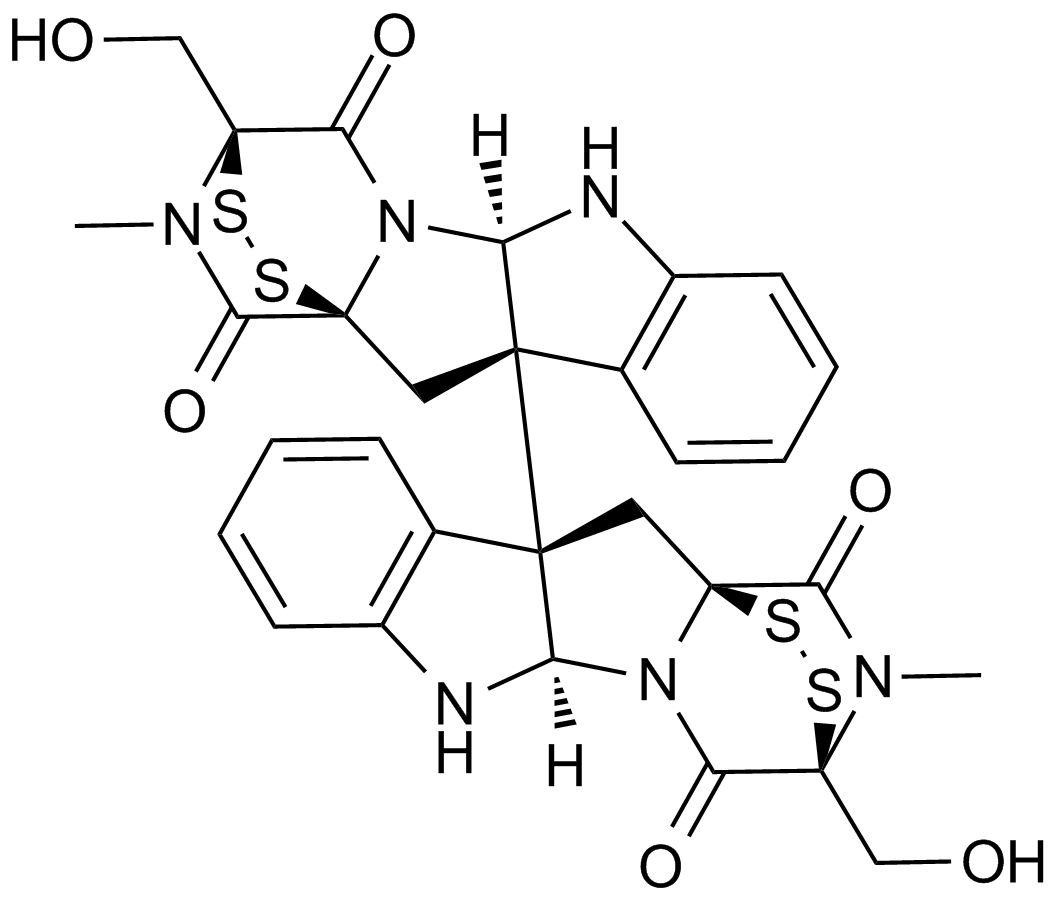
Chaetocin |
Katalog-Nr.GC14936
 One-Click Copy Product Info
|

Chaetocin ist ein unspezifischer Inhibitor von Histonmethyltransferase(HMT) wie SUV39H1 und beeinflusst dadurch die Genexpression.
Products are for research use only. Not for human use. We do not sell to patients.
Cas No.: 28097-03-2
Sample solution is provided at 25 µL, 10mM.
_1-3.$$$39978408@51.jpg');)
_1-9.$$$38538795@65.jpg');)
_1-9.$$$39112701@51.jpg');)
_1-7.$$$37316672@70.jpg');)
_366-372.$$$36198801@70.jpg');)
.$$$38565142@65.jpg');)
_1867-1883.$$$33248023@67.jpg');)
_eads6055.$$$39977546@45.jpg');)
_eadm9805.$$$40080571@45.jpg');)
_eadj3020.$$$39666821@45.jpg');)
_1-20.$$$39757301@28.jpg');)
_1-24.$$$38898113@28.jpg');)
_273-287.$$$36806353@46.jpg');)
_1-16.$$$37156877@44.jpg');)
_1-19.$$$37460805@44.jpg');)
_1291-1307.$$$34518654@46.jpg');)
Chaetocin ist ein unspezifischer Inhibitor von Histonmethyltransferase(HMT) wie SUV39H1 und beeinflusst dadurch die Genexpression[1]. Chaetocin hemmte HMT SU(VAR)3-9 mit einem IC50-Wert von 0.6 µM[2].
Chaetocin reduziert erheblich die Proliferation, das Klonierungspotenzial und die Migrationsfähigkeit der Glioblastom-Zelllinie T98G[3]. Chaetocin hemmt die Aufrechterhaltung der Stammzell-Eigenschaften und das Tumorwachstum von Blasenkrebs-Stammzellen(BCSCs) durch Suppression des KMT1A-GATA3-STAT3-Signalwegs(Hemmungsrate: 80.1%)[4]. Chaetocin hemmte die Proliferation von Eierstockkrebszellen(OC), induzierte einen Zellzyklusarrest in der G2/M-Phase und führte bei einer Konzentration von 2µM (24 Stunden) zu Apoptose[5]. Chaetocin hemmte die Zellvermehrung und reduzierte den PI3K/AKT-Signalweg sowie p-AKT in Magenkrebszellen(HGC-27) bei einer Konzentration von 200µM (24 Stunden)[6].
Chaetocin hemmte die Tumor-Entwicklung in einem Mausmodell für Magenkrebs, dem HGC-27-Zellen injiziert wurden, durch eine Gabe von 0.5 mg/kg/Tag über 24 Tage jeden zweiten Tag[6]. Chaetocin hemmte die Tumor-Entwicklung und reduzierte PCNA in einem Mausmodell für Gliome, dem U87MG-Zellen injiziert wurden, verabreicht mit 0.5 mg/kg/Tag jeden zweiten Tag über 25 Tage[7].
References:
[1]. Cherblanc F L, Chapman K L, Brown R, et al. Chaetocin is a nonspecific inhibitor of histone lysine methyltransferases[J]. Nature chemical biology, 2013, 9(3): 136-137.
[2]. Greiner D, Bonaldi T, Eskeland R, et al. Identification of a specific inhibitor of the histone methyltransferase SU (VAR) 3-9[J]. Nature chemical biology, 2005, 1(3): 143-145.
[3]. Sepsa A, Levidou G, Gargalionis A, et al. Emerging role of linker histone variant H1x as a biomarker with prognostic value in astrocytic gliomas. A multivariate analysis including trimethylation of H3K9 and H4K20[J]. PLoS One, 2015, 10(1): e0115101.
[4]. Yang Z, Wang H, Zhang N, et al. Chaetocin Abrogates the Self-Renewal of Bladder Cancer Stem Cells via the Suppression of the KMT1A-GATA3-STAT3 Circuit[J]. Frontiers in cell and developmental biology, 2020, 8: 424.
[5]. Li Z, Huang L, Wei L, et al. Chaetocin induces caspase?dependent apoptosis in ovarian cancer cells via the generation of reactive oxygen species[J]. Oncology Letters, 2019, 18(2): 1915-1921.
[6]. Wen C, Wang H, Wu X, et al. ROS-mediated inactivation of the PI3K/AKT pathway is involved in the antigastric cancer effects of thioredoxin reductase-1 inhibitor chaetocin[J]. Cell death & disease, 2019, 10(11): 1-16.
[7]. Dixit D, Ghildiyal R, Anto N P, et al. Chaetocin-induced ROS-mediated apoptosis involves ATM-YAP1 axis and JNK-dependent inhibition of glucose metabolism[J]. Cell death & disease, 2014, 5(5): e1212-e1212.
| Zellexperiment [1]: | |
Zelllinien | SKOV-3, OVCAR-3, KGN und A2780 Eierstockkrebszelllinien(OC) |
Vorbereitungsmethode | Die OC-Zellen wurden in 96-Well-Mikroplatten(1×10⁴ Zellen/Well) ausgesät und über Nacht bei 37°C inkubiert. Dann erfolgte eine Inkubation mit Chaetocin (0.05, 0.1, 0.25, 0.5, 0.75, 1 und 2 µM) bei 37°C für 24 Stunden. |
Reaktionsbedingungen | 0.05, 0.1, 0.25, 0.5, 0.75, 1 und 2 µM für 24 Stunden |
Anwendungen | Chaetocin hemmte die Lebensfähigkeit von SKOV-3-, OVCAR-3-, KGN- und A2780-Zellen dosisabhängig erheblich, mit halbmaximalen Hemmkonzentrationen von 0.30, 60.66, 81.86 bzw. 100.60 nM. |
| Tierversuch [2]: | |
Tiermodelle | Weibliche BALB/C Nacktmäuse |
Vorbereitungsmethode | Zwei Mäuse mit gleichem Tumorvolumen wurden in eine Chaetocin-Gruppe und eine Vehikel-Gruppe(n = 6 für jede Gruppe) aufgeteilt und erhielten täglich eine intraperitoneale Injektion(i.p.) von Chaetocin (0.5 mg/kg) bzw. des Vehikels(DMSO). Nach 10 Tagen Behandlung wurden die Mäuse getötet und die Tumoren gewogen. |
Dosierungsform | Intraperitoneale Injektion, 0.5 mg/kg/Tag für 10 Tage |
Anwendungen | Das durchschnittliche Tumorgewicht war in der Chaetocin-Gruppe im Vergleich zur Kontrollgruppe erheblich niedriger. |
References: | |
| Cas No. | 28097-03-2 | SDF | |
| Chemical Name | (3S,3'S,6R,6'R,14R,14'R,16S,16'S)-3,3'-bis(hydroxymethyl)-2,2'-dimethyl-2,2',3,3',6,6',7,7'-octahydro-1H,1'H-[14,14'-bi(3,11a-epidithiopyrazino[1',2':1,5]pyrrolo[2,3-b]indole)]-1,1',4,4'(15H,15'H)-tetraone | ||
| Canonical SMILES | O=C1[C@](CO)(SS2)N(C)C([C@]32N1[C@]4([H])[C@](C(C=CC=C5)=C5N4)([C@@]6(C(C=CC=C7)=C7N8)[C@@]8([H])N(C([C@](CO)(SS9)N%10C)=O)[C@]9(C6)C%10=O)C3)=O | ||
| Formula | C30H28N6O6S4 | M.Wt | 696.84 |
| Löslichkeit | DMSO: 25 mg/ml | Storage | Store at -20°C |
| General tips | Please select the appropriate solvent to prepare the stock solution according to the
solubility of the product in different solvents; once the solution is prepared, please store it in
separate packages to avoid product failure caused by repeated freezing and thawing.Storage method
and period of the stock solution: When stored at -80°C, please use it within 6 months; when stored
at -20°C, please use it within 1 month. To increase solubility, heat the tube to 37°C and then oscillate in an ultrasonic bath for some time. |
||
| Shipping Condition | Evaluation sample solution: shipped with blue ice. All other sizes available: with RT, or with Blue Ice upon request. | ||
| Prepare stock solution | |||

|
1 mg | 5 mg | 10 mg |
| 1 mM | 1.435 mL | 7.1752 mL | 14.3505 mL |
| 5 mM | 287 μL | 1.435 mL | 2.8701 mL |
| 10 mM | 143.5 μL | 717.5 μL | 1.435 mL |
Step 1: Enter information below (Recommended: An additional animal making an allowance for loss during the experiment)
 g
μL
g
μL
Step 2: Enter the in vivo formulation (This is only the calculator, not formulation. Please contact us first if there is no in vivo formulation at the solubility Section.)
Calculation results:
Working concentration: mg/ml;
Method for preparing DMSO master liquid: mg drug pre-dissolved in μL DMSO ( Master liquid concentration mg/mL, Please contact us first if the concentration exceeds the DMSO solubility of the batch of drug. )
Method for preparing in vivo formulation: Take μL DMSO master liquid, next addμL PEG300, mix and clarify, next addμL Tween 80, mix and clarify, next add μL saline, mix and clarify.
Method for preparing in vivo formulation: Take μL DMSO master liquid, next add μL Corn oil, mix and clarify.
Note: 1. Please make sure the liquid is clear before adding the next solvent.
2. Be sure to add the solvent(s) in order. You must ensure that the solution obtained, in the previous addition, is a clear solution before proceeding to add the next solvent. Physical methods such as vortex, ultrasound or hot water bath can be used to aid dissolving.
3. All of the above co-solvents are available for purchase on the GlpBio website.
Quality Control & SDS
- View current batch:
- Purity: >98.00% Appearance: A solid
- COA (Certificate of Analysis)
- SDS (Safety Data Sheet)
- Datasheet
Average Rating: 5 (Based on Reviews and 30 reference(s) in Google Scholar.)