

DIDS sodium salt (Synonyms: 4,4'Diisothiocyanato2.2'stilbenedisulfonic acid, MDL 101114ZA) |
Katalog-Nr.GC14830
 One-Click Copy Product Info
|

DIDS ist ein Inhibitor des Anion-Transports. DIDS hemmt den Chlorid-Kanal ClC-Ka(IC50: 100 μM) und den bakteriellen ClC-ec1Cl-/H+-Austauscher(IC50: circa 300 μM).
Products are for research use only. Not for human use. We do not sell to patients.
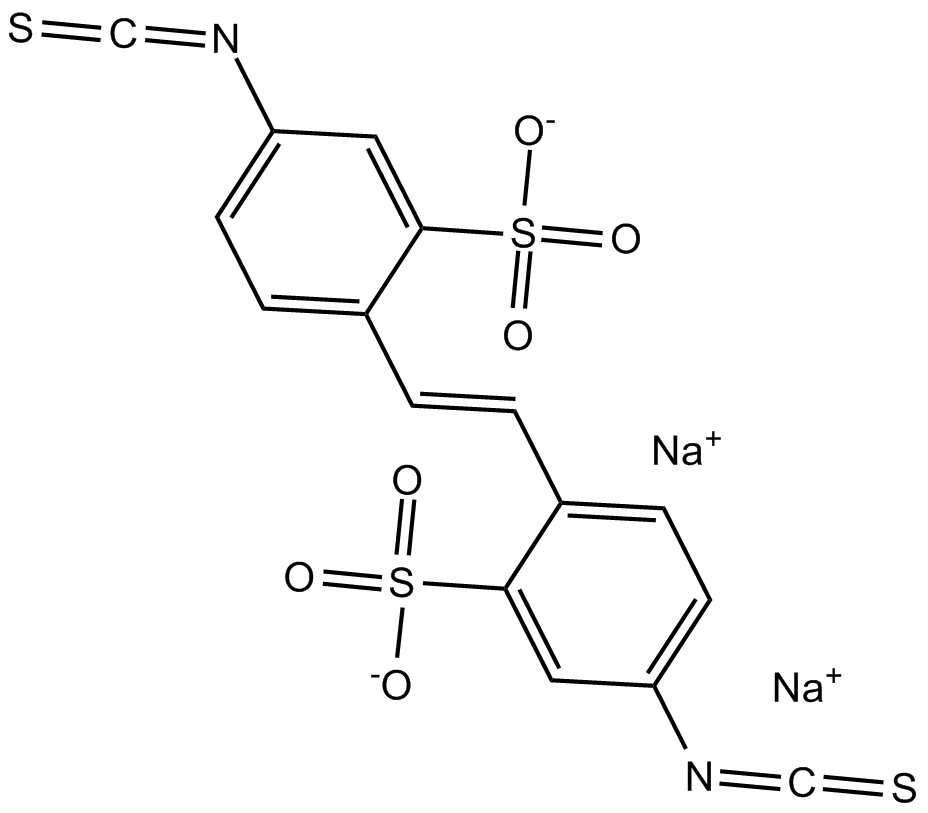
Cas No.: 67483-13-0
Sample solution is provided at 25 µL, 10mM.
DIDS ist ein Inhibitor des Anion-Transports. DIDS hemmt den Chlorid-Kanal ClC-Ka(IC50: 100 μM) und den bakteriellen ClC-ec1Cl-/H+-Austauscher(IC50: circa 300 μM)[1].
Chlorid-Kanäle sind eine große Proteinfamilie mit circa 13 Untergruppen. Chlorid-Kanäle übernehmen vielfältige physiologische Aufgaben. Beim Menschen gibt es 9 CLC-Proteine mit unterschiedlichen physiologischen Funktionen. Die CLC-Proteine gelten als vielversprechende neue Angriffspunkte für die Behandlung von Bluthochdruck, Osteoporose, gastrointestinalen und renalen Erkrankungen[1].
Die Wirkung von DIDS auf den Kalzium-aktivierten Chloridstrom[ICl (ca)] wurde an Muskelzellen der Kaninchen-Pfortader analysiert(mit der perforierten Patch-Technik). DIDS reduzierte konzentrationsabhängig die Amplitude spontaner transitorischer Einwärtsströme(STICs)(IC50: 2.1 x 10⁻⁴ M). Außerdem wurde die Wirkung auf die Kontraktion zerebraler Gefäßmuskelzellen geprüft. DIDS erweitert unter Druck verengte Hirnarterien(IC50: 69 ± 14 μM)[2, 3].
In vivo verstärkt DIDS allein die tumorsuppressive Wirkung von Hyperthermie bei 42.5 ℃ oder 43.5 ℃. Die Thermosensibilisierung verstärkt sich in Kombination mit Amilorid. Eine Hyperthermie bei 43.5 ℃ verzögerte das Tumorwachstum um 4 Tage. Die zusätzliche Gabe von 25 mg/kg DIDS verlängerte die Verzögerung auf circa 6 Tage. In vivo-in vitro-Exzisionsversuche zur Überlebensrate der Tumorzellen bestätigen: DIDS verstärkt den Hitze-induzierten Zelltod von Tumorzellen[4].
References:
[1] Wulff, Heike. "New light on the “Old” chloride channel blocker DIDS." ACS chemical biology 3.7 (2008): 399-401.
[2] Hogg, R. C., Q. Wang, and W. A. Large. "Effects of Cl channel blockers on Ca‐activated chloride and potassium currents in smooth muscle cells from rabbit portal vein." British journal of pharmacology 111.4 (1994): 1333-1341.
[3] Nelson, Mark T., et al. "Chloride channel blockers inhibit myogenic tone in rat cerebral arteries." The Journal of Physiology 502.2 (1997): 259-264.
[4] Lyons, John C., Brian D. Ross, and Chang W. Song. "Enhancement of hyperthermia effect in vivo by amiloride and DIDS." International Journal of Radiation Oncology* Biology* Physics 25.1 (1993): 95-103.
| Zellexperiment [1]: | |
Zelllinien | DRG(Hinterwurzelganglion)-Neuronen gewonnen aus dem Rückenmark 6-8 Wochen alter Sprague-Dawley-Ratten |
Vorbereitungsmethode | In DMSO löslich: > 10mM. Tipps zur Herstellung höher konzentrierter Lösungen: Bitte das Reagenzglas 10 Minuten bei 37℃ erwärmen oder kurz im Ultraschallbad schütteln. Die Stammlösung kann einige Monate unter -20℃ gelagert werden. |
Reaktionsbedingungen | 0.1, 1, 3, 10, 100 μm für 2 Minuten; Die Messung beginnt sofort bei Zugabe der ersten Tropfen. |
Anwendungen | An DRG-Neuronen aktiviert DIDS TRPV1(Transient receptor potential vanilloid type 1) nicht eigenständig. Dennoch verstärkt DIDS stark die durch Capsaicin oder sauren pH-Wert induzierten TRPV1-Ströme. DIDS beeinflusst die Funktion des TRPV1-Kanals auf eine Agonisten-abhängige Weise. |
| Tierversuch [2]: | |
Tiermodelle | gesunde neugeborene Sprague-Dawley-Ratten im Alter von 4-5 Tagen(männlich und weiblich) |
Vorbereitungsmethode | 5 mg/kg, intraperitoneale Injektion |
Dosierungsform | DIDS reduzierte erheblich die durch Ischämie-Hypoxie erhöhte mRNA und Protein-Expression von ClC-2(Chloridkanal 2) bei neugeborenen Ratten ab. DIDS verringte erheblich die Konzentration reaktiver Sauerstoffspezies(ROS). Zudem sinken die mRNA-Gehalte der induzierbaren Stickstoffmonoxid-Synthase(iNOS) und des Tumornekrosefaktor-Alpha(TNF-α) bei hypoxisch-ischämischen Schädigungen. Die erhöhte Anzahl an Caspase-3 und NG-2 Doppel-positiven Zellen nach hypoxisch-ischämischer Verletzung wird durch DIDS abgeschwächt. |
Anwendungen | Bitte die Löslichkeit jeder Verbindung laborintern prüfen. Die tatsächliche Löslichkeit kann geringfügig von dem theoretischen Wert abweichen. Die Abweichungen entstehen durch systemische Versuchsfehler und sind üblich. |
References: | |
| Cas No. | 67483-13-0 | SDF | |
| Überlieferungen | 4,4'Diisothiocyanato2.2'stilbenedisulfonic acid, MDL 101114ZA | ||
| Chemical Name | sodium (E)-6,6'-(ethene-1,2-diyl)bis(3-isothiocyanatobenzenesulfonate) | ||
| Canonical SMILES | S=C=NC1=CC=C(/C=C/C(C(S([O-])(=O)=O)=C2)=CC=C2N=C=S)C(S([O-])(=O)=O)=C1.[Na+].[Na+] | ||
| Formula | C16H8N2Na2O6S4 | M.Wt | 498.48 |
| Löslichkeit | 50mg/ml in DMSO (ultrasonic and warming and heat to 60°C); 30mg/ml in Water ( Need ultrasonic) | Storage | Store at -20°C, sealed storage, away from moisture |
| General tips | Please select the appropriate solvent to prepare the stock solution according to the
solubility of the product in different solvents; once the solution is prepared, please store it in
separate packages to avoid product failure caused by repeated freezing and thawing.Storage method
and period of the stock solution: When stored at -80°C, please use it within 6 months; when stored
at -20°C, please use it within 1 month. To increase solubility, heat the tube to 37°C and then oscillate in an ultrasonic bath for some time. |
||
| Shipping Condition | Evaluation sample solution: shipped with blue ice. All other sizes available: with RT, or with Blue Ice upon request. | ||
| Prepare stock solution | |||

|
1 mg | 5 mg | 10 mg |
| 1 mM | 2.0061 mL | 10.0305 mL | 20.061 mL |
| 5 mM | 401.2 μL | 2.0061 mL | 4.0122 mL |
| 10 mM | 200.6 μL | 1.003 mL | 2.0061 mL |
Step 1: Enter information below (Recommended: An additional animal making an allowance for loss during the experiment)
 g
μL
g
μL
Step 2: Enter the in vivo formulation (This is only the calculator, not formulation. Please contact us first if there is no in vivo formulation at the solubility Section.)
Calculation results:
Working concentration: mg/ml;
Method for preparing DMSO master liquid: mg drug pre-dissolved in μL DMSO ( Master liquid concentration mg/mL, Please contact us first if the concentration exceeds the DMSO solubility of the batch of drug. )
Method for preparing in vivo formulation: Take μL DMSO master liquid, next addμL PEG300, mix and clarify, next addμL Tween 80, mix and clarify, next add μL saline, mix and clarify.
Method for preparing in vivo formulation: Take μL DMSO master liquid, next add μL Corn oil, mix and clarify.
Note: 1. Please make sure the liquid is clear before adding the next solvent.
2. Be sure to add the solvent(s) in order. You must ensure that the solution obtained, in the previous addition, is a clear solution before proceeding to add the next solvent. Physical methods such as vortex, ultrasound or hot water bath can be used to aid dissolving.
3. All of the above co-solvents are available for purchase on the GlpBio website.
Quality Control & SDS
- View current batch:
- Purity: >98.00% Appearance: A solid
- COA (Certificate of Analysis)
- SDS (Safety Data Sheet)
- Datasheet
Average Rating: 5 (Based on Reviews and 39 reference(s) in Google Scholar.)