

Finerenone (Synonyms: BAY 94-8862) |
Katalog-Nr.GC60842
 One-Click Copy Product Info
|

FinerenoneFinerenone (BAY 94 - 8862) ist ein selektiver, oral aktives, nichtsteroid-Salz - Kortikosteroid-Rezeptor (MR) - Antagonist der dritten Generation mit einem IC50 von 18 nM.
Products are for research use only. Not for human use. We do not sell to patients.
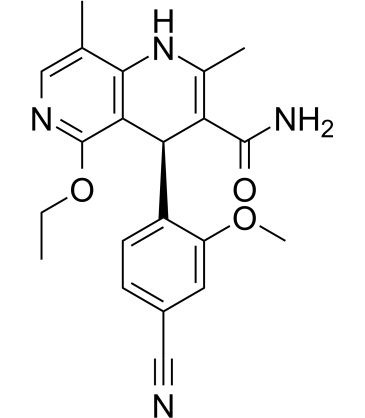
Cas No.: 1050477-31-0
Sample solution is provided at 25 µL, 10mM.
_1-3.$$$39978408@51.jpg');)
_1-9.$$$38538795@65.jpg');)
_1-9.$$$39112701@51.jpg');)
_1-7.$$$37316672@70.jpg');)
_366-372.$$$36198801@70.jpg');)
.$$$38565142@65.jpg');)
_1867-1883.$$$33248023@67.jpg');)
_eads6055.$$$39977546@45.jpg');)
_eadm9805.$$$40080571@45.jpg');)
_eadj3020.$$$39666821@45.jpg');)
_1-20.$$$39757301@28.jpg');)
_1-24.$$$38898113@28.jpg');)
_273-287.$$$36806353@46.jpg');)
_1-16.$$$37156877@44.jpg');)
_1-19.$$$37460805@44.jpg');)
_1291-1307.$$$34518654@46.jpg');)
Finerenone
Finerenone (BAY 94 - 8862) ist ein selektiver, oral aktives, nichtsteroid-Salz - Kortikosteroid-Rezeptor (MR) - Antagonist der dritten Generation mit einem IC50 von 18 nM. Finerenone ist für MR höher selektiv als Glukokortikoid-Rezeptor (GR), Androgen-Rezeptor (AR) und Progesteron-Rezeptor (AR) (> 500 - mal). Finerenone wird hauptsächlich in der Forschung von Herz-Nieren - Erkrankungen wie Typ - 2 - Diabetes und chronische Nierenerkrankungen verwendet.
In vitro reduzierte die Behandlung von neugeborenen Rattenkardiomyozyten (NRCM) mit Finerenon (20 nM) die durch hohe Glukose und hohe Fettsäuren stimulierte Apoptosis, verbesserte den Kardiomyozytenwechsel und reduzierte die ROS-Generation über den PPARγ / CD36 - Weg.
In vivo, orale Behandlung von chronischen Nierenerkrankungen (MWF) Modell und Wildtyp Ratten mit Finerenon (10 mg / kg) signifikant reduziert Albuminurie in MWF Ratten, erhöhte endothelliche Stickstoff-Oxid - Nutzung, und signifikant verbessert die endothelische Funktion in MWF Ratten. Finerenon (5 mg / kg) wurde intraperitoneal in Mäuse mit induzierter Retinopathie (OIR) injiziert, die den Netzhautsystolikdruck, Gliose, vaskuläre Leckage und Mikroglia / Makrophagendichte reduzierte. Finerenon (10 mg / kg) wurde oral in Mäuse mit Herz / Nierenentzündungsmodell verabreicht, was die Aufregulation von infiltrierenden renalen RORγt γ δ - positiven T-Zellen, die durch die Exposition von deoxycorticosterone Acetat (DOCA) Salz induziert wurden, signifikant verbesserte und Herz - und Nierenschäden verhinderte.
References:
[1] Liu L C Y, Schutte E, Gansevoort R T, et al. Finerenone: third-generation mineralocorticoid receptor antagonist for the treatment of heart failure and diabetic kidney disease[J]. Expert opinion on investigational drugs, 2015, 24(8): 1123-1135.
[2] Bădilă E. The expanding class of mineralocorticoid receptor modulators: New ligands for kidney, cardiac, vascular, systemic and behavioral selective actions[J]. Acta Endocrinologica (Bucharest), 2020, 16(4): 487.
[3] Agarwal R, Filippatos G, Pitt B, et al. Cardiovascular and kidney outcomes with finerenone in patients with type 2 diabetes and chronic kidney disease: the FIDELITY pooled analysis[J]. European heart journal, 2022, 43(6): 474-484.
[4] Jin T, Fu X, Liu M, et al. Finerenone attenuates myocardial apoptosis, metabolic disturbance and myocardial fibrosis in type 2 diabetes mellitus[J]. Diabetology & Metabolic Syndrome, 2023, 15(1): 87.
[5] González-Blázquez R, Somoza B, Gil-Ortega M, et al. Finerenone attenuates endothelial dysfunction and albuminuria in a chronic kidney disease model by a reduction in oxidative stress[J]. Frontiers in Pharmacology, 2018, 9: 1131.
[6] Jerome J R, Deliyanti D, Suphapimol V, et al. Finerenone, a non-steroidal mineralocorticoid receptor antagonist, reduces vascular injury and increases regulatory T-cells: Studies in rodents with diabetic and neovascular retinopathy[J]. International Journal of Molecular Sciences, 2023, 24(3): 2334.
[7] Luettges K, Bode M, Diemer J N, et al. Finerenone reduces renal RORγt γδ T cells and protects against cardiorenal damage[J]. American Journal of Nephrology, 2022, 53(7): 552-564.
| Cell experiment [1]: | |
Cell lines | Neonatale Ratten-Kardiomyozyten |
Preparation Method | Für die Zellkultur wurden neonatale Rattenkardiomyozyten (NRCMs) extrahiert, und es wurde DMEM-Medium verwendet. Die Regulierung von Hyperlipidämie oder Hyperglykämie wurde durch Inkubation mit hohen Konzentrationen von gesättigten FFA (Natriumpalmitat, 16:0, 0,3 mM) oder Glukose (D-Glukose, 33 mM) nachgeahmt. Palmitat wurde zuvor mit BSA in einem molaren Verhältnis von 3:1 konjugiert. Bei den Kontrollzellen wurde BSA wie beschrieben zugegeben, jedoch in Abwesenheit von Palmitat. Finerenon (20nM) wurde 1 Stunde vor der Stimulation zugegeben. |
Reaction Conditions | 20nM; 1 Stunde |
Applications | Finerenone reduziert die Apoptose von Kardiomyozyten, die durch hohe Glukose und hohe Fettsäuren stimuliert werden. Finerenon verbessert den Stoffwechsel der Kardiomyozyten und reduziert die ROS-Erzeugung über den PPARγ/CD36-Signalweg. |
| Animal experiment [2]: | |
Animal models | Männliche Wistar- und MWF-Ratten |
Preparation Method | Zwölf Wochen alte männliche Wistar- und MWF-Ratten wurden in Zweiergruppen unter kontrollierten Dunkel-Licht-Zyklen und Temperaturbedingungen gehalten, wobei Futter und Wasser ad libitum zur Verfügung standen. Die Tiere wurden nach dem Zufallsprinzip in Gruppen eingeteilt und erhielten Finerenon (10 mg/kg/Tag in 10 % EtOH, 40 % PEG400, 50 % Wasser; W-FIN; MWF-FIN) oder Vehikel (10 % EtOH, 40 % PEG400, 50 % Wasser; W-C; MWF-C) über einen Zeitraum von 4 Wochen einmal täglich oral verabreicht. Die letzte orale Verabreichung von FIN erfolgte am Tag vor der Tötung. |
Dosage form | 10mg/kg; p.o. |
Applications | Finerenon führte zu einer signifikanten Verringerung (>40 %) der Albuminurie im MWF-Modus, während die Normoalbuminurie bei Wistar-Ratten nicht beeinflusst wurde. |
References: [1] Jin T, Fu X, Liu M, et al. Finerenone attenuates myocardial apoptosis, metabolic disturbance and myocardial fibrosis in type 2 diabetes mellitus[J]. Diabetology & Metabolic Syndrome, 2023, 15(1): 87. [2] González-Blázquez R, Somoza B, Gil-Ortega M, et al. Finerenone attenuates endothelial dysfunction and albuminuria in a chronic kidney disease model by a reduction in oxidative stress[J]. Frontiers in Pharmacology, 2018, 9: 1131. | |
| Cas No. | 1050477-31-0 | SDF | |
| Überlieferungen | BAY 94-8862 | ||
| Canonical SMILES | O=C(C1=C(C)NC2=C(C(OCC)=NC=C2C)[C@@H]1C3=CC=C(C#N)C=C3OC)N | ||
| Formula | C21H22N4O3 | M.Wt | 378.42 |
| Löslichkeit | DMSO : 100 mg/mL (DMSO moisture absorption will reduce the solubility of the compound, please use a new DMSO; Need ultrasonic) | Storage | Store at -20°C |
| General tips | Please select the appropriate solvent to prepare the stock solution according to the
solubility of the product in different solvents; once the solution is prepared, please store it in
separate packages to avoid product failure caused by repeated freezing and thawing.Storage method
and period of the stock solution: When stored at -80°C, please use it within 6 months; when stored
at -20°C, please use it within 1 month. To increase solubility, heat the tube to 37°C and then oscillate in an ultrasonic bath for some time. |
||
| Shipping Condition | Evaluation sample solution: shipped with blue ice. All other sizes available: with RT, or with Blue Ice upon request. | ||
| Prepare stock solution | |||

|
1 mg | 5 mg | 10 mg |
| 1 mM | 2.6426 mL | 13.2128 mL | 26.4257 mL |
| 5 mM | 528.5 μL | 2.6426 mL | 5.2851 mL |
| 10 mM | 264.3 μL | 1.3213 mL | 2.6426 mL |
Step 1: Enter information below (Recommended: An additional animal making an allowance for loss during the experiment)
 g
μL
g
μL
Step 2: Enter the in vivo formulation (This is only the calculator, not formulation. Please contact us first if there is no in vivo formulation at the solubility Section.)
Calculation results:
Working concentration: mg/ml;
Method for preparing DMSO master liquid: mg drug pre-dissolved in μL DMSO ( Master liquid concentration mg/mL, Please contact us first if the concentration exceeds the DMSO solubility of the batch of drug. )
Method for preparing in vivo formulation: Take μL DMSO master liquid, next addμL PEG300, mix and clarify, next addμL Tween 80, mix and clarify, next add μL saline, mix and clarify.
Method for preparing in vivo formulation: Take μL DMSO master liquid, next add μL Corn oil, mix and clarify.
Note: 1. Please make sure the liquid is clear before adding the next solvent.
2. Be sure to add the solvent(s) in order. You must ensure that the solution obtained, in the previous addition, is a clear solution before proceeding to add the next solvent. Physical methods such as vortex, ultrasound or hot water bath can be used to aid dissolving.
3. All of the above co-solvents are available for purchase on the GlpBio website.
Quality Control & SDS
- View current batch:
- Purity: >99.50% Appearance: A solid
- COA (Certificate of Analysis)
- SDS (Safety Data Sheet)
- Datasheet
Average Rating: 5 (Based on Reviews and 4 reference(s) in Google Scholar.)