

G-1 |
Katalog-Nr.GC12766
 One-Click Copy Product Info
|

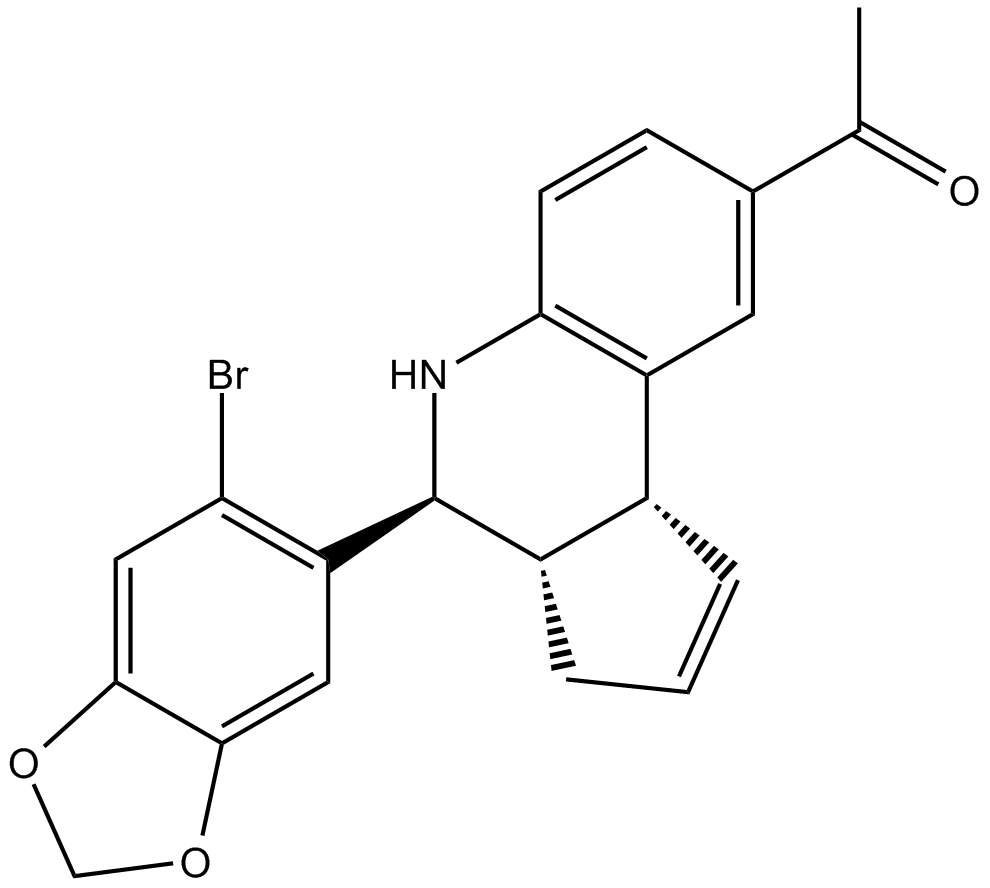
G-1 ist ein selektiver und potenter Agonist des GPR30-Rezeptors mit einem EC50-Wert von etwa 2 nM.
Products are for research use only. Not for human use. We do not sell to patients.
Cas No.: 881639-98-1
Sample solution is provided at 25 µL, 10mM.
G-1 ist ein selektiver und potenter Agonist des GPR30-Rezeptors mit einem EC50-Wert von etwa 2 nM[1].
Die Behandlung mit G-1(10-5 und 10-4 M) über 48 und 72 Stunden führte zu einer deutlichen Minderung der Proliferation von A549-Zellen. Nach 72 Stunden wurde der IC50-Wert für G-1 mit 2×10⁻⁵ M bestimmt[2]. Die Behandlung mit G-1 bei einer Konzentration von 2×10⁻⁵ M hatte keine deutliche Wirkung auf die CAT-Aktivität, führte aber zu einem beträchtlichen Anstieg der SOD- und GPx-Aktivität sowie des NO-Spiegels[2]. G-1 hemmte die Abgabe von TNF-α und IL-6 in primären menschlichen Makrophagen, die aus Monozyten nach 6-tägiger Behandlung mit GM-CSF gewonnen wurden. Der Agonist hemmte die Induktion beider Zytokine mit IC50-Werten von 209 nM bzw. 317 nM[3]. G-1 konnte auch die LPS-induzierte TNF-α-Freisetzung in der Maus-Makrophagen-Zelllinie RAW 264.7 hemmen[3].
Die Gabe von G-1 (50 mg/kg/Tag, 21 Tage) reduzierte erheblich die Schwere der experimentellen allergischen Enzephalomyelitis(EAE). Die G-1-Behandlung verringerte den Grad der Entzündung im lumbalen Rückenmark. In drei einzeln untersuchten Mäusen reduzierte die G-1-Behandlung den Anteil der in das ZNS infiltrierenden Makrophagen(CD45hiCD11b+)[3]. G-1 könnte einen neuro-protektiven Effekt auf Motoneuronen haben. Die intraperitoneale Injektion des GPR30-Agonisten G-1 über 14 Tage induziert neuro-protektive Effekte, die denen von E2 in gleicher Dosierung entsprechen[4].
References:
[1]. Bologa C G, Revankar C M, Young S M, et al. Virtual and biomolecular screening converge on a selective agonist for GPR30[J]. Nature chemical biology, 2006, 2(4): 207-212.
[2]. Kurt A H, Çelik A, Kelleci B M. Oxidative/antioxidative enzyme-mediated antiproliferative and proapoptotic effects of the GPER1 agonist G-1 on lung cancer cells[J]. Oncology Letters, 2015, 10(5): 3177-3182.
[3]. Blasko E, Haskell C A, Leung S, et al. Beneficial role of the GPR30 agonist G-1 in an animal model of multiple sclerosis[J]. Journal of neuroimmunology, 2009, 214(1-2): 67-77.
[4]. Cheng Q, Meng J, Wang X, et al. G-1 exerts neuroprotective effects through G protein-coupled estrogen receptor 1 following spinal cord injury in mice[J]. Bioscience Reports, 2016, 36(4).
| Zellexperiment [1]: | |
Zelllinien | A549-Zellen(menschliche Lungenkrebszellen) |
Vorbereitungsmethode | A549-Lungenkrebszellen wurden in 96-Well-Platten mit verschiedenen Konzentrationen(10-8, 10-7, 10-6, 10-5 und 10-4 M) von 17β-Estradiol und G-1 behandelt und 48 bzw. 72 Stunden inkubiert. Nach der Inkubation wurde in jedes Löscher 0.5 mg/ml MTT-Lösung(Sigma-Aldrich) zugegeben und 4 Stunden bei 37°C inkubiert. |
Reaktionsbedingungen | 0.01-100 µM für 48 und 72 Stunden |
Anwendungen | Die Behandlung mit G-1(10-5 und 10-4 M) über 48 und 72 Stunden führte zu einer signifikanten Verringerung der Zellproliferation. |
| Tierversuch [2]: | |
Tiermodelle | SJL-Mäuse(5-7 Wochen alt) |
Vorbereitungsmethode | SJL-Mäuse wurde subkutan 50 µg PLP139-151 und CFA(400 µg Mycobacterium tuberculosis) verabreicht. Die Behandlung mit G-1 erfolgte täglich über 21 Tage ab dem Tag der Krankheitsinduktion in einer Dosis von 50 mg/kg. Kontrollmäusen wurde in gleicher Weise ein Vehikel(5% Dimethylsulfoxid(DMSO), 95% Polyethylene glycol (PEG)-300) verabreicht. |
Dosierungsform | 50 mg/kg/Tag für 21 Tage |
Anwendungen | Die Gabe von G-1 führte zu einer deutlichen Reduzierung der Schwere der aktiv induzierten experimentellen allergischen Enzephalomyelitis(EAE), hatte aber keinen Einfluss auf die Häufigkeit des Krankheitsvorkommens. |
References: | |
| Cas No. | 881639-98-1 | SDF | |
| Chemical Name | rel-1-[4-(6-bromo-1,3-benzodioxol-5-yl)-3aR,4S,5,9bS-tetrahydro-3H-cyclopenta[c]quinolin-8-yl]-ethanone | ||
| Canonical SMILES | CC(C1=CC([C@@](C=CC2)([H])[C@@]2([H])[C@H](C3=CC(OCO4)=C4C=C3Br)N5)=C5C=C1)=O | ||
| Formula | C21H18BrNO3 | M.Wt | 412.28 |
| Löslichkeit | 1mg/ml in ethanol; 20mg/ml in DMSO; 30mg/ml in DMF | Storage | Store at -20°C |
| General tips | Please select the appropriate solvent to prepare the stock solution according to the
solubility of the product in different solvents; once the solution is prepared, please store it in
separate packages to avoid product failure caused by repeated freezing and thawing.Storage method
and period of the stock solution: When stored at -80°C, please use it within 6 months; when stored
at -20°C, please use it within 1 month. To increase solubility, heat the tube to 37°C and then oscillate in an ultrasonic bath for some time. |
||
| Shipping Condition | Evaluation sample solution: shipped with blue ice. All other sizes available: with RT, or with Blue Ice upon request. | ||
| Prepare stock solution | |||

|
1 mg | 5 mg | 10 mg |
| 1 mM | 2.4255 mL | 12.1277 mL | 24.2554 mL |
| 5 mM | 485.1 μL | 2.4255 mL | 4.8511 mL |
| 10 mM | 242.6 μL | 1.2128 mL | 2.4255 mL |
Step 1: Enter information below (Recommended: An additional animal making an allowance for loss during the experiment)
 g
μL
g
μL
Step 2: Enter the in vivo formulation (This is only the calculator, not formulation. Please contact us first if there is no in vivo formulation at the solubility Section.)
Calculation results:
Working concentration: mg/ml;
Method for preparing DMSO master liquid: mg drug pre-dissolved in μL DMSO ( Master liquid concentration mg/mL, Please contact us first if the concentration exceeds the DMSO solubility of the batch of drug. )
Method for preparing in vivo formulation: Take μL DMSO master liquid, next addμL PEG300, mix and clarify, next addμL Tween 80, mix and clarify, next add μL saline, mix and clarify.
Method for preparing in vivo formulation: Take μL DMSO master liquid, next add μL Corn oil, mix and clarify.
Note: 1. Please make sure the liquid is clear before adding the next solvent.
2. Be sure to add the solvent(s) in order. You must ensure that the solution obtained, in the previous addition, is a clear solution before proceeding to add the next solvent. Physical methods such as vortex, ultrasound or hot water bath can be used to aid dissolving.
3. All of the above co-solvents are available for purchase on the GlpBio website.
Quality Control & SDS
- View current batch:
- Purity: >99.50% Appearance: A solid
- COA (Certificate of Analysis)
- SDS (Safety Data Sheet)
- Datasheet
Average Rating: 5 (Based on Reviews and 37 reference(s) in Google Scholar.)