

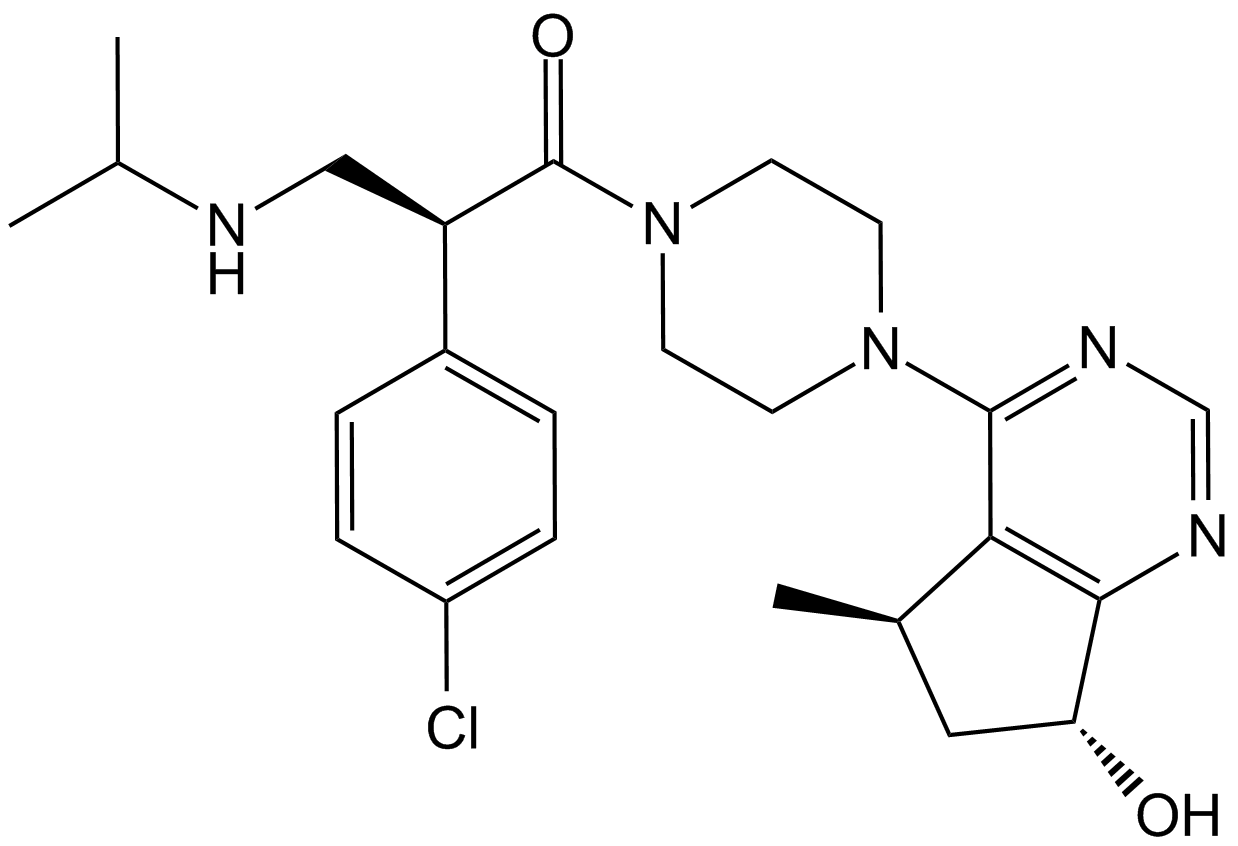
GDC-0068 (RG7440) (Synonyms: Ipatasertib, RG-7440) |
Katalog-Nr.GC11214
 One-Click Copy Product Info
|

GDC-0068 (RG7440)(RG7440, Ipatasertib) ist ein neuartiger, hochselektiver, ATP-kompetitiver Pan-Akt-Inhibitor, der alle 3 Isoformen von Akt1, Akt2 und Akt3 mit einer IC50 von 5,18 bzw. 8 nM hemmt.
Products are for research use only. Not for human use. We do not sell to patients.
Cas No.: 1001264-89-6
Sample solution is provided at 25 µL, 10mM.
_1-3.$$$39978408@51.jpg');)
_1-9.$$$38538795@65.jpg');)
_1-9.$$$39112701@51.jpg');)
_1-7.$$$37316672@70.jpg');)
_366-372.$$$36198801@70.jpg');)
.$$$38565142@65.jpg');)
_1867-1883.$$$33248023@67.jpg');)
_eads6055.$$$39977546@45.jpg');)
_eadm9805.$$$40080571@45.jpg');)
_eadj3020.$$$39666821@45.jpg');)
_1-20.$$$39757301@28.jpg');)
_1-24.$$$38898113@28.jpg');)
_273-287.$$$36806353@46.jpg');)
_1-16.$$$37156877@44.jpg');)
_1-19.$$$37460805@44.jpg');)
_1291-1307.$$$34518654@46.jpg');)
GDC-0068 (RG7440)(RG7440, Ipatasertib) ist ein neuartiger, hochselektiver, ATP-kompetitiver Pan-Akt-Inhibitor, der alle 3 Isoformen von Akt1, Akt2 und Akt3 mit einer IC50 von 5,18 bzw. 8 nM hemmt[1,5].
GDC-0068 reduzierte die Zellviabilität, induzierte Apoptose und hemmte die Phosphorylierung des Prolin-reichen Akt-Substrats 40 kDa sowie der p70 S6-Kinase dosisabhängig in PIK3CA-mutierten Hirnmetastasen-Zelllinien von Brustkrebs im Vergleich zu PIK3CA-Wildtyp-Zelllinien[6]. Die kombinierte Behandlung mit GDC-0068 (RG7440) und einer Mikrotubuli-hemmenden Chemotherapie, einschließlich Vinorelbin, Paclitaxel und Eribulin, führte zu einer antiproliferativen, proapoptotischen und antimetastatischen Wirkung auf humane Brustkrebszellen[7]. GDC-0068 (RG7440) blockierte die Akt-Signalübertragung sowohl in kultivierten humanen Krebszelllinien als auch in Tumortransplantationsmodellen. Das zeigte sich in einer dosisabhängigen Abnahme der Phosphorylierung nachgeschalteter Zielproteine. Die Hemmung der Akt-Aktivität durch GDC-0068 (RG7440) führte zu einem Stillstand des Zellzyklus und einer reduzierten Lebensfähigkeit der Krebszelllinien[2].
Präklinische pharmakologische Studien belegen, dass die Exposition gegenüber GDC-0068 (RG7440) einen dosisabhängigen pharmakodynamischen Effekt und eine starke Antitumorwirkung in einem breiten Spektrum humaner Krebszellen in vitro und in vivo zur Folge hat[5]. Die Therapie mit GDC-0068 (RG7440) hemmte erheblich das Wachstum von Wildtyp-Tumoren. Bei PUMA-Tumoren zeigte die Therapie mit GDC-0068 (RG7440) zwar eine gewisse Suppression, diese war aber im Vergleich zu Wildtyp-Tumoren weniger ausgeprägt. Immunhistochemische Färbungen zeigen, dass das Expressionsniveau von P-Akt sowohl in WT- als auch in PUMA-difizienten Tumoren nach der Therapie mit GDC-0068 (RG7440) reduziert ist. PUMA-abhängige Antitumorwirkungen von GDC-0068 (RG7440) bei Darmkrebs[4]. Als ATP-kompetitiver Akt-Inhibitor ist GDC-0068 (RG7440) ein vielversprechendes und sicheres Zielmolekül für Akt, was in einer ersten klinischen Studie der Phase I am Menschen nachgewiesen wurde[3].
References:
[1]. Lin K, Lin J, et,al. An ATP-site on-off switch that restricts phosphatase accessibility of Akt. Sci Signal. 2012 May 8;5(223):ra37. doi: 10.1126/scisignal.2002618. PMID: 22569334.
[2]. Lin J, Sampath D, et,al.Targeting activated Akt with GDC-0068, a novel selective Akt inhibitor that is efficacious in multiple tumor models. Clin Cancer Res. 2013 Apr 1;19(7):1760-72. doi: 10.1158/1078-0432.CCR-12-3072. Epub 2013 Jan 3. PMID: 23287563.
[3]. Saura C, Roda D, et,al. A First-in-Human Phase I Study of the ATP-Competitive AKT Inhibitor Ipatasertib Demonstrates Robust and Safe Targeting of AKT in Patients with Solid Tumors. Cancer Discov. 2017 Jan;7(1):102-113. doi: 10.1158/2159-8290.CD-16-0512. Epub 2016 Nov 21. Erratum in: Cancer Discov. 2018 Nov;8(11):1490. PMID: 27872130; PMCID: PMC5463454.
[4]. Sun L, Huang Y, et,al. Ipatasertib, a novel Akt inhibitor, induces transcription factor FoxO3a and NF-κB directly regulates PUMA-dependent apoptosis. Cell Death Dis. 2018 Sep 5;9(9):911. doi: 10.1038/s41419-018-0943-9. PMID: 30185800; PMCID: PMC6125489.
[5]. Blake JF, Xu R, et,al. Discovery and preclinical pharmacology of a selective ATP-competitive Akt inhibitor (GDC-0068) for the treatment of human tumors. J Med Chem. 2012 Sep 27;55(18):8110-27. doi: 10.1021/jm301024w. Epub 2012 Sep 18. PMID: 22934575.
[6]. Ippen FM, Grosch JK, et,al. Targeting the PI3K/Akt/mTOR pathway with the pan-Akt inhibitor GDC-0068 in PIK3CA-mutant breast cancer brain metastases. Neuro Oncol. 2019 Nov 4;21(11):1401-1411. doi: 10.1093/neuonc/noz105. PMID: 31173106; PMCID: PMC6827829.
[7]. Yan Y, Serra V, et,al.Evaluation and clinical analyses of downstream targets of the Akt inhibitor GDC-0068. Clin Cancer Res. 2013 Dec 15;19(24):6976-86. doi: 10.1158/1078-0432.CCR-13-0978. Epub 2013 Oct 18. PMID: 24141624.
| Kinase-Experiment [1]: | |
Vorbereitungsmethode | Inhibitor(GDC-0068 (RG7440)), Enzym(9 nM Akt1 oder 100 pM PKA) und Substrat (100 nM Crosstide) wurden mit 5 μM ATP in Assaypuffer(2%(v/v) DMSO) für 60 Minuten bei Raumtemperatur in einem Reaktionsvolumen von 5 μL inkubiert. Die Reaktionen wurden durch Zugabe von Enzym + Peptidsubstrat zu den ATP-Lösungen gestartet. Zur Beendigung der Reaktion wurde IMAP-Bindungsreagenz(15 μL) zugegeben, und die gestoppten Ansätze wurden mindestens 30 Minuten bei Raumtemperatur inkubiert. |
Anwendungen | GDC-0068 (RG7440) ist ein selektiver, ATP-kompetitiver Pan-Akt-Inhibitor, der Akt1, Akt2 und Akt3 mit einer IC50 von 5,18 bzw. 8 nM hemmt. |
| Zellexperiment [2]: | |
Zelllinien | HCT116-Zelle |
Vorbereitungsmethode | Um zu untersuchen, wie GDC-0068 (RG7440) das Tumorwachstum beeinflusst, wurde die Zellviabilität in HCT116-Zellen zu den angegebenen Zeitpunkten nach der Behandlung mit 1–20 μmol/L GDC-0068 (RG7440) mittels CCK-8-Assay bestimmt. |
Reaktionsbedingungen | 1–20 μmol/L GDC-0068 (RG7440) für 0, 3, 6, 12 und 24 Stunden |
Anwendungen | Die Zelllebensfähigkeit nahm mit steigender Dosis oder Zeit deutlich ab, die Zellproliferation wurde durch GDC-0068 (RG7440) dosis- und zeitabhängig gehemmt. |
| Tierversuch [3]: | |
Tiermodelle | Nacktmäuse |
Vorbereitungsmethode | Nacktmäuse wurden subkutan mit HCT116 WT oder PUMA−/− injiziert. Sobald der Tumor messbar war, wurden die Mäuse 15 Tage lang täglich mit 30 mg/kg GDC-0068 (RG7440) per oraler Sonde behandelt. |
Dosierungsform | 30 mg/kg GDC-0068 (RG7440)per oraler Sondengabe über 15 aufeinanderfolgende Tage |
Anwendungen | Die Therapie mit GDC-0068 (RG7440) hemmte das Wachstum von WT-Tumoren erheblich. Bei PUMA-Tumoren führte die Therapie mit GDC-0068 (RG7440) aber zu einer gewissen Suppression, die im Vergleich zu WT-Tumoren nicht so ausgeprägt war. |
References: | |
| Cas No. | 1001264-89-6 | SDF | |
| Überlieferungen | Ipatasertib, RG-7440 | ||
| Chemical Name | (2S)-2-(4-chlorophenyl)-1-[4-[(5R,7R)-7-hydroxy-5-methyl-6,7-dihydro-5H-cyclopenta[d]pyrimidin-4-yl]piperazin-1-yl]-3-(propan-2-ylamino)propan-1-one | ||
| Canonical SMILES | CC1CC(C2=C1C(=NC=N2)N3CCN(CC3)C(=O)C(CNC(C)C)C4=CC=C(C=C4)Cl)O | ||
| Formula | C24H32ClN5O2 | M.Wt | 458 |
| Löslichkeit | ≥ 22.9mg/mL in DMSO | Storage | Desiccate at -20°C |
| General tips | Please select the appropriate solvent to prepare the stock solution according to the
solubility of the product in different solvents; once the solution is prepared, please store it in
separate packages to avoid product failure caused by repeated freezing and thawing.Storage method
and period of the stock solution: When stored at -80°C, please use it within 6 months; when stored
at -20°C, please use it within 1 month. To increase solubility, heat the tube to 37°C and then oscillate in an ultrasonic bath for some time. |
||
| Shipping Condition | Evaluation sample solution: shipped with blue ice. All other sizes available: with RT, or with Blue Ice upon request. | ||
| Prepare stock solution | |||

|
1 mg | 5 mg | 10 mg |
| 1 mM | 2.1834 mL | 10.917 mL | 21.8341 mL |
| 5 mM | 436.7 μL | 2.1834 mL | 4.3668 mL |
| 10 mM | 218.3 μL | 1.0917 mL | 2.1834 mL |
Step 1: Enter information below (Recommended: An additional animal making an allowance for loss during the experiment)
 g
μL
g
μL
Step 2: Enter the in vivo formulation (This is only the calculator, not formulation. Please contact us first if there is no in vivo formulation at the solubility Section.)
Calculation results:
Working concentration: mg/ml;
Method for preparing DMSO master liquid: mg drug pre-dissolved in μL DMSO ( Master liquid concentration mg/mL, Please contact us first if the concentration exceeds the DMSO solubility of the batch of drug. )
Method for preparing in vivo formulation: Take μL DMSO master liquid, next addμL PEG300, mix and clarify, next addμL Tween 80, mix and clarify, next add μL saline, mix and clarify.
Method for preparing in vivo formulation: Take μL DMSO master liquid, next add μL Corn oil, mix and clarify.
Note: 1. Please make sure the liquid is clear before adding the next solvent.
2. Be sure to add the solvent(s) in order. You must ensure that the solution obtained, in the previous addition, is a clear solution before proceeding to add the next solvent. Physical methods such as vortex, ultrasound or hot water bath can be used to aid dissolving.
3. All of the above co-solvents are available for purchase on the GlpBio website.
Quality Control & SDS
- View current batch:
- Purity: >98.00% Appearance: A solid
- COA (Certificate of Analysis)
- SDS (Safety Data Sheet)
- Datasheet
Average Rating: 5 (Based on Reviews and 30 reference(s) in Google Scholar.)