

KHS 101 hydrochloride |
Katalog-Nr.GC13582
 One-Click Copy Product Info
|

neuronal differentiation inducer
Products are for research use only. Not for human use. We do not sell to patients.
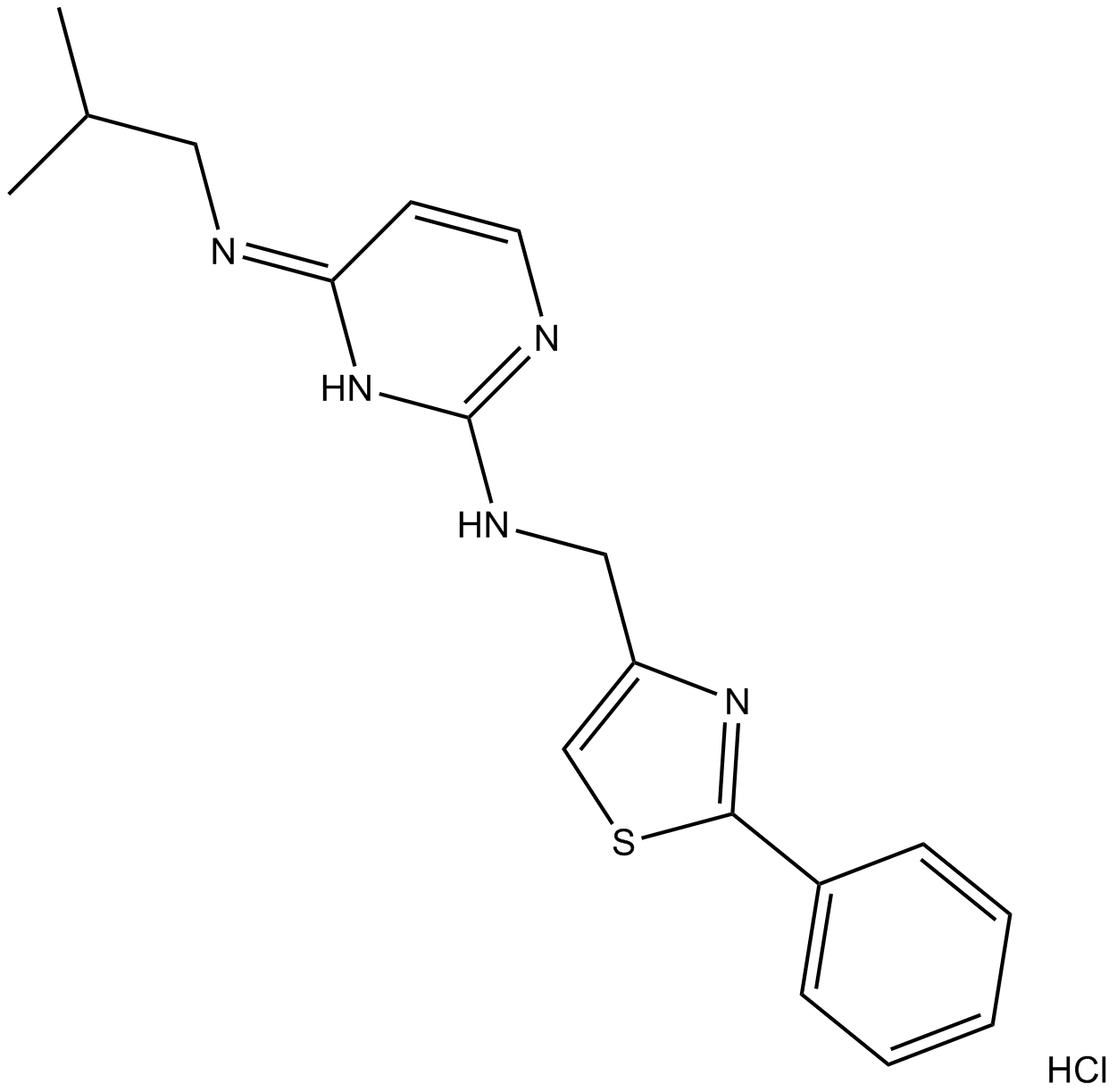
Cas No.: 1784282-12-7
Sample solution is provided at 25 µL, 10mM.
KHS101 hydrochloride could selectively induce a neuronal differentiation phenotype and interacts with transforming acidic coiled-coil-containing protein 3 (TACC3).
KHS101 increases neuronal differentiation of adherently cultured rat NPCs in a dose-dependent fashion (EC50 ~1 μM). KHS101-induced neuron formation (40-60% TuJ1+ cells at 1.5–5 μM KHS101) is also observed under neurosphere-forming conditions in secondary neurospheres derived from both the hippocampus and the subventricular zone (SVZ) of adult rats. Moreover, hippocampal NPCs treated with KHS101 and cultured adherently on microelectrode arrays for 12 d exhibit neuronal morphologies as well as spontaneous spiking activity, hence indicating the presence of functional, maturing neurons[1]. KHS101 markedly attenuates tumor cell growth as compared to the cells treated with the vehicle [dimethyl sulfoxide (DMSO)]. TACC3 is a known target of KHS101 in rodent neural progenitor cells. KHS101 has been shown to cause cellular destabilization of TACC3, hence reducing endogenous TACC3 protein levels over time [2].
Tumor cell proliferation is markedly reduced in KHS101-treated tumors (about twofold). KHS101-treated tumors show signs of elevated cell death (reduced cellularity/increased pyknosis) compared with tumors treated with vehicle control. KHS101 treatment markedly reduces both frontal-to-caudal tumor expansion and corpus callosum invasion of vimentin-positive GBM1 cells. It is also found that the survival of animals carrying GBMX1 tumors (established 2 or 6 weeks before treatment) is markedly increased by the KHS101 treatment regimen for 10 weeks. None of the mice have to be removed from the study because of adverse side effects of the treatment. An additional experiment using a continuous KHS101 treatment regimen until the experimental endpoints also shows a marked increase in the survival of GBMX1-bearing animals. Histological endpoint analysis of KHS101- and vehicle-treated animals confirms a significantly decreased tumor size in KHS101-treated mice[2].
References:
[1]. Wurdak H, et al. A small molecule accelerates neuronal differentiation in the adult rat. Proc Natl Acad Sci U S A. 2010 Sep 21;107(38):16542-7.
[2]. Polson ES, et al. KHS101 disrupts energy metabolism in human glioblastoma cells and reduces tumor growth in mice. Sci Transl Med. 2018 Aug 15;10(454). pii: eaar2718.
|
Animal experiment: |
Rats[2]Xenograft tumors in rats are allowed to establish for 6 weeks after injection of GBM1 cells (1×10⁵ cells) into the forebrain striatum and treated with vehicle or KHS101 for 10 days [6 mg/kg, subcutaneously (sc), twice daily]. To examine whether the observed mitochondrial/redox anomaly is associated with reduced tumor progression, the KHS101 dosing regimen from previous neurogenesis work in rats is adapted using a 10-week tumor treatment strategy (6 mg/kg, sc, twice a day, and biweekly treatment alternating five and three treatment days per week)[2]. |
|
References: [1]. Wurdak H, et al. A small molecule accelerates neuronal differentiation in the adult rat. Proc Natl Acad Sci U S A. 2010 Sep 21;107(38):16542-7. |
|
| Cas No. | 1784282-12-7 | SDF | |
| Chemical Name | (E)-6-(isobutylimino)-N-((2-phenylthiazol-4-yl)methyl)-1,6-dihydropyrimidin-2-amine hydrochloride | ||
| Canonical SMILES | CC(C/N=C(N1)\C=CN=C1NCC2=CSC(C3=CC=CC=C3)=N2)C.Cl | ||
| Formula | C18H21N5S.HCl | M.Wt | 375.92 |
| Löslichkeit | <18.8mg/ml in DMSO; <18.8mg/ml in ethanol | Storage | Store at 2-8°C |
| General tips | Please select the appropriate solvent to prepare the stock solution according to the
solubility of the product in different solvents; once the solution is prepared, please store it in
separate packages to avoid product failure caused by repeated freezing and thawing.Storage method
and period of the stock solution: When stored at -80°C, please use it within 6 months; when stored
at -20°C, please use it within 1 month. To increase solubility, heat the tube to 37°C and then oscillate in an ultrasonic bath for some time. |
||
| Shipping Condition | Evaluation sample solution: shipped with blue ice. All other sizes available: with RT, or with Blue Ice upon request. | ||
| Prepare stock solution | |||

|
1 mg | 5 mg | 10 mg |
| 1 mM | 2.6601 mL | 13.3007 mL | 26.6014 mL |
| 5 mM | 532 μL | 2.6601 mL | 5.3203 mL |
| 10 mM | 266 μL | 1.3301 mL | 2.6601 mL |
Step 1: Enter information below (Recommended: An additional animal making an allowance for loss during the experiment)
 g
μL
g
μL
Step 2: Enter the in vivo formulation (This is only the calculator, not formulation. Please contact us first if there is no in vivo formulation at the solubility Section.)
Calculation results:
Working concentration: mg/ml;
Method for preparing DMSO master liquid: mg drug pre-dissolved in μL DMSO ( Master liquid concentration mg/mL, Please contact us first if the concentration exceeds the DMSO solubility of the batch of drug. )
Method for preparing in vivo formulation: Take μL DMSO master liquid, next addμL PEG300, mix and clarify, next addμL Tween 80, mix and clarify, next add μL saline, mix and clarify.
Method for preparing in vivo formulation: Take μL DMSO master liquid, next add μL Corn oil, mix and clarify.
Note: 1. Please make sure the liquid is clear before adding the next solvent.
2. Be sure to add the solvent(s) in order. You must ensure that the solution obtained, in the previous addition, is a clear solution before proceeding to add the next solvent. Physical methods such as vortex, ultrasound or hot water bath can be used to aid dissolving.
3. All of the above co-solvents are available for purchase on the GlpBio website.
Quality Control & SDS
- View current batch:
- Purity: >98.00% Appearance: A jelly
- COA (Certificate of Analysis)
- SDS (Safety Data Sheet)
- Datasheet
Average Rating: 5 (Based on Reviews and 1 reference(s) in Google Scholar.)