

Luzindole (Synonyms: N-0774) |
Katalog-Nr.GC17898
 One-Click Copy Product Info
|

Luzindole (N-0774) ist ein selektiver Melatonin-Rezeptor-Antagonist.
Products are for research use only. Not for human use. We do not sell to patients.
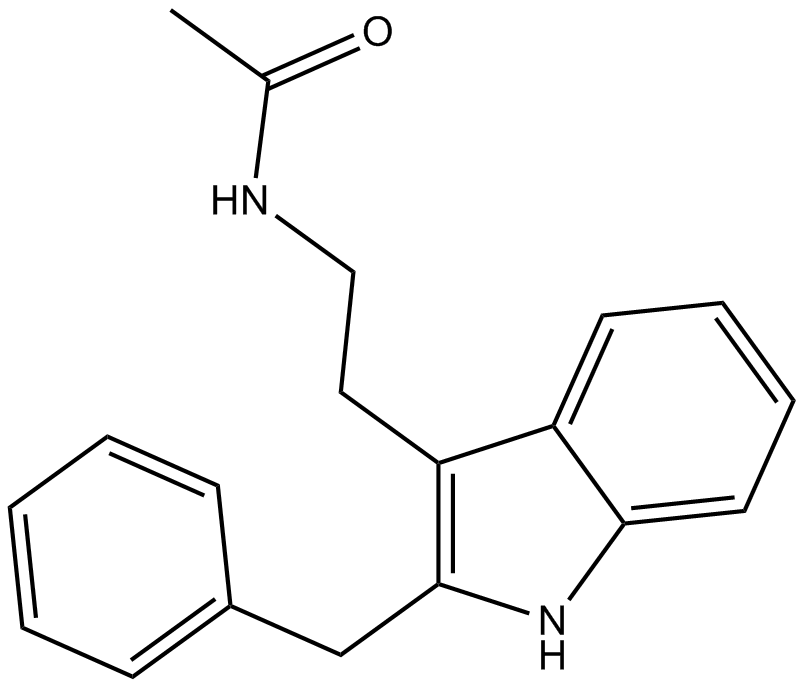
Cas No.: 117946-91-5
Sample solution is provided at 25 µL, 10mM.
_1-3.$$$39978408@51.jpg');)
_1-9.$$$38538795@65.jpg');)
_1-9.$$$39112701@51.jpg');)
_1-7.$$$37316672@70.jpg');)
_366-372.$$$36198801@70.jpg');)
.$$$38565142@65.jpg');)
_1867-1883.$$$33248023@67.jpg');)
_eads6055.$$$39977546@45.jpg');)
_eadm9805.$$$40080571@45.jpg');)
_eadj3020.$$$39666821@45.jpg');)
_1-20.$$$39757301@28.jpg');)
_1-24.$$$38898113@28.jpg');)
_273-287.$$$36806353@46.jpg');)
_1-16.$$$37156877@44.jpg');)
_1-19.$$$37460805@44.jpg');)
_1291-1307.$$$34518654@46.jpg');)
Luzindole is a selective melatonin receptor (MT) antagonist, with a Ki value of 158nM for MT1 and 10.2nM for MT2[1]. Luzindole preferentially acts on the MT2 (Mel1b) receptor[2]. Luzindole can be used to evaluate the role of melatonin receptor signaling in various pathways, including circadian rhythms, animal behavior, and melanocyte responses, both in vitro and in vivo[3]. Luzindole can also inhibit experimental autoimmune encephalomyelitis (EAE) and has antidepressant effects[4].
In vitro, Luzindole (200μM) pre-treatment of Cal27 tongue squamous cell carcinoma cells for 2 hours, followed by co-incubation with 2mM melatonin for 24 hours, blocked the promotion of melatonin on TFE3 (transcription factor E3) dephosphorylation and nuclear translocation, thereby inhibiting the autophagy process and increasing Caspase-3 activity[5]. Luzindole (10nM, 100nM, and 100mM) pre-treatment of estrogen receptor-positive Ishikawa endometrial cancer cells for 96 hours, followed by co-incubation with 1nM melatonin, completely blocked the inhibitory effect of melatonin on cell proliferation[6].
In vivo, Luzindole (0.35mg/kg) alone or in combination with lipopolysaccharide (LPS, 1.25mg/kg), administered by intraperitoneal injection to Swiss mice for 1.5 hours, can induce intestinal inflammation and morphological changes. Luzindole treatment alone led to shortened villus height, reduced goblet cell count, increased levels of non-protein sulfhydryls (NP-SHs), and decreased catalase (CAT) activity[7]. Luzindole (40mg/kg), administered by intraperitoneal injection in an LPS/D-GalN-induced acute liver injury mouse model, significantly alleviated histological damage in the liver, reduced plasma levels of transaminases, and improved mouse survival rates. Luzindole also inhibited the production of pro-inflammatory cytokines TNF-α and IL-6, and the activation of caspase-3, -8, and -9, as well as the cleavage of caspase-3 and PARP, thereby attenuating LPS/D-GalN-induced hepatocyte apoptosis[8].
References:
[1] Chan KH, Wong YH. A molecular and chemical perspective in defining melatonin receptor subtype selectivity. Int J Mol Sci. 2013 Sep 6;14(9):18385-406.
[2] Teh MT, Sugden D. Comparison of the structure-activity relationships of melatonin receptor agonists and antagonists: lengthening the N-acyl side-chain has differing effects on potency on Xenopus melanophores. Naunyn Schmiedebergs Arch Pharmacol. 1998 Nov;358(5):522-8.
[3] Gengatharan A, Malvaut S, Marymonchyk A, et al. Adult neural stem cell activation in mice is regulated by the day/night cycle and intracellular calcium dynamics. Cell. 2021 Feb 4;184(3):709-722.e13.
[4] Constantinescu CS, Hilliard B, Ventura E, et al. Luzindole, a melatonin receptor antagonist, suppresses experimental autoimmune encephalomyelitis. Pathobiology. 1997;65(4):190-4.
[5] Fan T, Pi H, Li M, et al. Inhibiting MT2-TFE3-dependent autophagy enhances melatonin-induced apoptosis in tongue squamous cell carcinoma. J Pineal Res. 2018 Mar;64(2).
[6] Kanishi Y, Kobayashi Y, Noda S, et al. Differential growth inhibitory effect of melatonin on two endometrial cancer cell lines. J Pineal Res. 2000 May;28(4):227-33.
[7] Matos RS, Oriá RB, Bruin PFC, et al. Acute blockade of endogenous melatonin by Luzindole, with or without peripheral LPS injection, induces jejunal inflammation and morphological alterations in Swiss mice. Braz J Med Biol Res. 2021 Aug 20;54(11):e11215.
[8] Luo Y, Yang Y, Shen Y, et al. Luzindole attenuates LPS/d-galactosamine-induced acute hepatitis in mice. Innate Immun. 2020 May;26(4):319-327.
| Cell experiment [1]: | |
Cell lines | Cal27 cells (human tongue squamous cell carcinoma cell line) |
Preparation Method | Cal27 cells were maintained in Dulbecco's modified Eagle's medium (DMEM) supplemented with 10% fetal bovine serum (FBS) at 37°C, 5% CO₂. Luzindole (200μM) was used to pre-treat Cal27 cells for 2 hours, followed by the addition of melatonin (2mM) for 24 hours. |
Reaction Conditions | 200μM; 2 hours |
Applications | Luzindole partially blocked the melatonin-induced enhancement of TFE3 dephosphorylation and nuclear translocation. Luzindole also inhibited the increase in TFE3 transcriptional activity and autophagy-related gene expression. Additionally, Luzindole increased caspase-3 activity, indicating that it sensitized Cal27 cells to melatonin-induced apoptosis by inhibiting the MT2-TFE3-dependent autophagy pathway. |
| Animal experiment [2]: | |
Animal models | BALB/c mice |
Preparation Method | Mice were divided into four groups: control (solvent injection), Luzindole (40mg/kg, i.p.), LPS/D-GalN (LPS 10μg/kg + D-GalN 700mg/kg, i.p.), and Luzindole + LPS/D-GalN (Luzindole 30 minutes before LPS/D-GalN). Mice were sacrificed at different time points (1.5 hours, 6 hours, and 7 days) for plasma and liver tissue analysis. |
Dosage form | 40mg/kg; i.p. |
Applications | Luzindole treatment significantly alleviated LPS/D-GalN-induced liver injury, as evidenced by reduced levels of plasma transaminases (ALT and AST), decreased histological damage in liver tissue, and improved survival rates. Additionally, Luzindole suppressed the production of pro-inflammatory cytokines (TNF-α and IL-6) and inhibited hepatocyte apoptosis by reducing caspase-3, -8, and -9 activities and cleavage of caspase-3 and PARP. |
References: | |
| Cas No. | 117946-91-5 | SDF | |
| Überlieferungen | N-0774 | ||
| Chemical Name | N-(2-(2-benzyl-1H-indol-3-yl)ethyl)acetamide | ||
| Canonical SMILES | O=C(C)NCCC1=C(CC2=CC=CC=C2)NC3=CC=CC=C13 | ||
| Formula | C19H20N2O | M.Wt | 292.38 |
| Löslichkeit | 20mg/mL in DMSO, 30mg/mL in DMF, 30mg/mL in Ethanol | Storage | Store at -20°C |
| General tips | Please select the appropriate solvent to prepare the stock solution according to the
solubility of the product in different solvents; once the solution is prepared, please store it in
separate packages to avoid product failure caused by repeated freezing and thawing.Storage method
and period of the stock solution: When stored at -80°C, please use it within 6 months; when stored
at -20°C, please use it within 1 month. To increase solubility, heat the tube to 37°C and then oscillate in an ultrasonic bath for some time. |
||
| Shipping Condition | Evaluation sample solution: shipped with blue ice. All other sizes available: with RT, or with Blue Ice upon request. | ||
| Prepare stock solution | |||

|
1 mg | 5 mg | 10 mg |
| 1 mM | 3.4202 mL | 17.101 mL | 34.2021 mL |
| 5 mM | 684 μL | 3.4202 mL | 6.8404 mL |
| 10 mM | 342 μL | 1.7101 mL | 3.4202 mL |
Step 1: Enter information below (Recommended: An additional animal making an allowance for loss during the experiment)
 g
μL
g
μL
Step 2: Enter the in vivo formulation (This is only the calculator, not formulation. Please contact us first if there is no in vivo formulation at the solubility Section.)
Calculation results:
Working concentration: mg/ml;
Method for preparing DMSO master liquid: mg drug pre-dissolved in μL DMSO ( Master liquid concentration mg/mL, Please contact us first if the concentration exceeds the DMSO solubility of the batch of drug. )
Method for preparing in vivo formulation: Take μL DMSO master liquid, next addμL PEG300, mix and clarify, next addμL Tween 80, mix and clarify, next add μL saline, mix and clarify.
Method for preparing in vivo formulation: Take μL DMSO master liquid, next add μL Corn oil, mix and clarify.
Note: 1. Please make sure the liquid is clear before adding the next solvent.
2. Be sure to add the solvent(s) in order. You must ensure that the solution obtained, in the previous addition, is a clear solution before proceeding to add the next solvent. Physical methods such as vortex, ultrasound or hot water bath can be used to aid dissolving.
3. All of the above co-solvents are available for purchase on the GlpBio website.
Quality Control & SDS
- View current batch:
- Purity: >98.00% Appearance: A solid
- COA (Certificate of Analysis)
- SDS (Safety Data Sheet)
- Datasheet
Average Rating: 5 (Based on Reviews and 32 reference(s) in Google Scholar.)