

ML334 (Synonyms: LH601) |
Katalog-Nr.GC38819
 One-Click Copy Product Info
|

ML334 ist ein potenter, zellpermeabler Aktivator von NFR2.
Products are for research use only. Not for human use. We do not sell to patients.
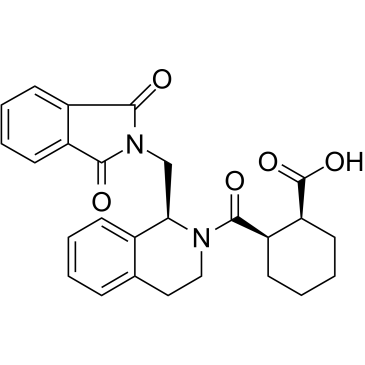
Cas No.: 1432500-66-7
Sample solution is provided at 25 µL, 10mM.
_1-3.$$$39978408@51.jpg');)
_1-9.$$$38538795@65.jpg');)
_1-9.$$$39112701@51.jpg');)
_1-7.$$$37316672@70.jpg');)
_366-372.$$$36198801@70.jpg');)
.$$$38565142@65.jpg');)
_1867-1883.$$$33248023@67.jpg');)
_eads6055.$$$39977546@45.jpg');)
_eadm9805.$$$40080571@45.jpg');)
_eadj3020.$$$39666821@45.jpg');)
_1-20.$$$39757301@28.jpg');)
_1-24.$$$38898113@28.jpg');)
_273-287.$$$36806353@46.jpg');)
_1-16.$$$37156877@44.jpg');)
_1-19.$$$37460805@44.jpg');)
_1291-1307.$$$34518654@46.jpg');)
ML334 ist ein potenter, zellpermeabler Aktivator von NFR2. Es wird durch die Hemmung der Keap1-NFR2-Protein-Protein-Interatktion erreicht. Es zeigt eine Bindungsaffinität zu Keap1 mit einer Dissoziationskonstante (Kd) von 1 μM in kompetitiven Oberflächenplassmonresonanz-Assays (SPR). Darüber hinaus konkurriert ML334 mit einem Mrf2-Peptid und weist in Fluoreszenzpolarisations-(FP-) Assays einen IC50 von 1.6 μM auf[1-3].
ML334(100 μM; 3 Stunden) induziert die Expression und nukleare Translokation von nuklearem Faktor (Erythroid-derived 2)-like 2 (NRF2) in HEK293-Zellen. In der Zwischenzeit induzierte die ML334-Behandlung die Expression von HO1-und TRX1-Proteinen in HEK293-Zellen[4].ML334-induzierte (50 μM; 48 Stunden) Überrexpression von Nrf2 verstärkt die antifibrotsiche Wirkung von Panaxatriol-Saponin (PTS) in kardialen Fibroblasten[5].
[1]. Hu L, Magesh S, Chen L, Wang L, Lewis TA, Chen Y, Khodier C, Inoyama D, Beamer LJ, Emge TJ, Shen J, Kerrigan JE, Kong AN, Dandapani S, Palmer M, Schreiber SL, Munoz B. et,al. Discovery of a small-molecule inhibitor and cellular probe of Keap1-Nrf2 protein-protein interaction. Bioorg Med Chem Lett. 2013 May 15;23(10):3039-43. doi: 10.1016/j.bmcl.2013.03.013. Epub 2013 Mar 14. PMID: 23562243; PMCID: PMC3648997.
[2]. Shen J, Magesh S, et,al. Enantiomeric characterization and structure elucidation of LH601A using vibrational circular dichroism spectroscopy. Spectrochim Acta A Mol Biomol Spectrosc. 2018 Mar 5;192:312-317. doi: 10.1016/j.saa.2017.11.033. Epub 2017 Nov 21. PMID: 29172127; PMCID: PMC10544735.
[3]. Wang L, Lewis T. et,al. The identification and characterization of non-reactive inhibitor of Keap1-Nrf2 interaction through HTS using a fluorescence polarization assay. 2012 Dec 17 [updated 2013 Sep 16]. In: Probe Reports from the NIH Molecular Libraries Program [Internet]. Bethesda (MD): National Center for Biotechnology Information (US); 2010–. PMID: 24260785.
[4]. Wen X, Thorne G, et,al. Activation of NRF2 Signaling in HEK293 Cells by a First-in-Class Direct KEAP1-NRF2 Inhibitor. J Biochem Mol Toxicol. 2015 Jun;29(6):261-6. doi: 10.1002/jbt.21693. Epub 2015 Feb 12. PMID: 25683455; PMCID: PMC4713195.
[5]. Yao H, He Q, et,al. Panaxatriol saponin ameliorates myocardial infarction-induced cardiac fibrosis by targeting Keap1/Nrf2 to regulate oxidative stress and inhibit cardiac-fibroblast activation and proliferation. Free Radic Biol Med. 2022 Sep;190:264-275. doi: 10.1016/j.freeradbiomed.2022.08.016. Epub 2022 Aug 14. Erratum in: Free Radic Biol Med. 2023 Jun;202:34. PMID: 35977659.
| Zellexperiment [1]: | |
Zelllinien | HEK293-Zellen |
Vorbereitungsmethode | Die Zellen wurden 3 Stunden lang mit ML334 behandelt. |
Reaktionsbedingungen | 100 μM; 3 Stunden |
Anwendungen | ML334 verbessert die Expression und nukleare Translokation von nuklearen Faktor (Erythroid-derived 2)-Like 2 (NFR2) in HEK293-Zellen. |
| Tierversuch [2]: | |
Tiermodelle | |
Vorbereitungsmethode | Ein biotinyliertes 16mer-Peptid aus der Keap1-Bindungsregion von Nrf2 wurde durch Streptavidin auf einer CM5-Chipoberfläche (300 RU) eingefangen. Eine Lösung, die 40 nM der Keich-Domäne des Keap1-Proteins enthält, wurde mit ML334 vorinkubiert und über die immobilisierte Nrf2-Peptidoberfläche injiziert. Der Assay wurde bei 25 ℃ mit einer Durchflussrate von 50 μL/min durchgefüht, was eine Assoziationszeit von 1 Minute und eine Dissoziationszeit von 3 Minuten ermöglicht. Die Sensorchipoberfläche wurde mit 1 M Nacl bei einer Durchflussrate von 100 μL/min für 1 Minute regeneriert, gefolgt von 2 aufeinander folgenden 1-minütigen Wäschen mit dem laufenden Puffer bei gleicher Durchflussrate. Das Bindungssignal von Keap1 an Nrf2 wurde aufgezeichnet. Die Konzentration von ungebundenem Keap1 wurde unter Verwendung seiner Standardkurve berechnet, und der Anteil von gebundenem Keap1 wurde gegen die Konzentration der Verbindungen aufgetragen. |
Dosierungsform | |
Anwendungen | In einem konpetitiven Oberflächenplasmonresonanz (SPR)-Assay bindet ML334 mit einem Kd von1 μM. |
References: | |
| Cas No. | 1432500-66-7 | SDF | |
| Überlieferungen | LH601 | ||
| Canonical SMILES | O=C(C1=CC=CC=C1C2=O)N2C[C@@H]3C4=CC=CC=C4CCN3C([C@H]5[C@H](CCCC5)C(O)=O)=O | ||
| Formula | C26H26N2O5 | M.Wt | 446.5 |
| Löslichkeit | DMSO: 44.65 mg/mL (100.00 mM); Ethanol: 44.65 mg/mL (100.00 mM) | Storage | Store at -20°C, stored under nitrogen |
| General tips | Please select the appropriate solvent to prepare the stock solution according to the
solubility of the product in different solvents; once the solution is prepared, please store it in
separate packages to avoid product failure caused by repeated freezing and thawing.Storage method
and period of the stock solution: When stored at -80°C, please use it within 6 months; when stored
at -20°C, please use it within 1 month. To increase solubility, heat the tube to 37°C and then oscillate in an ultrasonic bath for some time. |
||
| Shipping Condition | Evaluation sample solution: shipped with blue ice. All other sizes available: with RT, or with Blue Ice upon request. | ||
| Prepare stock solution | |||

|
1 mg | 5 mg | 10 mg |
| 1 mM | 2.2396 mL | 11.1982 mL | 22.3964 mL |
| 5 mM | 447.9 μL | 2.2396 mL | 4.4793 mL |
| 10 mM | 224 μL | 1.1198 mL | 2.2396 mL |
Step 1: Enter information below (Recommended: An additional animal making an allowance for loss during the experiment)
 g
μL
g
μL
Step 2: Enter the in vivo formulation (This is only the calculator, not formulation. Please contact us first if there is no in vivo formulation at the solubility Section.)
Calculation results:
Working concentration: mg/ml;
Method for preparing DMSO master liquid: mg drug pre-dissolved in μL DMSO ( Master liquid concentration mg/mL, Please contact us first if the concentration exceeds the DMSO solubility of the batch of drug. )
Method for preparing in vivo formulation: Take μL DMSO master liquid, next addμL PEG300, mix and clarify, next addμL Tween 80, mix and clarify, next add μL saline, mix and clarify.
Method for preparing in vivo formulation: Take μL DMSO master liquid, next add μL Corn oil, mix and clarify.
Note: 1. Please make sure the liquid is clear before adding the next solvent.
2. Be sure to add the solvent(s) in order. You must ensure that the solution obtained, in the previous addition, is a clear solution before proceeding to add the next solvent. Physical methods such as vortex, ultrasound or hot water bath can be used to aid dissolving.
3. All of the above co-solvents are available for purchase on the GlpBio website.
Quality Control & SDS
- View current batch:
- Purity: >98.00% Appearance: A solid
- COA (Certificate of Analysis)
- SDS (Safety Data Sheet)
- Datasheet
Average Rating: 5 (Based on Reviews and 16 reference(s) in Google Scholar.)