

Oleanolic acid (Synonyms: Astrantiagenin C, Caryophyllin, Giganteumgenin C, Gledigenin 1, NSC 114945, Oleanoic Acid, Virgaureagenin B) |
Katalog-Nr.GN10184
 One-Click Copy Product Info
|

Oleanolic acid ist ein natürliches pentazyklisches Triterpenoid, das für seine Wirksamkeit bei der Behandlung von Hepatitis bekannt ist.
Products are for research use only. Not for human use. We do not sell to patients.
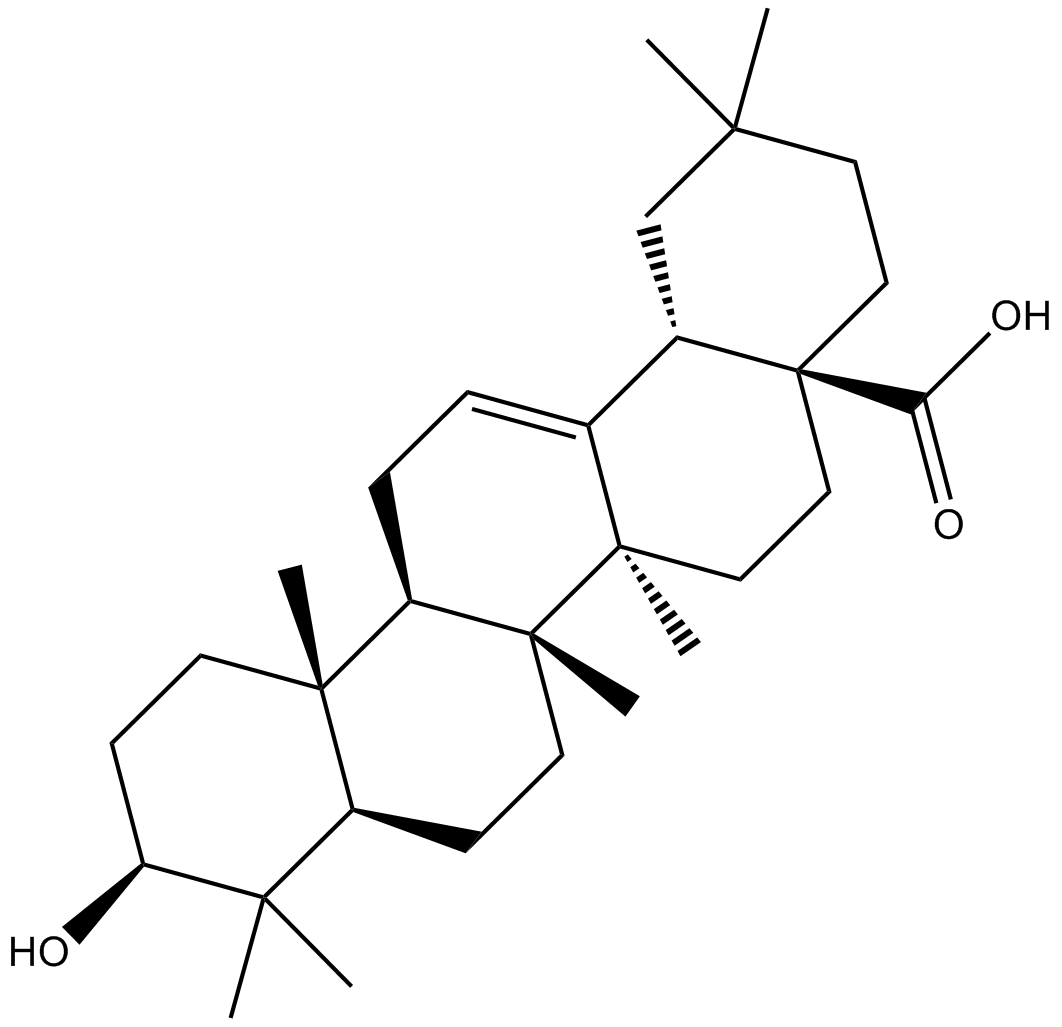
Cas No.: 508-02-1
Sample solution is provided at 25 µL, 10mM.
Oleanolic acid ist ein natürliches pentazyklisches Triterpenoid, das für seine Wirksamkeit bei der Behandlung von Hepatitis bekannt ist. Außerdem zeigt es antitumorale Wirkungen bei verschiedenen Krebsarten[1-3].
Oleanolic acid in Konzentrationen von 50 μM, 65 μM und 80 μM verstärkte bei Verabreichung über 24 oder 48 Stunden die Fähigkeit von Regorafenib, das Wachstum von PLC-Zellen zu hemmen, besonders bei Dosen von 65 μM oder 80 μM[4]. Oleanolic acid in Konzentrationen von 2 μM, 4 μM und 8 μM, verabreicht über 48 Stunden, wirkt als Aktivator von Nrf2. Sie zeigt eine dosisabhängige Abschwächunng der TGF-β1-induzierten epithelial-mesenchymalen Transition(EMT) in NRK-52E-Zellen[5]. Außerdem induziert Oleanolic acid in einer Konzentration von 50 μM nach 6-stündiger Anwendung die Prostacyclin-Freisetzung in menschlichen Koronar-Glattmuskelzellen(SMC) über einen Cox-2-abhängigen Mechanismus[6].
Oleanolic acid(50 mg/kg/d; i.g; 2 Wochen) wirkt in vivo anti-EMT und verstärkt die Antitumorwirkung von Regorafenib[4]. Oleanolic acid(10-100 mg/kg; ip) zeigte ein signifikantes antiepileptogenes Potenzial bei Pentylentetrazol-induzierten Anfällen[7].
References:
[1]. Pollier J, Goossens A. Oleanolic acid. Phytochemistry. 2012 May;77:10-5. doi: 10.1016/j.phytochem.2011.12.022. Epub 2012 Feb 28. PMID: 22377690.
[2]. Ma W, Wang DD, et,al. Caveolin-1 plays a key role in the oleanolic acid-induced apoptosis of HL-60 cells. Oncol Rep. 2014 Jul;32(1):293-301. doi: 10.3892/or.2014.3177. Epub 2014 May 15. PMID: 24842472.
[3]. Žiberna L, Šamec D, et,al. Oleanolic Acid Alters Multiple Cell Signaling Pathways: Implication in Cancer Prevention and Therapy. Int J Mol Sci. 2017 Mar 16;18(3):643. doi: 10.3390/ijms18030643. PMID: 28300756; PMCID: PMC5372655.
[4]. Wang H, Zhong W, et,al. Oleanolic Acid Inhibits Epithelial-Mesenchymal Transition of Hepatocellular Carcinoma by Promoting iNOS Dimerization. Mol Cancer Ther. 2019 Jan;18(1):62-74. doi: 10.1158/1535-7163.MCT-18-0448. Epub 2018 Oct 8. PMID: 30297361.
[5]. He WM, Yin JQ, et,al. Oleanolic acid attenuates TGF-β1-induced epithelial-mesenchymal transition in NRK-52E cells. BMC Complement Altern Med. 2018 Jul 4;18(1):205. doi: 10.1186/s12906-018-2265-y. PMID: 29973206; PMCID: PMC6031099.
[6]. Martínez-González J, Rodríguez-Rodríguez R, et,al. Oleanolic acid induces prostacyclin release in human vascular smooth muscle cells through a cyclooxygenase-2-dependent mechanism. J Nutr. 2008 Mar;138(3):443-8. doi: 10.1093/jn/138.3.443. PMID: 18287347.
[7]. Akünal Türel C, Yunusoğlu O. Oleanolic acid suppresses pentylenetetrazole-induced seizure in vivo. Int J Environ Health Res. 2023 May;33(5):529-540. doi: 10.1080/09603123.2023.2167947. Epub 2023 Feb 22. PMID: 36812380.
| Zellexperiment [1]: | |
Zelllinien | PLC-Zellen(Peritoneallymphozyten (PLC-PRF-5)) |
Vorbereitungsmethode | PLC-Zellen(5 × 10³ Zellen/mL) wurden in 96-Well-Kulturplatten ausgesät und 20 Stunden inkubiert. Dann wurden die Zellen entweder mit Lösungsmittel allein, oleanolic acid(in Konzentrationen von 50 μM, 65 μM und 80 μM), Regorafenib oder einer Kombination aus oleanolic acid und Regorafenib behandelt. Die Zellen wurden dann entweder 24 Stunden oder 48 Stunden inkubiert. |
Reaktionsbedingungen | 50, 65 und 80 μM; 24/48 Stunden |
Anwendungen | Oleanolic acid in Dosen von 65 μM oder 80 μM verstärkte die Wirksamkeit von Regorafenib bei der Unterdrückung des Wachstums von PLC-Zellen. |
| Tierversuch [1]: | |
Tiermodelle | 6-8 Wochen alte männliche BAlB/c nu/nu-Mäuse |
Vorbereitungsmethode | 1 × 10⁶ PLC-Zellen, suspendiert in PBS, wurden zur Inokulation subkutan in Mäuse injiziert, die dann nach dem Zufallsprinzip in vier Gruppen aufgeteilt wurden. Zwei Wochen nach der Inokulation erhielten die Versuchsgruppen für weitere zwei Wochen oral oleanolic acid (50 mg/kg täglich) und Regorafenib(10 mg/kg täglich) oder eine Kombination aus oleanolic acid (50 mg/kg täglich) und Regorafenib(10 mg/kg täglich). Die Kontrollgruppe erhielt für denselben Zeitraum die gleiche Menge Kochsalzlösung. |
Dosierungsform | 50 mg/kg/Tag; i.g; 2 Wochen |
Anwendungen | Die Behandlung mit Oleanolic acid hemmte das Tumorwachstum erheblich. Sie kann die Antitumorwirkung von Regorafenib verstärken. |
References: [1].Wang H, Zhong W, et,al. Oleanolic Acid Inhibits Epithelial-Mesenchymal Transition of Hepatocellular Carcinoma by Promoting iNOS Dimerization. Mol Cancer Ther. 2019 Jan;18(1):62-74. doi: 10.1158/1535-7163.MCT-18-0448. Epub 2018 Oct 8. PMID: 30297361. | |
| Cas No. | 508-02-1 | SDF | |
| Überlieferungen | Astrantiagenin C, Caryophyllin, Giganteumgenin C, Gledigenin 1, NSC 114945, Oleanoic Acid, Virgaureagenin B | ||
| Chemical Name | (4aS,6aR,6aS,6bR,8aR,10S,12aR,14bS)-10-hydroxy-2,2,6a,6b,9,9,12a-heptamethyl-1,3,4,5,6,6a,7,8,8a,10,11,12,13,14b-tetradecahydropicene-4a-carboxylic acid | ||
| Canonical SMILES | CC1(CCC2(CCC3(C(=CCC4C3(CCC5C4(CCC(C5(C)C)O)C)C)C2C1)C)C(=O)O)C | ||
| Formula | C30H48O3 | M.Wt | 456.71 |
| Löslichkeit | ≥ 16.6mg/mL in DMSO,ultrasonic solubilization | Storage | Store at 2-8°C |
| General tips | Please select the appropriate solvent to prepare the stock solution according to the
solubility of the product in different solvents; once the solution is prepared, please store it in
separate packages to avoid product failure caused by repeated freezing and thawing.Storage method
and period of the stock solution: When stored at -80°C, please use it within 6 months; when stored
at -20°C, please use it within 1 month. To increase solubility, heat the tube to 37°C and then oscillate in an ultrasonic bath for some time. |
||
| Shipping Condition | Evaluation sample solution: shipped with blue ice. All other sizes available: with RT, or with Blue Ice upon request. | ||
| Prepare stock solution | |||

|
1 mg | 5 mg | 10 mg |
| 1 mM | 2.1896 mL | 10.9479 mL | 21.8957 mL |
| 5 mM | 437.9 μL | 2.1896 mL | 4.3791 mL |
| 10 mM | 219 μL | 1.0948 mL | 2.1896 mL |
Step 1: Enter information below (Recommended: An additional animal making an allowance for loss during the experiment)
 g
μL
g
μL
Step 2: Enter the in vivo formulation (This is only the calculator, not formulation. Please contact us first if there is no in vivo formulation at the solubility Section.)
Calculation results:
Working concentration: mg/ml;
Method for preparing DMSO master liquid: mg drug pre-dissolved in μL DMSO ( Master liquid concentration mg/mL, Please contact us first if the concentration exceeds the DMSO solubility of the batch of drug. )
Method for preparing in vivo formulation: Take μL DMSO master liquid, next addμL PEG300, mix and clarify, next addμL Tween 80, mix and clarify, next add μL saline, mix and clarify.
Method for preparing in vivo formulation: Take μL DMSO master liquid, next add μL Corn oil, mix and clarify.
Note: 1. Please make sure the liquid is clear before adding the next solvent.
2. Be sure to add the solvent(s) in order. You must ensure that the solution obtained, in the previous addition, is a clear solution before proceeding to add the next solvent. Physical methods such as vortex, ultrasound or hot water bath can be used to aid dissolving.
3. All of the above co-solvents are available for purchase on the GlpBio website.
Quality Control & SDS
- View current batch:
- Purity: >98.00% Appearance: A solid
- COA (Certificate of Analysis)
- SDS (Safety Data Sheet)
- Datasheet
Average Rating: 5 (Based on Reviews and 30 reference(s) in Google Scholar.)