

Roblitinib (Synonyms: Roblitinib) |
Katalog-Nr.GC19154
 One-Click Copy Product Info
|

Roblitinib (FGF-401) ist ein 1,8-Naphthyridin-Pyridin-Derivat.
Products are for research use only. Not for human use. We do not sell to patients.
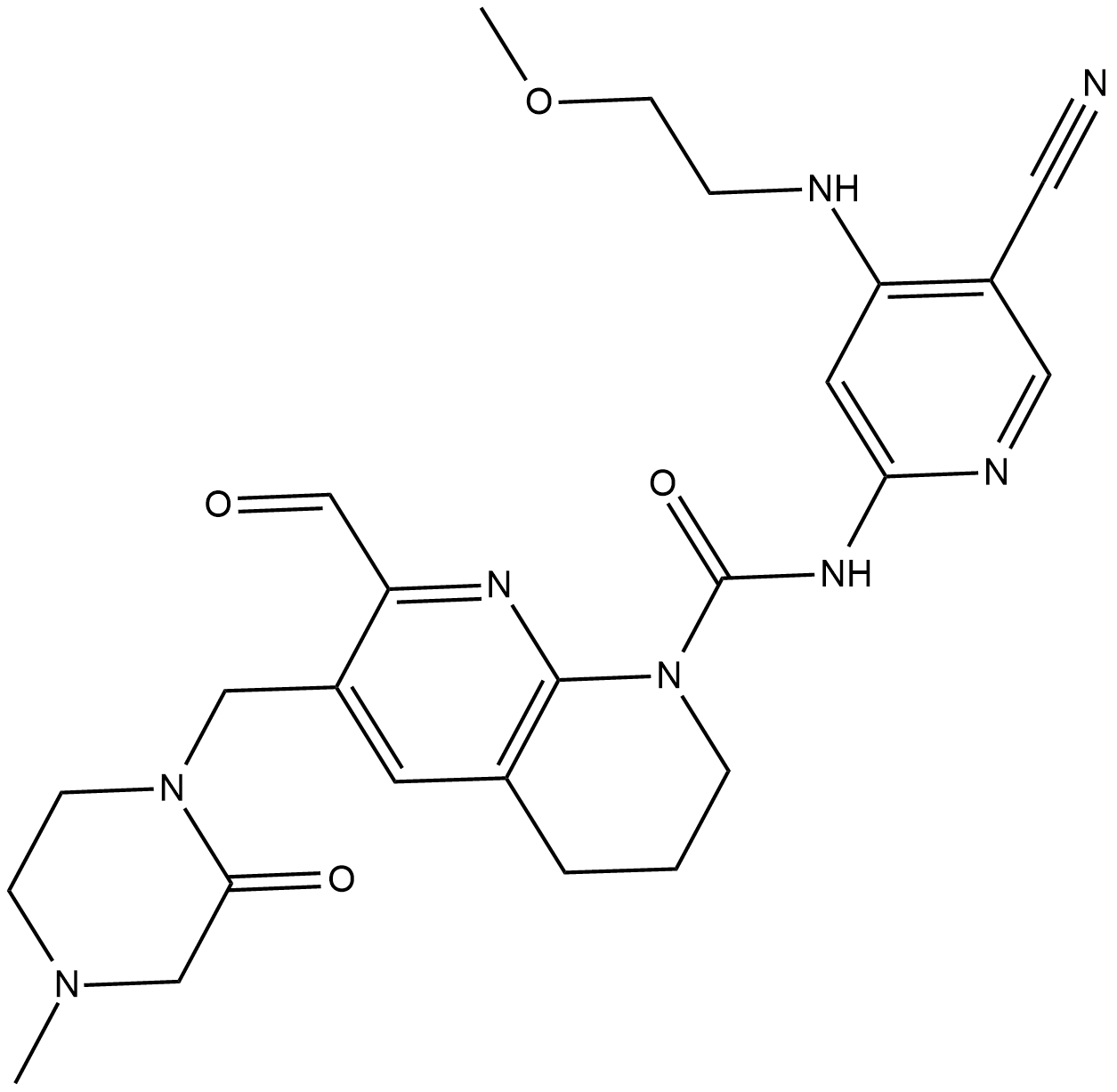
Cas No.: 1708971-55-4
Sample solution is provided at 25 µL, 10mM.
Roblitinib (FGF-401) ist ein 1,8-Naphthyridin-Pyridin-Derivat[5]. Roblitinib bindet an eine inaktive (autoinhibierte Bremse, geschlossenes Aktivierungssegment) DFG-Din-Enzymform; der Ligand bindet kovalent an FGFR4 und wird als Typ-VI-Inhibitor eingestuft[7].
Roblitinib ist ein oral aktiver und hochselektiver FGFR4-Inhibitor mit einer IC50 von 1,9 nM ohne Off-Target-Effekte[3]. Roblitinib hat eine antitumorale Wirkung[4].
Bei Mäusen führte die Behandlung mit PKM2-IN-1 im Vergleich zur Kontrollgruppe zu einer deutlichen Verringerung des Tumorvolumens und des Tumorgewichts. Bei den mit PKM2-IN-1 behandelten Mäusen wurde hingegen keine signifikante Gewichtsreduktion festgestellt, was darauf hindeutet, dass PKM2-IN-1 keine größeren Organtoxizitäten verursacht. Somit stellt die Verwendung spezifischer PKM2-Inhibitoren zur Blockierung des glykolytischen Stoffwechsels und zur gezielten Beeinflussung des Krebszellstoffwechsels einen vielversprechenden therapeutischen Ansatz für die Behandlung von PKM2-überexprimierendem Eierstockkrebs dar[6]. In Herzen von 7 Tage alten Mäusen blockierte der PKM2-spezifische Inhibitor PKM2-IN-1 die Proliferation von Kardiomyozyten in HRR-Gruppen signifikant, was darauf hindeutet, dass die HRR-induzierte Proliferation von Kardiomyozyten durch PKM2-IN-1 vollständig aufgehoben wurde[2].
References:
[1]: Zou Y, Zheng S, et,al. N6-methyladenosine regulated FGFR4 attenuates ferroptotic cell death in recalcitrant HER2-positive breast cancer. Nat Commun. 2022 May 13;13(1):2672. doi: 10.1038/s41467-022-30217-7. PMID: 35562334; PMCID: PMC9106694.
[2]: Chan SL, Schuler M, et,al. A first-in-human phase 1/2 study of FGF401 and combination of FGF401 with spartalizumab in patients with hepatocellular carcinoma or biomarker-selected solid tumors. J Exp Clin Cancer Res. 2022 Jun 2;41(1):189. doi: 10.1186/s13046-022-02383-5. PMID: 35655320; PMCID: PMC9161616.
[3]: National Center for Biotechnology Information (2022). PubChem Patent Summary for US-9266883-B2. Retrieved September 6, 2022 from https://pubchem.ncbi.nlm.nih.gov/patent/US-9266883-B2.
[4]: Fairhurst RA, Knoepfel T, et,al. Discovery of Roblitinib (FGF401) as a Reversible-Covalent Inhibitor of the Kinase Activity of Fibroblast Growth Factor Receptor 4. J Med Chem. 2020 Nov 12;63(21):12542-12573. doi: 10.1021/acs.jmedchem.0c01019. Epub 2020 Oct 1. PMID: 32930584.
[5]: Roskoski R Jr. The role of fibroblast growth factor receptor (FGFR) protein-tyrosine kinase inhibitors in the treatment of cancers including those of the urinary bladder. Pharmacol Res. 2020 Jan;151:104567. doi: 10.1016/j.phrs.2019.104567. Epub 2019 Nov 23. PMID: 31770593.
[6]: Zhou Z , Chen X , et,al. Characterization of FGF401 as a reversible covalent inhibitor of fibroblast growth factor receptor 4. Chem Commun (Camb). 2019 May 21;55(42):5890-5893. doi: 10.1039/c9cc02052g. PMID: 31041948.
[7]: Roskoski R Jr. Classification of small molecule protein kinase inhibitors based upon the structures of their drug-enzyme complexes. Pharmacol Res. 2016 Jan;103:26-48. doi: 10.1016/j.phrs.2015.10.021. Epub 2015 Oct 31. PMID: 26529477.
[8]: Weiss A, Adler F, et,al. FGF401, A First-In-Class Highly Selective and Potent FGFR4 Inhibitor for the Treatment of FGF19-Driven Hepatocellular Cancer. Mol Cancer Ther. 2019 Dec;18(12):2194-2206. doi: 10.1158/1535-7163.MCT-18-1291. Epub 2019 Aug 13. PMID: 31409633.
| Zellexperiment [1]: | |
Zelllinien | Hep3B, JHH7, und HUH7 cells |
Vorbereitungsmethode | Roblitinib wurde zu 10 mmol/L in 100 % DMSO gelöst, um es zu verwenden. |
Reaktionsbedingungen | Roblitinib 5nM,500nM für 1 Stunden-72 Stunden |
Anwendungen | Im Vergleich zu den anderen Behandlungsgruppen zeigte die mit Roblitinib behandelte Gruppe ein geringeres Tumorvolumen. Die Kombination von Roblitinib und anderen Medikamenten zeigte eine synergistische Antitumorwirkung bei Trastuzumab-resistentem Brustkrebs. |
| Tierversuch [2]: | |
Tiermodelle | Vier Wochen alte weibliche BALB/c Nacktmäuse |
Vorbereitungsmethode | Die mit 1:1 Matrigel gemischten Zellen wurden subkutan in die Fettpolster der Mäuse injiziert. Die Mäuse wurden nach dem Zufallsprinzip in vier Gruppen eingeteilt und mit Vehikel, Trastuzumab und Roblitinib (30 mg/kg, orale Verabreichung) behandelt. Das Tumorvolumen wurde alle 3 Tage gemessen. |
Dosierungsform | Roblitinib (30 mg/kg, orale Verabreichung) |
Anwendungen | Im Vergleich zu den anderen Behandlungsgruppen zeigte die mit Roblitinib behandelte Gruppe ein geringeres Tumorvolumen. Die Kombination von Roblitinib und anderen Medikamenten zeigte eine synergistische Antitumorwirkung bei Trastuzumab-resistentem Brustkrebs. |
References: | |
| Cas No. | 1708971-55-4 | SDF | |
| Überlieferungen | Roblitinib | ||
| Canonical SMILES | CN1CC(N(CC2=CC(CCCN3C(NC4=CC(NCCOC)=C(C#N)C=N4)=O)=C3N=C2C=O)CC1)=O | ||
| Formula | C25H30N8O4 | M.Wt | 506.56 |
| Löslichkeit | DMSO : 6 mg/mL (11.84 mM) | Storage | Store at -20°C |
| Shipping Condition | Evaluation sample solution: shipped with blue ice. All other sizes available: with RT, or with Blue Ice upon request. | ||
| Prepare stock solution | |||

|
1 mg | 5 mg | 10 mg |
| 1 mM | 1.9741 mL | 9.8705 mL | 19.741 mL |
| 5 mM | 394.8 μL | 1.9741 mL | 3.9482 mL |
| 10 mM | 197.4 μL | 987 μL | 1.9741 mL |
Step 1: Enter information below (Recommended: An additional animal making an allowance for loss during the experiment)
 g
μL
g
μL
Step 2: Enter the in vivo formulation (This is only the calculator, not formulation. Please contact us first if there is no in vivo formulation at the solubility Section.)
Calculation results:
Working concentration: mg/ml;
Method for preparing DMSO master liquid: mg drug pre-dissolved in μL DMSO ( Master liquid concentration mg/mL, Please contact us first if the concentration exceeds the DMSO solubility of the batch of drug. )
Method for preparing in vivo formulation: Take μL DMSO master liquid, next addμL PEG300, mix and clarify, next addμL Tween 80, mix and clarify, next add μL saline, mix and clarify.
Method for preparing in vivo formulation: Take μL DMSO master liquid, next add μL Corn oil, mix and clarify.
Note: 1. Please make sure the liquid is clear before adding the next solvent.
2. Be sure to add the solvent(s) in order. You must ensure that the solution obtained, in the previous addition, is a clear solution before proceeding to add the next solvent. Physical methods such as vortex, ultrasound or hot water bath can be used to aid dissolving.
3. All of the above co-solvents are available for purchase on the GlpBio website.
Quality Control & SDS
- View current batch:
- Purity: >99.00% Appearance: A solid
- COA (Certificate of Analysis)
- SDS (Safety Data Sheet)
- Datasheet
Average Rating: 5 (Based on Reviews and 9 reference(s) in Google Scholar.)