

Roblitinib (Synonyms: Roblitinib) |
Catalog No.GC19154
 One-Click Copy Product Info
|

Roblitinib is an orally active fibroblast growth factor receptor 4 (FGFR4) antagonist (IC50=1.9nM).
Products are for research use only. Not for human use. We do not sell to patients.
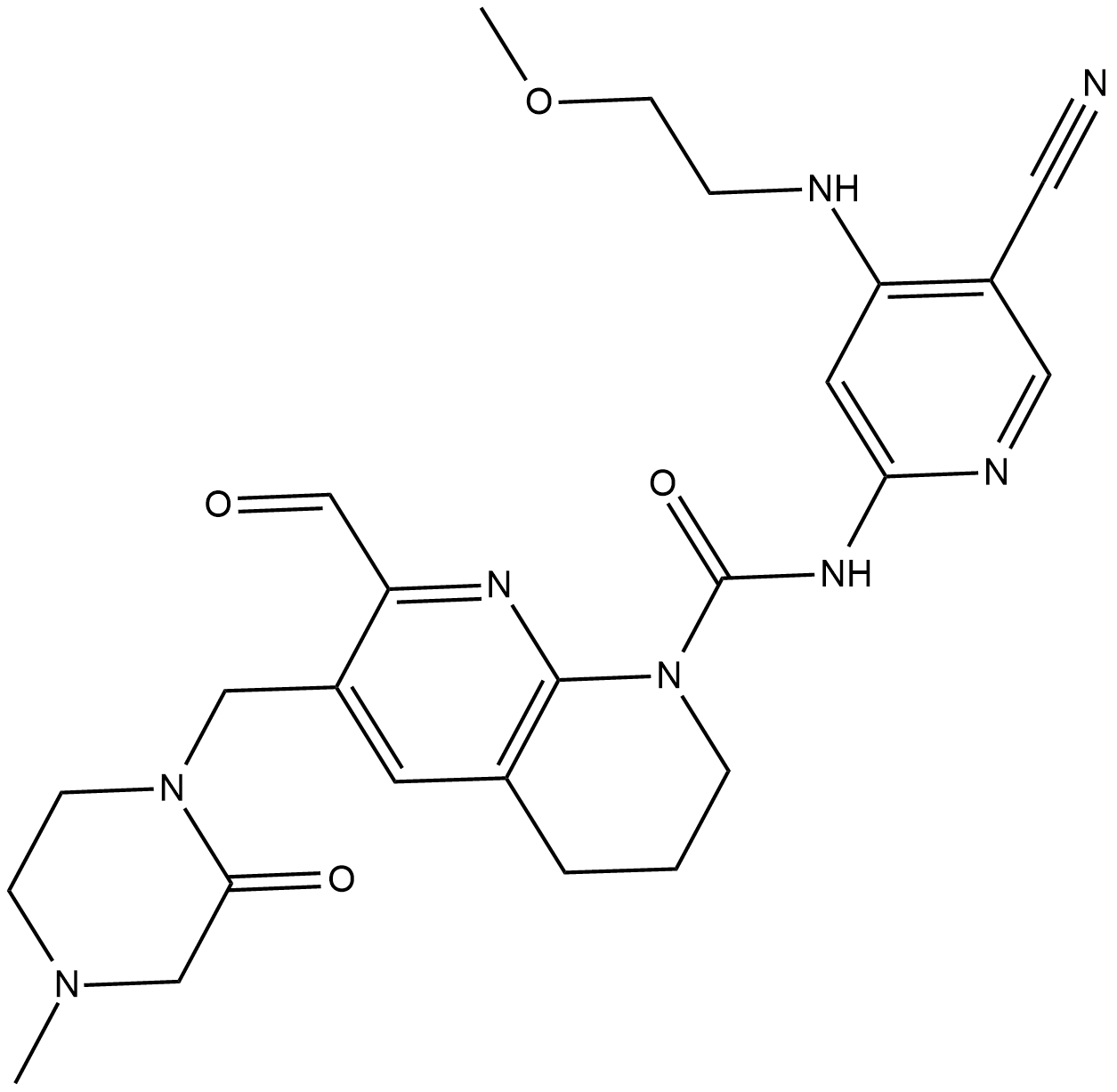
Cas No.: 1708971-55-4
Sample solution is provided at 25 µL, 10mM.
Roblitinib is an orally active fibroblast growth factor receptor 4 (FGFR4) antagonist (IC50=1.9nM). Roblitinib forms a reversible hemithioacetal covalent interaction with Cys552 in the ATP-binding site of the FGFR4 kinase domain, inhibits FGFR4 kinase activity and blocks the FGF19-FGFR4-βKlotho signaling axis. Roblitinib can be used in research related to hepatocellular carcinoma and solid tumors[1-4].
In vitro, treatment with 1μM Roblitinib for 24h caused G1 cell cycle arrest in HCC09-0913 cells[5]. Treatment with Roblitinib for 48h inhibited the viability, proliferation and migration ability of hepatoma cells (HepG2, Huh7)[6]. Treatment with Roblitinib (0.01-1000nM) for 6 days significantly inhibited FGFR4 V550L signaling and reduced cell viability in RD cells and RH30 cells[7].
In vivo, oral administration of Roblitinib (30mg/kg; twice daily for 21 days) to orthotopic xenograft mice carrying PAX3-FOXO1 or PAX7-FOXO1 fusion genes inhibited the proliferation and self-renewal capacity of alveolar rhabdomyosarcoma tumor cells[8]. Oral administration of Roblitinib (100mg/kg; twice daily) from day 7 to day 13 after bleomycin induction to C57BL/6N mice with pulmonary fibrosis did not change the extent of pulmonary fibrosis, lung hydroxyproline content, or mRNA levels of collagen, fibronectin and ACTA2 in lung tissue[9]. Oral administration of Roblitinib (30mg/kg; twice daily) for 9 consecutive days to SCID mice bearing subcutaneous human hepatocellular carcinoma PDX models (HCC09-0913; high expression of FGF19/FGFR4) inhibited tumor cell proliferation, induced G1 cell cycle arrest, normalized tumor vasculature and reduced tumor hypoxia. In the orthotopic transplantation model of HCC09-0913, oral administration of Roblitinib (30mg/kg; twice daily) for 28 consecutive days inhibited tumor growth and prolonged overall survival of mice[10].
References:
[1] Fairhurst RA, Knoepfel T, Buschmann N, et al. Discovery of Roblitinib (FGF401) as a Reversible-Covalent Inhibitor of the Kinase Activity of Fibroblast Growth Factor Receptor 4. J Med Chem. 2020;63(21):12542-12573.
[2] Huynh H, Ng WH. Reactivation of the PI3K/mTOR Signaling Pathway Confers Resistance to the FGFR4 Inhibitor FGF401. Int J Mol Sci. 2025 Oct 9;26(19):9818.
[3] Zhou Z, Chen X, Fu Y, et al. Characterization of FGF401 as a reversible covalent inhibitor of fibroblast growth factor receptor 4. Chem Commun. 2019;00:1-4.
[4] Schadt HS, Wolf A, Mahl JA, et al. Bile acid sequestration by cholestyramine mitigates FGFR4 inhibition-induced ALT elevation. Toxicol Sci. 2018;164(2):508-522.
[5] Huynh H, Prawira A, Le TBU, et al. FGF401 and vinorelbine synergistically mediate antitumor activity and vascular normalization in FGF19-dependent hepatocellular carcinoma. Exp Mol Med. 2020;52(11):1857-1868.
[6] Yang Y, Zhang Y, Cao J, et al. FGFR4 and EZH2 inhibitors synergistically induce hepatocellular carcinoma apoptosis via repressing YAP signaling. J Exp Clin Cancer Res. 2023 Apr 22;42(1):96.
[7] Fiorito E, Szybowska P, Haugsten EM, et al. Strategies to inhibit FGFR4 V550L-driven rhabdomyosarcoma. Br J Cancer. 2022;127(10):1939-1953.
[8] Kalita B, Martinez-Cebrian G, McEvoy J, et al. PAX translocations remodel mitochondrial metabolism through altered leucine usage in rhabdomyosarcoma. Cell. 2025 May 15;188(10):2757-2777.e22.
[9] Ghanem M, Justet A, Jaillet M, et al. Identification of FGFR4 as a regulator of myofibroblast differentiation in pulmonary fibrosis. Am J Physiol Lung Cell Mol Physiol. 2024;327(5):L818-L830.
[10] Tai DWM, Le TBU, Prawira A, et al. Targeted inhibition of FGF19/FGFR cascade improves antitumor immunity and response rate in hepatocellular carcinoma. Hepatology International. 2021;15(5):1236-1246.
| Cell experiment [1]: | |
|
Cell lines |
HCC09-0913 cells (human hepatocellular carcinoma cell line) |
|
Preparation Method |
HCC09-0913 cells were treated with Roblitinib at 1μM for 24h, followed by stimulation with 200ng/mL recombinant FGF19 for 30min. Cells were harvested for detection of FRS-2α and Erk1/2 phosphorylation via Western blot analysis. Cell cycle distribution was analyzed by flow cytometry. |
|
Reaction Conditions |
1μM; 24h |
|
Applications |
Roblitinib abolished FGF19-stimulated phosphorylation of FRS-2α and Erk1/2. Roblitinib increased the percentage of cells in the G1 and sub-G1 phases with a concomitant decrease in the percentage of cells in the G2/M and S phases. |
| Animal experiment [2]: | |
|
Animal models |
Orthotopic patient-derived xenograft (O-PDX) mice bearing PAX3-FOXO1 or PAX7-FOXO1 alveolar rhabdomyosarcoma |
|
Preparation Method |
Mice were orally administered Roblitinib at 30mg/kg twice daily for 21 days. Tumor burden was monitored weekly by bioluminescence imaging. In combination studies, mice were additionally treated with tigecycline or vincristine plus irinotecan. Tumor tissues were collected for immunohistochemical analysis of Ki67 positivity and cellularity. |
|
Dosage form |
30mg/kg; p.o.; twice daily for 21 days |
|
Applications |
Roblitinib inhibited the growth of alveolar rhabdomyosarcoma tumors in vivo and prolonged survival in PAX3-FOXO1 fusion-positive PDX models. Roblitinib combined with tigecycline synergistically suppressed tumor progression, with several PAX3-FOXO1 fusion-positive mice achieving complete responses. Roblitinib combined with vincristine and irinotecan further prolonged survival. Roblitinib plus tigecycline significantly reduced Ki67 positivity and cellularity in tumor tissues. |
References: [1] Huynh H, Prawira A, Le TBU, et al. FGF401 and vinorelbine synergistically mediate antitumor activity and vascular normalization in FGF19-dependent hepatocellular carcinoma. Exp Mol Med. 2020;52(11):1857-1868. [2] Kalita B, Martinez-Cebrian G, McEvoy J, et al. PAX translocations remodel mitochondrial metabolism through altered leucine usage in rhabdomyosarcoma. Cell. 2025 May 15;188(10):2757-2777.e22. | |
| Cas No. | 1708971-55-4 | SDF | |
| Synonyms | Roblitinib | ||
| Canonical SMILES | CN1CC(N(CC2=CC(CCCN3C(NC4=CC(NCCOC)=C(C#N)C=N4)=O)=C3N=C2C=O)CC1)=O | ||
| Formula | C25H30N8O4 | M.Wt | 506.56 |
| Solubility | DMSO : 6 mg/mL (11.84 mM) | Storage | Store at -20°C |
| Shipping Condition | Evaluation sample solution: shipped with blue ice. All other sizes available: with RT, or with Blue Ice upon request. | ||
| Prepare stock solution | |||

|
1 mg | 5 mg | 10 mg |
| 1 mM | 1.9741 mL | 9.8705 mL | 19.741 mL |
| 5 mM | 394.8 μL | 1.9741 mL | 3.9482 mL |
| 10 mM | 197.4 μL | 987 μL | 1.9741 mL |
Step 1: Enter information below (Recommended: An additional animal making an allowance for loss during the experiment)
 g
μL
g
μL
Step 2: Enter the in vivo formulation (This is only the calculator, not formulation. Please contact us first if there is no in vivo formulation at the solubility Section.)
Calculation results:
Working concentration: mg/ml;
Method for preparing DMSO master liquid: mg drug pre-dissolved in μL DMSO ( Master liquid concentration mg/mL, Please contact us first if the concentration exceeds the DMSO solubility of the batch of drug. )
Method for preparing in vivo formulation: Take μL DMSO master liquid, next addμL PEG300, mix and clarify, next addμL Tween 80, mix and clarify, next add μL saline, mix and clarify.
Method for preparing in vivo formulation: Take μL DMSO master liquid, next add μL Corn oil, mix and clarify.
Note: 1. Please make sure the liquid is clear before adding the next solvent.
2. Be sure to add the solvent(s) in order. You must ensure that the solution obtained, in the previous addition, is a clear solution before proceeding to add the next solvent. Physical methods such as vortex, ultrasound or hot water bath can be used to aid dissolving.
3. All of the above co-solvents are available for purchase on the GlpBio website.
Quality Control & SDS
- View current batch:
- Purity: >99.00% Appearance: A solid
- COA (Certificate of Analysis)
- SDS (Safety Data Sheet)
- Datasheet
Average Rating: 5 (Based on Reviews and 9 reference(s) in Google Scholar.)