

Sitostanol (Synonyms: 24α-ethyl Cholestanol, NSC 49081, β-Sitostanol, Stigmastanol) |
Katalog-Nr.GC18398
 One-Click Copy Product Info
|

Sitostanol ist das aus Hypericum riparium isolierte 6-Amino-Derivat.
Products are for research use only. Not for human use. We do not sell to patients.
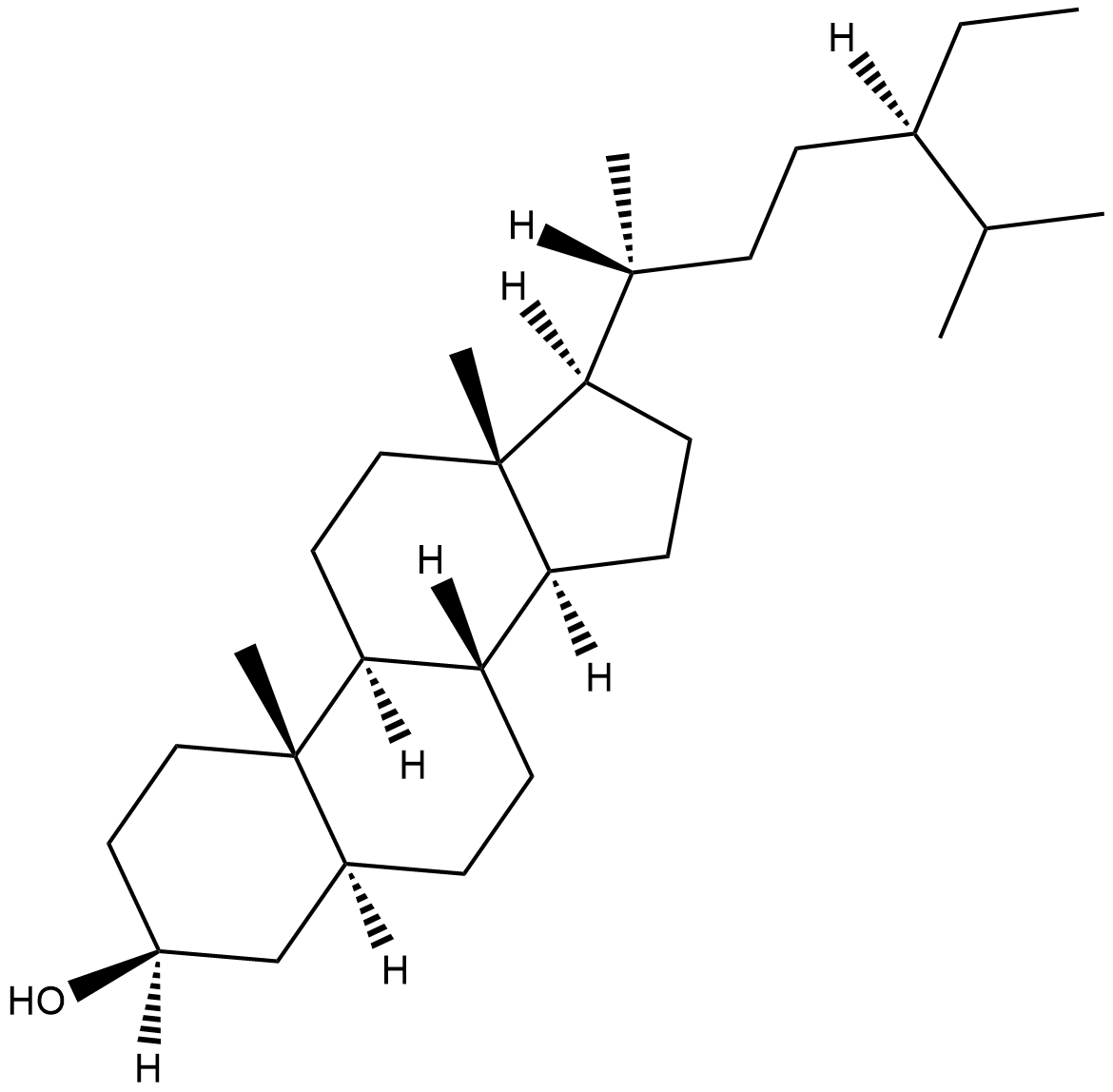
Cas No.: 83-45-4
Sample solution is provided at 25 µL, 10mM.
_1-3.$$$39978408@51.jpg');)
_1-9.$$$38538795@65.jpg');)
_1-9.$$$39112701@51.jpg');)
_1-7.$$$37316672@70.jpg');)
_366-372.$$$36198801@70.jpg');)
.$$$38565142@65.jpg');)
_1867-1883.$$$33248023@67.jpg');)
_eads6055.$$$39977546@45.jpg');)
_eadm9805.$$$40080571@45.jpg');)
_eadj3020.$$$39666821@45.jpg');)
_1-20.$$$39757301@28.jpg');)
_1-24.$$$38898113@28.jpg');)
_273-287.$$$36806353@46.jpg');)
_1-16.$$$37156877@44.jpg');)
_1-19.$$$37460805@44.jpg');)
_1291-1307.$$$34518654@46.jpg');)
Sitostanol is a metabolite of the common plant sterol sitosterol that can decrease micellar solubility of cholesterol [1]. Sitostanol can reduce intestinal absorption of cholesterol and positively affect cholesterol metabolism in intestinal epithelial cells [2]. Sitostanol can be used as a model compound to develop GC-MS methods for characterizing and quantifying the oxidation products of Sitostanol [3].
In vitro, Sitostanol (1.2µM) treatment of peripheral blood mononuclear cells (PBMCs) from asthma patients for 48 hours increased the number of Treg cells and promoted the secretion of IL-17 and IL-10[4]. Treatment with Sitostanol (1.2µM) for 24h significantly reduced maximal respiration in hepG2 cells at low glucose concentrations[5].
In vivo, Sitostanol treatment via oral administration at a dose of 0.64g/day for 10 weeks significantly reduced plasma cholesterol levels and inhibited the development of atherosclerosis in rabbits[6]. Daily oral administration of Sitostanol (2.25g/100g) for 4 weeks significantly reduced plasma low-density lipoprotein cholesterol (LDL-C) concentrations and altered hepatic cholesterol metabolism in guinea pigs[7].
References:
[1] Ikeda I, Tanabe Y, Sugano M. Effects of sitosterol and sitostanol on micellar solubility of cholesterol[J]. Journal of nutritional science and vitaminology, 1989, 35(4): 361-369.
[2] Plat J, Mensink R P. Plant stanol and sterol esters in the control of blood cholesterol levels: mechanism and safety aspects[J]. The American journal of cardiology, 2005, 96(1): 15-22.
[3] Soupas L, Juntunen L, Säynäjoki S, et al. GC‐MS method for characterization and quantification of sitostanol oxidation products[J]. Journal of the American Oil Chemists' Society, 2004, 81(2): 135-141.
[4] Brüll F, Mensink R P, Steinbusch M F, et al. Beneficial effects of sitostanol on the attenuated immune function in asthma patients: results of an in vitro approach[J]. 2012.
[5] Nascimento E B M, Konings M, Schaart G, et al. In vitro effects of sitosterol and sitostanol on mitochondrial respiration in human brown adipocytes, myotubes and hepatocytes[J]. European journal of nutrition, 2020, 59(5): 2039-2045.
[6] Ntanios F Y, Jones P J H, Frohlich J J. Dietary sitostanol reduces plaque formation but not lecithin cholesterol acyl transferase activity in rabbits[J]. Atherosclerosis, 1998, 138(1): 101-110.
[7] Ramjiganesh T, Roy S, McIntyre J C, et al. The hypocholesterolaemic effects of sitostanol in the guinea pig are in part related to changes in hepatic lipids and lipoprotein composition[J]. British journal of nutrition, 2001, 85(2): 165-172.
| Cell experiment [1]: | |
Cell lines | Peripheral blood mononuclear cells (PBMCs) |
Preparation Method | PBMCs were cultured in RPMI 1640, containing 25mM HEPES and L-glutamine, supplemented with 1% penicillin/streptomycin, 1% sodium pyruvate, and 1% human serum pool, heat-inactivated for 30 minutes at 56°C. PBMCs were seeded 1×10⁶/ml in 24-wells flat bottom culture plates. Cells were then incubated with 1.2µM Sitostanol for 48h for cytokine assays. |
Reaction Conditions | 1.2µM; 48h |
Applications | Sitostanol treatment enhanced the levels of IL-10 and IL-17 in PBMCs. |
| Animal experiment [2]: | |
Animal models | Male Hartley guinea pigs |
Preparation Method | Fifty male Hartley guinea pigs, weighing between 300 and 400g, were randomly assigned to one of the 2 dietary groups (ten per group). One group received Sitostanol 2.5g/100g/day. The control group fed a low-cholesterol diet. Two guinea pigs were kept per metal cage and were housed in a light cycle room (light from 07:00 to 19:00) with a temperature of 23℃ for a period of 4 weeks. The guinea pigs had free access to diet and water. Animals were killed by cardiac puncture after halothane anaesthesia, and blood was collected to analyze plasma lipoproteins for characterization. Liver was harvested to determine hepatic lipids. |
Dosage form | 2.5g/100g/day for 4 weeks; p.o. |
Applications | Sitostanol treatment significantly reduced plasma LDL-C concentrations and altered hepatic cholesterol metabolism in guinea pigs. |
References: | |
| Cas No. | 83-45-4 | SDF | |
| Überlieferungen | 24α-ethyl Cholestanol, NSC 49081, β-Sitostanol, Stigmastanol | ||
| Chemical Name | (5α)-stigmastan-3β-ol | ||
| Canonical SMILES | CC(C)[C@H](CC)CC[C@@H](C)[C@@]1([H])CC[C@@]2([H])[C@]3([H])CC[C@@]4([H])C[C@@H](O)CC[C@]4(C)[C@@]3([H])CC[C@@]21C | ||
| Formula | C29H52O | M.Wt | 416.7 |
| Löslichkeit | Ethanol : 5 mg/mL (12.00 mM; Need ultrasonic); DMSO : < 1 mg/mL (insoluble or slightly soluble) | Storage | Store at -20°C |
| General tips | Please select the appropriate solvent to prepare the stock solution according to the
solubility of the product in different solvents; once the solution is prepared, please store it in
separate packages to avoid product failure caused by repeated freezing and thawing.Storage method
and period of the stock solution: When stored at -80°C, please use it within 6 months; when stored
at -20°C, please use it within 1 month. To increase solubility, heat the tube to 37°C and then oscillate in an ultrasonic bath for some time. |
||
| Shipping Condition | Evaluation sample solution: shipped with blue ice. All other sizes available: with RT, or with Blue Ice upon request. | ||
| Prepare stock solution | |||

|
1 mg | 5 mg | 10 mg |
| 1 mM | 2.3998 mL | 11.999 mL | 23.9981 mL |
| 5 mM | 480 μL | 2.3998 mL | 4.7996 mL |
| 10 mM | 240 μL | 1.1999 mL | 2.3998 mL |
Step 1: Enter information below (Recommended: An additional animal making an allowance for loss during the experiment)
 g
μL
g
μL
Step 2: Enter the in vivo formulation (This is only the calculator, not formulation. Please contact us first if there is no in vivo formulation at the solubility Section.)
Calculation results:
Working concentration: mg/ml;
Method for preparing DMSO master liquid: mg drug pre-dissolved in μL DMSO ( Master liquid concentration mg/mL, Please contact us first if the concentration exceeds the DMSO solubility of the batch of drug. )
Method for preparing in vivo formulation: Take μL DMSO master liquid, next addμL PEG300, mix and clarify, next addμL Tween 80, mix and clarify, next add μL saline, mix and clarify.
Method for preparing in vivo formulation: Take μL DMSO master liquid, next add μL Corn oil, mix and clarify.
Note: 1. Please make sure the liquid is clear before adding the next solvent.
2. Be sure to add the solvent(s) in order. You must ensure that the solution obtained, in the previous addition, is a clear solution before proceeding to add the next solvent. Physical methods such as vortex, ultrasound or hot water bath can be used to aid dissolving.
3. All of the above co-solvents are available for purchase on the GlpBio website.
Quality Control & SDS
- View current batch:
- Purity: >98.00% Appearance: A solid
- COA (Certificate of Analysis)
- SDS (Safety Data Sheet)
- Datasheet
Average Rating: 5 (Based on Reviews and 17 reference(s) in Google Scholar.)