

Nitrosoglutathione (GSNO) (Synonyms: S-Nitroso-L-glutathione) |
Katalog-Nr.GC11815
 One-Click Copy Product Info
|

SNOG (GSNO), ein exogener NO-Donor und ein Substrat fÜr das Alkoholdehydrogenase-Klasse-III-Isoenzym der Ratte, hemmt zerebrovaskulÄre Angiotensin-II-abhÄngige und -unabhÄngige AT1-Rezeptorantworten.
Products are for research use only. Not for human use. We do not sell to patients.
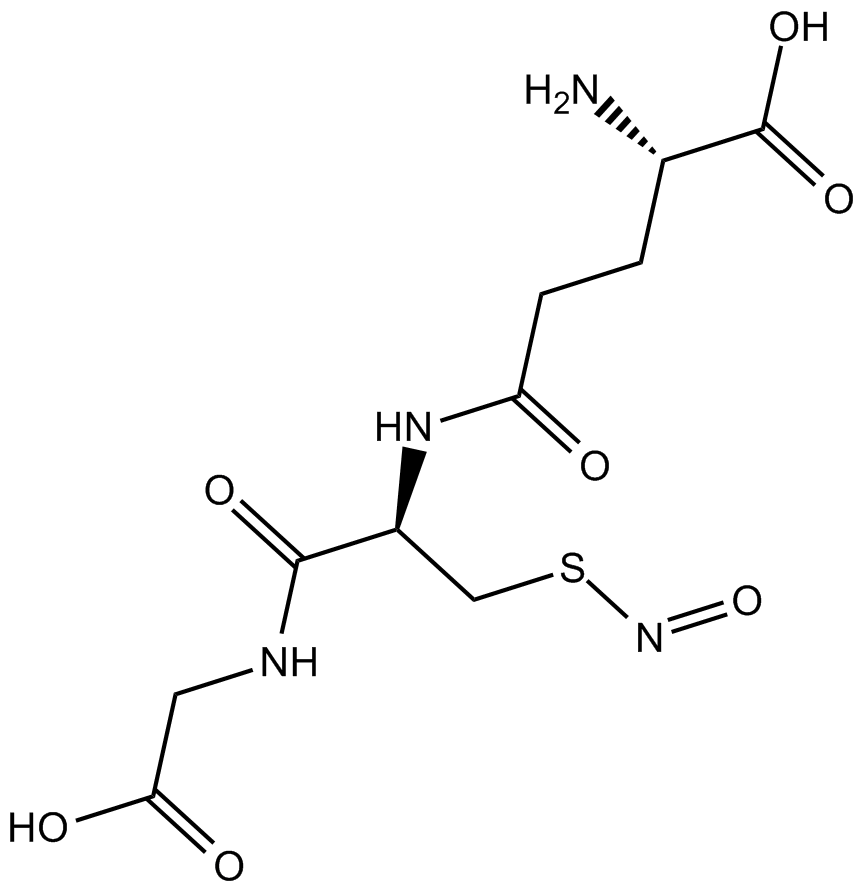
Cas No.: 57564-91-7
Sample solution is provided at 25 µL, 10mM.
_1-3.$$$39978408@51.jpg');)
_1-9.$$$38538795@65.jpg');)
_1-9.$$$39112701@51.jpg');)
_1-7.$$$37316672@70.jpg');)
_366-372.$$$36198801@70.jpg');)
.$$$38565142@65.jpg');)
_1867-1883.$$$33248023@67.jpg');)
_eads6055.$$$39977546@45.jpg');)
_eadm9805.$$$40080571@45.jpg');)
_eadj3020.$$$39666821@45.jpg');)
_1-20.$$$39757301@28.jpg');)
_1-24.$$$38898113@28.jpg');)
_273-287.$$$36806353@46.jpg');)
_1-16.$$$37156877@44.jpg');)
_1-19.$$$37460805@44.jpg');)
_1291-1307.$$$34518654@46.jpg');)
Nitrosoglutathione (GSNO) is an S-nitrosylthiol NO donor based on natural glutathione [1]. Nitrosoglutathione is an effective smooth muscle relaxant and platelet aggregation inhibitor, capable of inhibiting the AT1 receptor responses dependent and independent of brain vascular angiotensin II [2]. Nitrosoglutathione selectively inhibits platelet and NF-κB activation [3].
In vitro, Nitrosoglutathione (1-100μM; 5h) can activate Ras, Src and ERK1/2 MAP kinases and promote HeLa cell proliferation. However, when HeLa cells are exposed to 1mM Nitrosoglutathione, cell proliferation is inhibited [4]. Nitrosoglutathione (500μM; 2h) treatment of neutrophils reduces TNFα-induced NF-κB activity and inhibits IκBα degradation [5].
In vivo, Nitrosoglutathione (8mg/kg/day; 7d; i.v.) significantly reduces systolic blood pressure, diastolic blood pressure and mean arterial pressure in rats with preeclampsia (PE) from day 14 to day 20 [6]. Nitrosoglutathione (0.2 and 0.6mg/kg; single administration; i.v.) significantly inhibits the production of superoxide in rats with ischemia/reperfusion injury models and inhibits NF-κB activation, iNOS induction and 3-nitrotyrosine expression, and upregulats the expression of endothelial NOS in flap vessels [7].
References:
[1] Bouressam ML, Lecat S, Raoul A, et al. S-nitrosoglutathione inhibits cerebrovascular angiotensin II-dependent and -independent AT receptor responses: A possible role of S-nitrosation. Br J Pharmacol. 2019;176(12):2049-2062.
[2] Jensen DE, Belka GK, Du Bois GC. S-Nitrosoglutathione is a substrate for rat alcohol dehydrogenase class III isoenzyme. Biochem J. 1998;331 (Pt 2) (Pt 2):659-668.
[3] Fortenberry J D, Owens M L, Brown L A S. S-nitrosoglutathione enhances neutrophil DNA fragmentation and cell death[J]. American Journal of Physiology-Lung Cellular and Molecular Physiology, 1999, 276(3): L435-L442.
[4] Batista W L, Ogata F T, Curcio M F, et al. S-nitrosoglutathione and endothelial nitric oxide synthase-derived nitric oxide regulate compartmentalized ras S-nitrosylation and stimulate cell proliferation[J]. Antioxidants & redox signaling, 2013, 18(3): 221-238.
[5] Fortenberry J D, Owens M L, Chen N X, et al. S-nitrosoglutathione inhibits TNF-α-induced NF κ B activation in neutrophils[J]. Inflammation Research, 2001, 50(2): 89-95.
[6] Brown, Caneta et al. “The effects of S-nitrosoglutathione and S-nitroso-N-acetyl-D, L-penicillamine in a rat model of pre-eclampsia.” Journal of natural science, biology, and medicine vol. 4,2 (2013): 330-5.
[7] Kuo YR, Wang FS, Jeng SF, Lutz BS, Huang HC, Yang KD. Nitrosoglutathione promotes flap survival via suppression of reperfusion injury-induced superoxide and inducible nitric oxide synthase induction. J Trauma. 2004;57(5):1025-1031.
| Cell experiment [1]: | |
Cell lines | HeLa cells |
Preparation Method | HeLa cells (8×10³) were seeded in a 96-well culture plate and subjected to a 24-h period of starvation with MEM 0.5% FBS at 37°C, 5% CO2 . Cells were exposed to different concentrations of Nitrosoglutathione for 5h. In the assay that was used, PP2 (a Src kinase inhibitor) or BIBX1382 (an EGFR inhibitor) or LY294002 (PI3K inhibitor) or PD98059 (MEK inhibitor) was added 30min before stimulation with Nitrosoglutathione, EGF, Bk, or FBS. Cells were washed and subsequently incubated with MTT (0.5mg/ml) reagent at 37°C, 5% CO2, for 2h to measure the daily proliferation rate. The medium was discarded, and 100μl of cold isopropanol was added to monitor the absorbance spectrophotometrically at 570nm. The experiment was repeated three times. Cell pro-liferation was evaluated by a cell count assay. Cells were cultured in six-well plates to attain 40%–50% confluence and stimulated during 5h with Nitrosoglutathione or FBS in a culture medium without supplements. After 24–48h stimulation, cells were trypsinized and counted using an inverted microscope |
Reaction Conditions | 0, 0.1, 1, 10, 50, 100, and 1000μM; 5h |
Applications | Cells pretreated with low concentrations (1.0-100μM) of Nitrosoglutathione showed significant stimulation and proliferation at 24 and 48 hours. However, exposing HeLa cells to 1.0 millimole of Nitrosoglutathioneinhibited cell proliferation. |
| Animal experiment [2]: | |
Animal models | Sprague-Dawley rats |
Preparation Method | On day 14 of gestation, female Sprague-Dawley rats were separated into five groups and treated intravenously for 7 days as follows: (i) 0.3mL 0.9% saline (control, n = 11); (ii) 50mg/kg Body Weight (BW) N-nitro-L-arginine methyl ester (L-NAME) in 0.3mL saline (n = 10); (iii) 50mg/kg BW L-NAME and 8mg/kg BW Nitrosoglutathione in 0.15mL saline (n = 6); (iv) 50 mg/kg BW L-NAME in 0.15mL saline and 8mg/kg BW SNAP in 0.15mL DMSO (n = 9); and (v) 0.15mL DMSO and 0.15mL saline (SNAP control, n = 7). Blood pressures were measured on day 14 through day 20, a 4-h urine sample was taken on day 20, and animals were sacrificed on day 21. Pups were counted and weighed individually. |
Dosage form | 8mg/kg/day; 7d; i.v. |
Applications | Nitrosoglutathione significantly decreased systolic, diastolic, and mean arterial pressures in Pre-eclampsia (PE)-induced rats from day 14 through day 20. |
References: | |
| Cas No. | 57564-91-7 | SDF | |
| Überlieferungen | S-Nitroso-L-glutathione | ||
| Chemical Name | (S)-2-amino-5-(((R)-1-((carboxymethyl)amino)-3-(nitrosothio)-1-oxopropan-2-yl)amino)-5-oxopentanoic acid | ||
| Canonical SMILES | O=C(CC[C@@H](C(O)=O)N)N[C@H](C(NCC(O)=O)=O)CSN=O | ||
| Formula | C10H16N4O7S | M.Wt | 336.32 |
| Löslichkeit | DMSO:67mg/ml | Storage | Store at -20°C, protect from light |
| General tips | Please select the appropriate solvent to prepare the stock solution according to the
solubility of the product in different solvents; once the solution is prepared, please store it in
separate packages to avoid product failure caused by repeated freezing and thawing.Storage method
and period of the stock solution: When stored at -80°C, please use it within 6 months; when stored
at -20°C, please use it within 1 month. To increase solubility, heat the tube to 37°C and then oscillate in an ultrasonic bath for some time. |
||
| Shipping Condition | Evaluation sample solution: shipped with blue ice. All other sizes available: with RT, or with Blue Ice upon request. | ||
| Prepare stock solution | |||

|
1 mg | 5 mg | 10 mg |
| 1 mM | 2.9734 mL | 14.8668 mL | 29.7336 mL |
| 5 mM | 594.7 μL | 2.9734 mL | 5.9467 mL |
| 10 mM | 297.3 μL | 1.4867 mL | 2.9734 mL |
Step 1: Enter information below (Recommended: An additional animal making an allowance for loss during the experiment)
 g
μL
g
μL
Step 2: Enter the in vivo formulation (This is only the calculator, not formulation. Please contact us first if there is no in vivo formulation at the solubility Section.)
Calculation results:
Working concentration: mg/ml;
Method for preparing DMSO master liquid: mg drug pre-dissolved in μL DMSO ( Master liquid concentration mg/mL, Please contact us first if the concentration exceeds the DMSO solubility of the batch of drug. )
Method for preparing in vivo formulation: Take μL DMSO master liquid, next addμL PEG300, mix and clarify, next addμL Tween 80, mix and clarify, next add μL saline, mix and clarify.
Method for preparing in vivo formulation: Take μL DMSO master liquid, next add μL Corn oil, mix and clarify.
Note: 1. Please make sure the liquid is clear before adding the next solvent.
2. Be sure to add the solvent(s) in order. You must ensure that the solution obtained, in the previous addition, is a clear solution before proceeding to add the next solvent. Physical methods such as vortex, ultrasound or hot water bath can be used to aid dissolving.
3. All of the above co-solvents are available for purchase on the GlpBio website.
Quality Control & SDS
- View current batch:
- Purity: >98.00% Appearance: A solid
- COA (Certificate of Analysis)
- SDS (Safety Data Sheet)
- Datasheet
Average Rating: 5 (Based on Reviews and 16 reference(s) in Google Scholar.)