

ML-265 (Synonyms: CID-44246499,NCGC00186528,TEPP-46) |
カタログ番号GC11741
 One-Click Copy Product Info
|

ML-265は、広く認識されているPKM2(ピルビン酸キナーゼ筋肉アイソフォーム2)のアクチベーターとして広く使用されている。
Products are for research use only. Not for human use. We do not sell to patients.
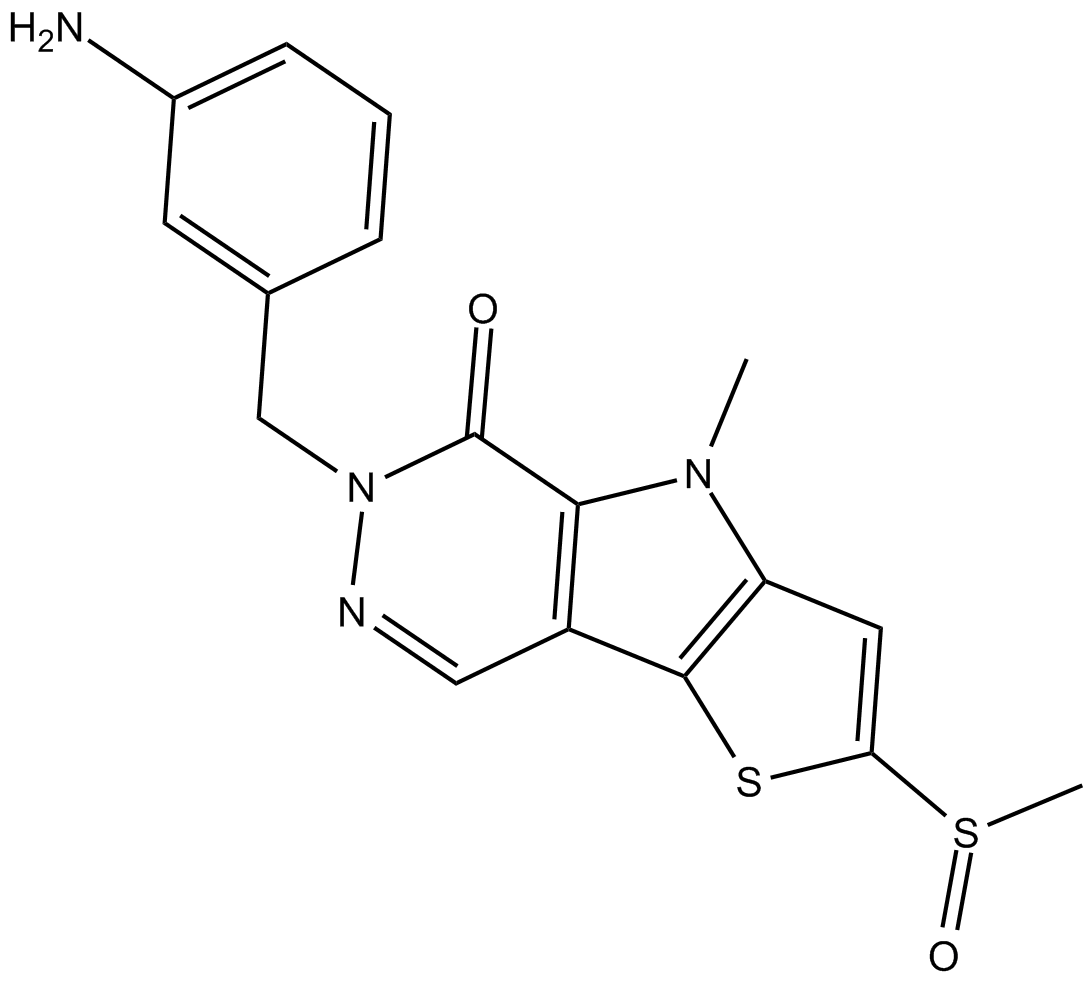
Cas No.: 1221186-53-3
Sample solution is provided at 25 µL, 10mM.
ML-265は、広く認識されているPKM2(ピルビン酸キナーゼ筋肉アイソフォーム2)のアクチベーターとして広く使用されている。ML-265は生化学的アッセイ(AC50 = 92 nM)および細胞ベースのアッセイの両方でPKM2を活性化し、PKM1(ピルビン酸キナーゼ筋肉アイソフォーム1)、PKLおよびPKRに対して高い選択性を示す。ML-265は元々がん治療の可能性として開発された。そのため、ML-265はPKM2を薬理学的に活性化することで神経保護効果を探るための理想的なリード分子となる。PKM2は多くのがんで過剰発現しており、ROS(活性酸素種)によって阻害され、解糖系のフラックスが酸化的PPP(ペントースリン酸経路)にシフトしてNADPH生成が行われる。小分子化合物であるML-265はPKM2をポジティブに調節し、酸化的PPPへの解糖系フラックスを減少させ、ROS条件下でのNADPH生合成を鈍化させることができる(図)。
ML-265は、組換えヒトPKM2の強力な活性化を示し、最大活性化は249 ± 14%(最適フィット値±標準誤差)、半最大活性化濃度(AC50)は108 ± 20 nMである。ML-265の光受容体におけるPK活性化能力を調査するために、661W細胞株が利用された。組換え酵素で観察された結果と同様に、ML-265はin vitroでPK活性を増加させた(最大活性化 = 515 ± 12%、AC50 = 19 ± 2 nM)。
ウサギに硝子体内投与されたML-265の眼内薬物動態プロファイルを確認するために、異なる用量のML-265をウサギに単回硝子体内注射(50 μL)した。硝子体の体積を1.15 mLと仮定すると、ウサギの硝子体内の最終濃度は約100 μMおよび1000 μMであった。単回硝子体内注射後の複数の時間点で水様液が採取された。分布相の半減期(t1/2)は8.3 ± 0.5時間で、消失相のt1/2は141.6 ± 35時間である。ML-265は硝子体内注射後に比較的長い半減期を持ち、注射後少なくとも2週間は活性が維持される。
References:
[1]: Walsh MJ, Brimacombe KR, Anastasiou D, et al. ML265: A potent PKM2 activator induces tetramerization and reduces tumor formation and size in a mouse xenograft model. Probe Reports from the NIH Molecular Libraries Program [Internet]
[2] TJ Wubben, M Pawar, E Weh, et,al. Small molecule activation of metabolic enzyme pyruvate kinase muscle isozyme 2, PKM2,circumvents photoreceptor apoptosis. Sci. Rep., 10 (2020), p. 2990, doi.org /10.1038/s41598-020-59999-w.
[3] Chakrabarti G, Gerber DE, Boothman DA. Expanding antitumor therapeutic windows by targeting cancer-specific nicotinamide adenine dinucleotide phosphate-biogenesis pathways. Clin. Pharmacol. Adv. Applications. 2015;7:57.
[4]: Xu W, Yang H, et,al. Oncometabolite 2-hydroxyglutarate is a competitive inhibitor of α-ketoglutarate-dependent dioxygenases. Cancer Cell. 2011 Jan 18;19(1):17-30. doi: 10.1016/j.ccr.2010.12.014. PMID: 21251613; PMCID: PMC3229304.
| 細胞実験[1]: | |
細胞株 | 661W細胞株 |
準備方法 | 661W細胞株の実験では、ML-265による処理開始前に培地を交換した。 |
反応条件 | 細胞を10-7, 10-6, 10-5, 10-4, 10-3, 10-2 M濃度のML-265で2時間インキュベートした。 |
アプリケーション | ML-265は、光受容体においてPKM2を薬理学的に活性化することによる神経保護効果を探索するための理想的なリード分子である。このin vitroデータは、低分子活性化剤が細胞膜を通過し、PK活性を増強できることを示唆している。 |
| 動物実験 [1]: | |
動物モデル | Brown-Norway マウス |
準備方法 | 眼内薬物動態試験を除くすべてのin vivo試験に成体ラットを使用した。すべてのラットは室温で飼育され、12時間の明暗サイクルで飼育された。 |
投与形態 | 異なる濃度(10-7、10-6、10-5、10-4、10-3、10-2 M)のML-265を2 μLずつ硝子体内へゆっくりと注入した。ML-265を硝子体腔内にゆっくり注入し、4時間後に摘出した。 |
アプリケーション | ML-265の硝子体内注射は、in vivoで170±26%までPKを活性化することができ、AC50=59±38μMであった。ML-265のPKM2に対する特異性と、PKM2の発現が網膜外層に限局していることを考慮すると、ML-265は網膜や視細胞の細胞膜を通過してPKM2を活性化できる可能性が高い。 |
参考文献: [1]. TJ Wubben, M Pawar, E Weh, et,al. Small molecule activation of metabolic enzyme pyruvate kinase muscle isozyme 2, PKM2,circumvents photoreceptor apoptosis. Sci. Rep., 10 (2020), p. 2990, doi.org /10.1038/s41598-020-59999-w. | |
| Cas No. | 1221186-53-3 | SDF | |
| 同義語 | CID-44246499,NCGC00186528,TEPP-46 | ||
| Chemical Name | 6-[(3-aminophenyl)methyl]-4,6-dihydro-4-methyl-2-(methylsulfinyl)-5H-thieno[2’,3’:4,5]pyrrolo[2,3-d]pyridazin-5-one | ||
| Canonical SMILES | CS(C1=CC(N2C)=C(S1)C3=C2C(N(CC4=CC(N)=CC=C4)N=C3)=O)=O | ||
| Formula | C17H16N4O2S2 | M.Wt | 372.5 |
| 溶解度 | ≥ 37.3mg/mL in DMSO | Storage | Store at -20°C |
| General tips | Please select the appropriate solvent to prepare the stock solution according to the
solubility of the product in different solvents; once the solution is prepared, please store it in
separate packages to avoid product failure caused by repeated freezing and thawing.Storage method
and period of the stock solution: When stored at -80°C, please use it within 6 months; when stored
at -20°C, please use it within 1 month. To increase solubility, heat the tube to 37°C and then oscillate in an ultrasonic bath for some time. |
||
| Shipping Condition | Evaluation sample solution: shipped with blue ice. All other sizes available: with RT, or with Blue Ice upon request. | ||
| Prepare stock solution | |||

|
1 mg | 5 mg | 10 mg |
| 1 mM | 2.6846 mL | 13.4228 mL | 26.8456 mL |
| 5 mM | 536.9 μL | 2.6846 mL | 5.3691 mL |
| 10 mM | 268.5 μL | 1.3423 mL | 2.6846 mL |
Step 1: Enter information below (Recommended: An additional animal making an allowance for loss during the experiment)
 g
μL
g
μL
Step 2: Enter the in vivo formulation (This is only the calculator, not formulation. Please contact us first if there is no in vivo formulation at the solubility Section.)
Calculation results:
Working concentration: mg/ml;
Method for preparing DMSO master liquid: mg drug pre-dissolved in μL DMSO ( Master liquid concentration mg/mL, Please contact us first if the concentration exceeds the DMSO solubility of the batch of drug. )
Method for preparing in vivo formulation: Take μL DMSO master liquid, next addμL PEG300, mix and clarify, next addμL Tween 80, mix and clarify, next add μL saline, mix and clarify.
Method for preparing in vivo formulation: Take μL DMSO master liquid, next add μL Corn oil, mix and clarify.
Note: 1. Please make sure the liquid is clear before adding the next solvent.
2. Be sure to add the solvent(s) in order. You must ensure that the solution obtained, in the previous addition, is a clear solution before proceeding to add the next solvent. Physical methods such as vortex, ultrasound or hot water bath can be used to aid dissolving.
3. All of the above co-solvents are available for purchase on the GlpBio website.
Quality Control & SDS
- View current batch:
- Purity: >98.00% Appearance: A solid
- COA (Certificate of Analysis)
- SDS (Safety Data Sheet)
- Datasheet
Average Rating: 5 (Based on Reviews and 35 reference(s) in Google Scholar.)