
ML-265
Products are for research use only. Not for human use. We do not sell to patients.
| Pack Size | Price | Availability | Quantity | Action |
|---|---|---|---|---|
| 10mM (in 1mL DMSO) | $68.00 | In Stock | 1 | |
| 5mg | $61.00 | In Stock | 1 | |
| 10mg | $92.00 | In Stock | 1 | |
| 50mg | $190.00 | In Stock | 1 | |
| 100mg | $297.00 | In Stock | 1 |
Citations
1 publicationsPublications from researchers using this productDescription
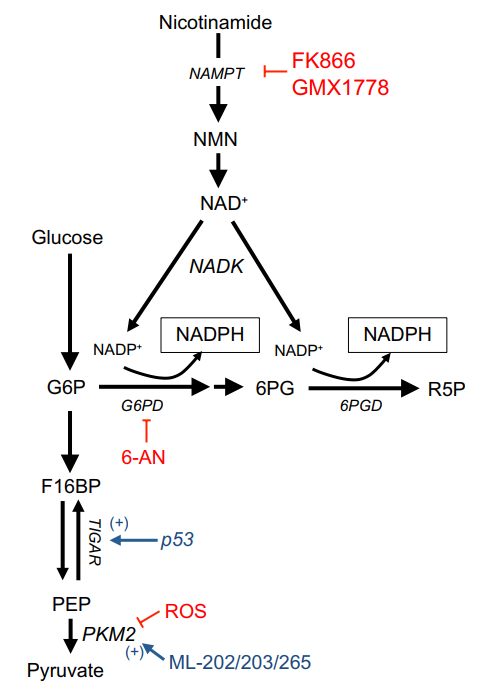
ML-265 is widely used as an acknowledged PKM2 (pyruvate kinase muscle isoform 2) activator[1][2] ML-265 activates of PKM2 in both biochemical (AC50 = 92 nM) and cell-based assays with high selectivity over PKM1(pyruvate kinase muscle isoform 1), PKL and PKR. ML-265 was originally developed as a potential cancer therapy. Therefore, ML-265 represents an ideal lead molecule to explore the neuroprotective effects of pharmacologically activating PKM2[2]. PKM2, which is overexpressed in many cancers, is inhibited by ROS, allowing glycolytic flux to be shuttled into the oxidative PPP for NADPH generation. The small-molecule compounds, ML-265, can positively modulate PKM2, thereby decreasing glycolytic flux into the oxidative PPP and blunting NADPH biogenesis during ROS(fig.) [3].
ML-265 displayed powerful activation of recombinant human PKM2 with a maximum activation of 249 ± 14% (best-fit value ± std. error) , the half-maximum activating concentration (AC50) shows 108 ± 20 nM. To investigate the ability of ML-265 to activate PK in photoreceptors, the 661W cell line was utilized. Similar to the results observed with the recombinant enzyme, ML-265 increased PK activity in vitro (maximum activation = 515 ± 12% and AC50 = 19 ± 2 nM) [2].
To determine the intraocular pharmacokinetic profile of intravitreally administered ML-265 in rabbits. Single, intravitreal injections (50 μL) of two different doses of ML-265 were performed in rabbits. Assuming a vitreous volume of 1.15 mL, the final concentrations in the rabbit vitreous were approximately 100 μM and 1000 μM, respectively. The aqueous humor was sampled at multiple time points after the single intravitreal injection. The distribution phase has a half-life (t1/2) of 8.3 ± 0.5 hours. The elimination phase has a t1/2 = 141.6 ± 35 hours. ML-265 has a relatively long half-life in the eye following intravitreal injection and remains active at least two weeks after injection.[2].
References:
[1]: Walsh MJ, Brimacombe KR, Anastasiou D, et al. ML265: A potent PKM2 activator induces tetramerization and reduces tumor formation and size in a mouse xenograft model. Probe Reports from the NIH Molecular Libraries Program [Internet]
[2] TJ Wubben, M Pawar, E Weh, et,al. Small molecule activation of metabolic enzyme pyruvate kinase muscle isozyme 2, PKM2,circumvents photoreceptor apoptosis. Sci. Rep., 10 (2020), p. 2990, doi.org /10.1038/s41598-020-59999-w.
[3] Chakrabarti G, Gerber DE, Boothman DA. Expanding antitumor therapeutic windows by targeting cancer-specific nicotinamide adenine dinucleotide phosphate-biogenesis pathways. Clin. Pharmacol. Adv. Applications. 2015;7:57.
[4]: Xu W, Yang H, et,al. Oncometabolite 2-hydroxyglutarate is a competitive inhibitor of α-ketoglutarate-dependent dioxygenases. Cancer Cell. 2011 Jan 18;19(1):17-30. doi: 10.1016/j.ccr.2010.12.014. PMID: 21251613; PMCID: PMC3229304.
Protocol
| Cell experiment [1]: | |
|
Cell lines |
661 W photoreceptor cell line |
|
Preparation Method |
For 661 W cell line experiments, media was replaced prior to the start of treatment with ML-265. |
|
Reaction Conditions |
Cells were incubated with10-7, 10-6, 10-5, 10-4, 10-3, 10-2 M concentrations of ML-265 for 2 hours |
|
Applications |
ML-265 represents an ideal lead molecule to explore the neuroprotective effects of pharmacologically activating PKM2 in photoreceptors. This in vitro data suggests the small molecule activator is able to cross the cell membrane and enhance PK activity. |
| Animal experiment [1]: | |
|
Animal models |
Brown-Norway mice |
|
Preparation Method |
Adult rats were utilized for all in vivo ML-265 studies except ocular pharmacokinetic studies. All rats were housed at room temperature with 12-hour light and 12-hour dark cycle. |
|
Dosage form |
Inject 2 μL of different concentrations(10-7, 10-6, 10-5, 10-4, 10-3, 10-2 M) of ML-265 slowly into the vitreous cavity,and harvest 4 hours later. |
|
Applications |
Intravitreal injection of ML-265 was able to activate PK in vivo up to 170 ± 26% with an AC50 = 59 ± 38 μM. Considering both the specificity of ML-265 for PKM2 and the fact that PKM2 expression is confined to the outer retina, ML-265 is most likely able to traverse the retina and the cell membranes of photoreceptors to activate PKM2 。 |
|
References: |
|
Product Documents
Chemical Properties
Use stock solutions within 6 months when stored at -80°C or within 1 month when stored at -20°C.
To improve solubility, warm the tube to 37°C and sonicate it for an appropriate period.
CalculatorsMolarity / Dilution / Molecular Weight / Unit Conversion / In Vivo Formulation / Solubility
Reviews
Review for ML-265
- 5 Star100%
- 4 Star0%
- 3 Star0%
- 2 Star0%
- 1 Star0%