

5-Aminolevulinic acid hydrochloride |
Catalog No.GC18078
 One-Click Copy Product Info
|

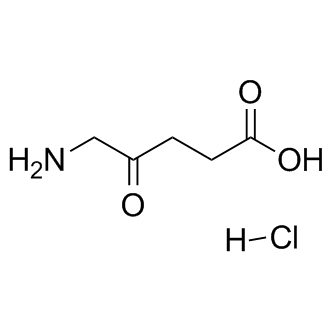
5-Aminolevulinic acid hydrochloride is the hydrochloride salt of 5-aminolevulinic acid, an endogenous precursor in porphyrin and heme biosynthesis.
Products are for research use only. Not for human use. We do not sell to patients.
Cas No.: 5451-09-2
Sample solution is provided at 25 µL, 10mM.
5-Aminolevulinic acid hydrochloride is the hydrochloride salt of 5-aminolevulinic acid, an endogenous precursor in porphyrin and heme biosynthesis[1]. 5-Aminolevulinic acid hydrochloride is converted through the heme-biosynthetic pathway to protoporphyrin IX, which produces fluorescence and reactive oxygen species after light activation[1,2]. 5-Aminolevulinic acid hydrochloride is used in research on photodynamic diagnosis, photodynamic therapy, tumor imaging, porphyrin metabolism, and mitochondrial-heme biology[1-5].
In vitro, 5-Aminolevulinic acid hydrochloride (0.05mM, 0.1mM, 0.25mM, 0.5mM, 1mM, and 2mM; 6 or 24h), followed by 635nm red-light irradiation, increased intracellular protoporphyrin IX accumulation and reactive oxygen species generation in HuCC-T1 cholangiocarcinoma cells in a concentration- and time-dependent manner and enhanced phototoxicity[1].
In vivo, mice bearing peritoneal dissemination models of bile-duct cancer received 5-Aminolevulinic acid hydrochloride (250mg/kg; single intraperitoneal injection), and fluorescence was assessed 3h later. 5-Aminolevulinic acid hydrochloride enhanced tumoral protoporphyrin IX accumulation and improved fluorescent detection of small peritoneal lesions[2].
References:
[1] Kim CH, Chung CW, Choi KH, Yoo JJ, Kim do H, Jeong YI, et al. Effect of 5-aminolevulinic acid-based photodynamic therapy via reactive oxygen species in human cholangiocarcinoma cells. Int J Nanomedicine. 2011;6:1357-1363. doi:10.2147/IJN.S21395.
[2] Kushibiki T, Hirasawa T, Okawa S, Ishihara M. 5-Aminolevulinic-acid-mediated photodynamic diagnosis enhances the detection of peritoneal dissemination in bile duct cancer. In Vivo. 2017;31(5):905-910. doi:10.21873/invivo.11141.
[3] Kim CH, Chung CW, Lee HM, Kim DH, Kwak TW, Jeong YI, et al. Synergistic effects of 5-aminolevulinic acid based photodynamic therapy and celecoxib via oxidative stress in human cholangiocarcinoma cells. Int J Nanomedicine. 2013;8:2173-2186. doi:10.2147/IJN.S44394.
[4] Tanaka Y, Kaneko K, Inoue H, Ishii T, Endo M, Masuda T, et al. Efficacy of 5-aminolevulinic acid-mediated photodynamic therapy in a mouse model of esophageal cancer. Oncol Lett. 2020;20(4):82. doi:10.3892/ol.2020.11943.
[5] Chung CW, Kim CH, Choi KH, Yoo JJ, Jeong YI, Kang DH. Effect of surfactant on 5-aminolevulinic acid uptake and PpIX generation in human cholangiocarcinoma cells. Eur J Pharm Biopharm. 2012;80(2):453-458. doi:10.1016/j.ejpb.2011.10.008.
| Cell experiment [1]: | |
|
Cell lines |
HuCC-T1 cholangiocarcinoma cells |
|
Preparation Method |
HuCC-T1 cells were cultured and exposed to different 5-Aminolevulinic acid hydrochloride concentrations before red-light irradiation. Protoporphyrin IX accumulation was measured by fluorescence, reactive oxygen species were detected using DCFH-DA, and growth inhibition after the photodynamic response was evaluated by cell-viability assay. |
|
Reaction Conditions |
0.05mM, 0.1mM, 0.25mM, 0.5mM, 1mM, and 2mM; 6 or 24h |
|
Applications |
5-Aminolevulinic acid hydrochloride (0.05mM to 2mM; 6 or 24h) increased intracellular protoporphyrin IX accumulation in HuCC-T1 cholangiocarcinoma cells with concentration and time; 635nm red-light irradiation increased reactive oxygen species generation and phototoxicity. |
| Animal experiment [2]: | |
|
Animal models |
Mouse model of bile-duct cancer peritoneal dissemination |
|
Preparation Method |
After establishment of a bile-duct cancer peritoneal dissemination model, mice received a single intraperitoneal injection and then underwent photodynamic diagnosis. Fluorescence imaging was used to assess protoporphyrin IX accumulation in tumors and detection of small peritoneal lesions. |
|
Dosage form |
250mg/kg for single intraperitoneal injection |
|
Applications |
5-Aminolevulinic acid hydrochloride (250mg/kg; single intraperitoneal injection) produced detectable tumoral protoporphyrin IX fluorescence in the mouse model of bile-duct cancer peritoneal dissemination and improved recognition of small peritoneal disseminated lesions. |
References: [1] Kim CH, Chung CW, Choi KH, Yoo JJ, Kim do H, Jeong YI, et al. Effect of 5-aminolevulinic acid-based photodynamic therapy via reactive oxygen species in human cholangiocarcinoma cells. Int J Nanomedicine. 2011;6:1357-1363. doi:10.2147/IJN.S21395. [2] Kushibiki T, Hirasawa T, Okawa S, Ishihara M. 5-Aminolevulinic-acid-mediated photodynamic diagnosis enhances the detection of peritoneal dissemination in bile duct cancer. In Vivo. 2017;31(5):905-910. doi:10.21873/invivo.11141. | |
| Cas No. | 5451-09-2 | SDF | |
| Chemical Name | 5-amino-4-oxopentanoic acid hydrochloride | ||
| Canonical SMILES | NCC(CCC(O)=O)=O.Cl | ||
| Formula | C5H9NO3.HCl | M.Wt | 167.59 |
| Solubility | DMSO : 34 mg/mL ( 202.87 mM) Water : 34 mg/mL Ethanol : 10 mg/mL | Storage | Store at -20°C |
| General tips | Please select the appropriate solvent to prepare the stock solution according to the
solubility of the product in different solvents; once the solution is prepared, please store it in
separate packages to avoid product failure caused by repeated freezing and thawing.Storage method
and period of the stock solution: When stored at -80°C, please use it within 6 months; when stored
at -20°C, please use it within 1 month. To increase solubility, heat the tube to 37°C and then oscillate in an ultrasonic bath for some time. |
||
| Shipping Condition | Evaluation sample solution: shipped with blue ice. All other sizes available: with RT, or with Blue Ice upon request. | ||
| Prepare stock solution | |||

|
1 mg | 5 mg | 10 mg |
| 1 mM | 5.9669 mL | 29.8347 mL | 59.6694 mL |
| 5 mM | 1.1934 mL | 5.9669 mL | 11.9339 mL |
| 10 mM | 596.7 μL | 2.9835 mL | 5.9669 mL |
Step 1: Enter information below (Recommended: An additional animal making an allowance for loss during the experiment)
 g
μL
g
μL
Step 2: Enter the in vivo formulation (This is only the calculator, not formulation. Please contact us first if there is no in vivo formulation at the solubility Section.)
Calculation results:
Working concentration: mg/ml;
Method for preparing DMSO master liquid: mg drug pre-dissolved in μL DMSO ( Master liquid concentration mg/mL, Please contact us first if the concentration exceeds the DMSO solubility of the batch of drug. )
Method for preparing in vivo formulation: Take μL DMSO master liquid, next addμL PEG300, mix and clarify, next addμL Tween 80, mix and clarify, next add μL saline, mix and clarify.
Method for preparing in vivo formulation: Take μL DMSO master liquid, next add μL Corn oil, mix and clarify.
Note: 1. Please make sure the liquid is clear before adding the next solvent.
2. Be sure to add the solvent(s) in order. You must ensure that the solution obtained, in the previous addition, is a clear solution before proceeding to add the next solvent. Physical methods such as vortex, ultrasound or hot water bath can be used to aid dissolving.
3. All of the above co-solvents are available for purchase on the GlpBio website.
Quality Control & SDS
- View current batch:
- Purity: >98.00% Appearance: A solid
- COA (Certificate of Analysis)
- SDS (Safety Data Sheet)
- Datasheet
Average Rating: 5 (Based on Reviews and 14 reference(s) in Google Scholar.)