

ALW-II-49-7 |
Catalog No.GC68647
 One-Click Copy Product Info
|

ALW-II-49-7 is a selective EphB2 kinase inhibitor with an IC50 value of 40nM.
Products are for research use only. Not for human use. We do not sell to patients.
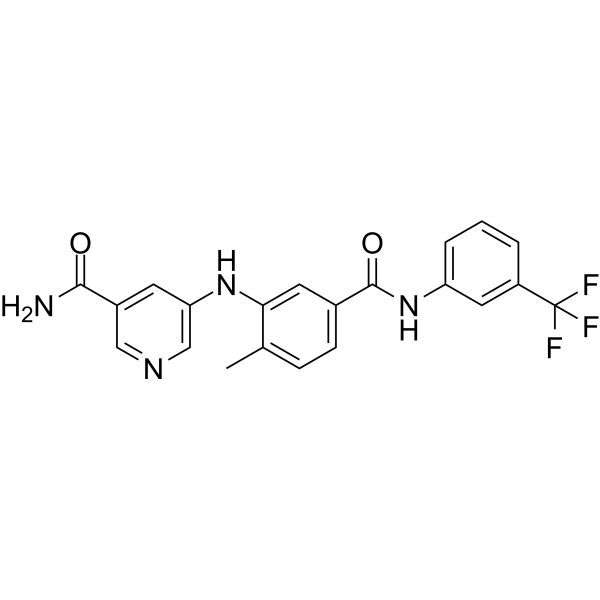
Cas No.: 1135219-23-6
Sample solution is provided at 25 µL, 10mM.
_1-3.$$$39978408@51.jpg');)
_1-9.$$$38538795@65.jpg');)
_1-9.$$$39112701@51.jpg');)
_1-7.$$$37316672@70.jpg');)
_366-372.$$$36198801@70.jpg');)
.$$$38565142@65.jpg');)
_1867-1883.$$$33248023@67.jpg');)
_eads6055.$$$39977546@45.jpg');)
_eadm9805.$$$40080571@45.jpg');)
_eadj3020.$$$39666821@45.jpg');)
_1-20.$$$39757301@28.jpg');)
_1-24.$$$38898113@28.jpg');)
_273-287.$$$36806353@46.jpg');)
_1-16.$$$37156877@44.jpg');)
_1-19.$$$37460805@44.jpg');)
_1291-1307.$$$34518654@46.jpg');)
ALW-II-49-7 is a selective EphB2 kinase inhibitor with an IC50 value of 40nM[1]. ALW-II-49-7 is also characterized as a DDR1 inhibitor(IC50 =12.4nM) and a DDR2 inhibitor(IC50=18.6nM)[2]. EphB2 kinase, a receptor tyrosine kinase belonging to the Eph family, is involved in various cellular signal transduction processes, including cell migration, adhesion, differentiation and proliferation[3]. DDR1 and DDR2 are also receptor tyrosine kinases that are widely expressed on the cell surface, activate downstream signaling pathways by recognizing collagen in the extracellular matrix, and regulate cell adhesion, migration, proliferation, and differentiation[4]. ALW-II-49-7 is commonly used in research of cancer and fibrosis[5][6].
In vitro, ALW-II-49-7 (0.01-10μM; 1h) inhibit the activity of EphB2 kinase in U87 glioblastoma cells[1]. In HEK293T (293T) cells transfected with wild-type DDR2, ALW-II-49-7 (0.1-10μM; 16h) decreases DDR2 phosphorylation in a dose-dependent manner[2]. ALW-II-49-7(3μM; 24h) significantly inhibited DDR1 phosphorylation induced by collagen I and reduced the synthesis of collagen IV in HEK293 cell lines and DDR1 knockout mesangial cells[7].
References:
[1] Choi Y, Syeda F, Walker JR, et al. Discovery and structural analysis of Eph receptor tyrosine kinase inhibitors. Bioorg Med Chem Lett. 2009;19(15):4467-4470.
[2] Terai H, Tan L, Beauchamp EM, et al. Characterization of DDR2 Inhibitors for the Treatment of DDR2 Mutated Nonsmall Cell Lung Cancer. ACS Chem Biol. 2015;10(12):2687-2696.
[3] Liu W, Yu C, Li J, Fang J. The Roles of EphB2 in Cancer. Front Cell Dev Biol. 2022;10:788587.
[4] Agarwal G, Smith AW, Jones B. Discoidin domain receptors: Micro insights into macro assemblies. Biochim Biophys Acta Mol Cell Res. 2019;1866(11):118496.
[5] Pasquale EB. Eph receptors and ephrins in cancer: bidirectional signalling and beyond. Nat Rev Cancer. 2010;10(3):165-180.
[6] Ling S, Kwak D, Kim KK. Inhibition of discoidin domain receptor 2 reveals kinase-dependent and kinase-independent functions in regulating fibroblast activity. Am J Physiol Lung Cell Mol Physiol. 2023;325(3):L342-L351.
[7] Jeffries DE, Borza CM, Blobaum AL, Pozzi A, Lindsley CW. Discovery of VU6015929: A Selective Discoidin Domain Receptor 1/2 (DDR1/2) Inhibitor to Explore the Role of DDR1 in Antifibrotic Therapy. ACS Med Chem Lett. 2019;11(1):29-33.
| Cell experiment [1]: | |
Cell lines | HEK293T (293T) cells |
Preparation Method | HEK293T (293T) cells were cultured in Dulbecco’s Modified Eagle’s Medium containing 10% fetal bovine serum, 20mM HEPES buffer, 100U/ml penicillin, 100μg/ml streptomycin, and 100μg/ml gentamicin. DDR2 was transiently expressed in 293T cells by the pCMV6 expression vector. Cells were treated with depicted concentrations of ALW-II-49-7(0.1-10μM) for 16h. Cell lysates were immunoprecipitated with anti-DDR2, followed by Western blotting with anti-DDR2 or antiphosphotyrosine. |
Reaction Conditions | 0.1-10μM; 16h |
Applications | ALW-II-49-7 decreases DDR2 phosphorylation in a dose-dependent manner. |
References: | |
| Cas No. | 1135219-23-6 | SDF | |
| Formula | C21H17F3N4O2 | M.Wt | 414.38 |
| Solubility | DMSO : 100 mg/mL (241.32 mM; Need ultrasonic) | Storage | Store at -20°C |
| General tips | Please select the appropriate solvent to prepare the stock solution according to the
solubility of the product in different solvents; once the solution is prepared, please store it in
separate packages to avoid product failure caused by repeated freezing and thawing.Storage method
and period of the stock solution: When stored at -80°C, please use it within 6 months; when stored
at -20°C, please use it within 1 month. To increase solubility, heat the tube to 37°C and then oscillate in an ultrasonic bath for some time. |
||
| Shipping Condition | Evaluation sample solution: shipped with blue ice. All other sizes available: with RT, or with Blue Ice upon request. | ||
| Prepare stock solution | |||

|
1 mg | 5 mg | 10 mg |
| 1 mM | 2.4132 mL | 12.0662 mL | 24.1324 mL |
| 5 mM | 482.6 μL | 2.4132 mL | 4.8265 mL |
| 10 mM | 241.3 μL | 1.2066 mL | 2.4132 mL |
Step 1: Enter information below (Recommended: An additional animal making an allowance for loss during the experiment)
 g
μL
g
μL
Step 2: Enter the in vivo formulation (This is only the calculator, not formulation. Please contact us first if there is no in vivo formulation at the solubility Section.)
Calculation results:
Working concentration: mg/ml;
Method for preparing DMSO master liquid: mg drug pre-dissolved in μL DMSO ( Master liquid concentration mg/mL, Please contact us first if the concentration exceeds the DMSO solubility of the batch of drug. )
Method for preparing in vivo formulation: Take μL DMSO master liquid, next addμL PEG300, mix and clarify, next addμL Tween 80, mix and clarify, next add μL saline, mix and clarify.
Method for preparing in vivo formulation: Take μL DMSO master liquid, next add μL Corn oil, mix and clarify.
Note: 1. Please make sure the liquid is clear before adding the next solvent.
2. Be sure to add the solvent(s) in order. You must ensure that the solution obtained, in the previous addition, is a clear solution before proceeding to add the next solvent. Physical methods such as vortex, ultrasound or hot water bath can be used to aid dissolving.
3. All of the above co-solvents are available for purchase on the GlpBio website.
Quality Control & SDS
- View current batch:
- Purity: >98.00% Appearance: A solid
- COA (Certificate of Analysis)
- SDS (Safety Data Sheet)
- Datasheet
Average Rating: 5 (Based on Reviews and 30 reference(s) in Google Scholar.)