

Amenamevir (Synonyms: ASP2151) |
Catalog No.GC19028
 One-Click Copy Product Info
|

Amenamevir is a helicase-primase inhibitor which has potent antiviral activity against HSVs with an EC50 of 14 ng/mL.
Products are for research use only. Not for human use. We do not sell to patients.
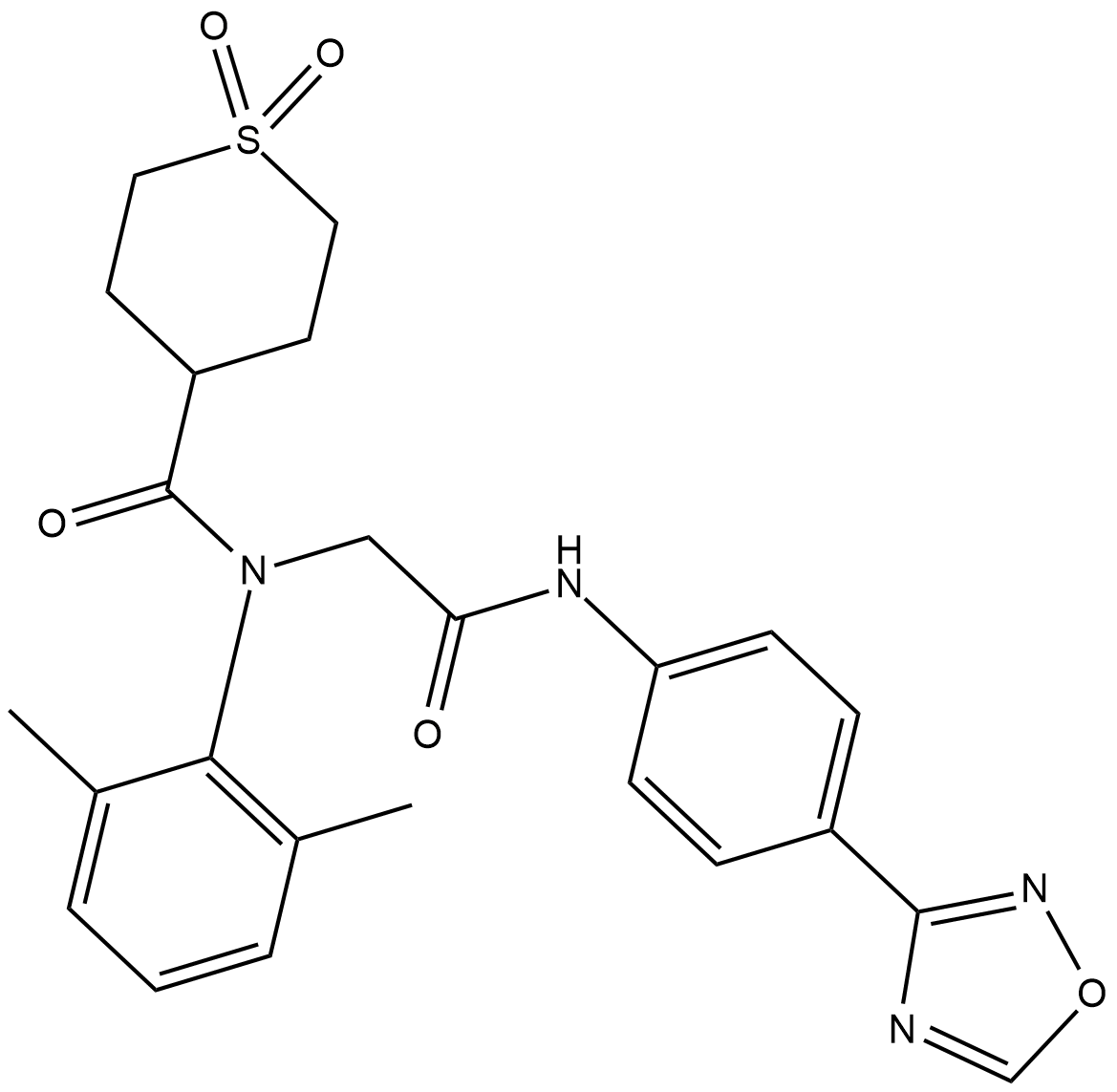
Cas No.: 841301-32-4
Sample solution is provided at 25 µL, 10mM.
_1-3.$$$39978408@51.jpg');)
_1-9.$$$38538795@65.jpg');)
_1-9.$$$39112701@51.jpg');)
_1-7.$$$37316672@70.jpg');)
_366-372.$$$36198801@70.jpg');)
.$$$38565142@65.jpg');)
_1867-1883.$$$33248023@67.jpg');)
_eads6055.$$$39977546@45.jpg');)
_eadm9805.$$$40080571@45.jpg');)
_eadj3020.$$$39666821@45.jpg');)
_1-20.$$$39757301@28.jpg');)
_1-24.$$$38898113@28.jpg');)
_273-287.$$$36806353@46.jpg');)
_1-16.$$$37156877@44.jpg');)
_1-19.$$$37460805@44.jpg');)
_1291-1307.$$$34518654@46.jpg');)
Amenamevir is a helicase-primase inhibitor which has potent antiviral activity against HSVs with an EC50 of 14 ng/mL.
Amenamevir (ASP2151) inhibits the replication of the HSV strains isolated in Japan and the United States as well as the laboratory-stocked strains. The mean EC50s of Amenamevir against HSV-1 and HSV-2 are 14 (range, 7.7 to 20) and 30 ng/mL (range, 15 to 58), respectively, whereas those of acyclovir (ACV) are 29 (range, 18 to 38) and 71 ng/mL (range, 45 to 95), respectively. The EC50s of Amenamevir against HSV strains are significantly lower than those of ACV[1].
Amenamevir (ASP2151) administration accelerates the reduction in virus titer in a dose-dependent manner in the range of 3 to 30 mg/kg/day. Amenamevir treatment decreases both lesion scores and HSV-1 titers in a dose-dependent manner, irrespective of the dosing interval. Based on the correlation curves, the PK parameters at which HSV-1 growth is completely suppressed by oral administration of Amenamevir are estimated to be 10,000 ng/mL or higher for the maximum concentration of drug in serum (Cmax), 60 ug • h/ml or higher for concentration-time curve over 24 h (AUC24h), and 21 to 24 h for T>100 . The mean concentration of Amenamevir in plasma at 5 days postinfection increases in a dose-dependent manner, with doses of 3 mg Amenamevir/g or higher significantly reducing the intradermal HSV-1 titer[1].
References:
[1]. Katsumata K, et al. Pharmacokinetics and pharmacodynamics of ASP2151, a helicase-primase inhibitor, in a murine model of herpes simplex virus infection. Antimicrob Agents Chemother. 2013 Mar;57(3):1339-46.
|
Cell experiment: |
The antiviral activities of Amenamevir (ASP2151) and ACV against HSVs are tested using a plaque reduction assay. Briefly, HEF cells are seeded into multi well plates and incubated until they form a monolayer. After the medium is removed, the cells are infected with HSV-1 or HSV-2, and the plates are further incubated for 1 h at 37°C. The cells are washed twice with maintenance medium and then treated with the test compound (including Amenamevir) until clear plaques appear. The cells are then fixed with 10% formalin in phosphate-buffered saline, stained with a 0.02% crystal violet solution, and the number of plaques is determined under a light microscope. The EC50, which represents the concentration of test compound needed to reduce the plaque number by 50%, is calculated using nonlinear regression analysis with a sigmoid-maximum effect (Emax) model[1]. |
|
Animal experiment: |
Female hairless mice (HOS:HR-1, 7 to 8 weeks old) are infected with a suspension of HSV-1 strain WT51 (15 μL/mouse; titer, 2×10⁸ PFU/mL) or CI-116 (15 μL/mouse; titer, 4×10⁷ PFU/mL) in the dorsolateral skin stripped as a small square using a needle, under anesthesia. The day of HSV-1 infection is designated day zero postinfection. Total daily doses of 1, 3, 10, 30, or 100 mg/kg/day ASP2151 are orally administered to HSV-1-infected mice (n=5) for 5 days. Amenamevir (ASP2151) treatments are started 2 to 3 h after HSV infection either as a single daily dose (every 24 h, q24h) or as two (every 12 h, q12h) or three (every 8 h, q8h) divided doses. Lesion scores and intradermal HSV-1 titers are measured on day 5 postinfection[1]. |
|
References: [1]. Katsumata K, et al. Pharmacokinetics and pharmacodynamics of ASP2151, a helicase-primase inhibitor, in a murine model of herpes simplex virus infection. Antimicrob Agents Chemother. 2013 Mar;57(3):1339-46. |
|
| Cas No. | 841301-32-4 | SDF | |
| Synonyms | ASP2151 | ||
| Canonical SMILES | O=C(C(CC1)CCS1(=O)=O)N(C2=C(C)C=CC=C2C)CC(NC3=CC=C(C4=NOC=N4)C=C3)=O | ||
| Formula | C24H26N4O5S | M.Wt | 482.55 |
| Solubility | DMSO : ≥ 50 mg/mL (103.62 mM) | Storage | Store at -20°C |
| General tips | Please select the appropriate solvent to prepare the stock solution according to the
solubility of the product in different solvents; once the solution is prepared, please store it in
separate packages to avoid product failure caused by repeated freezing and thawing.Storage method
and period of the stock solution: When stored at -80°C, please use it within 6 months; when stored
at -20°C, please use it within 1 month. To increase solubility, heat the tube to 37°C and then oscillate in an ultrasonic bath for some time. |
||
| Shipping Condition | Evaluation sample solution: shipped with blue ice. All other sizes available: with RT, or with Blue Ice upon request. | ||
| Prepare stock solution | |||

|
1 mg | 5 mg | 10 mg |
| 1 mM | 2.0723 mL | 10.3616 mL | 20.7232 mL |
| 5 mM | 414.5 μL | 2.0723 mL | 4.1446 mL |
| 10 mM | 207.2 μL | 1.0362 mL | 2.0723 mL |
Step 1: Enter information below (Recommended: An additional animal making an allowance for loss during the experiment)
 g
μL
g
μL
Step 2: Enter the in vivo formulation (This is only the calculator, not formulation. Please contact us first if there is no in vivo formulation at the solubility Section.)
Calculation results:
Working concentration: mg/ml;
Method for preparing DMSO master liquid: mg drug pre-dissolved in μL DMSO ( Master liquid concentration mg/mL, Please contact us first if the concentration exceeds the DMSO solubility of the batch of drug. )
Method for preparing in vivo formulation: Take μL DMSO master liquid, next addμL PEG300, mix and clarify, next addμL Tween 80, mix and clarify, next add μL saline, mix and clarify.
Method for preparing in vivo formulation: Take μL DMSO master liquid, next add μL Corn oil, mix and clarify.
Note: 1. Please make sure the liquid is clear before adding the next solvent.
2. Be sure to add the solvent(s) in order. You must ensure that the solution obtained, in the previous addition, is a clear solution before proceeding to add the next solvent. Physical methods such as vortex, ultrasound or hot water bath can be used to aid dissolving.
3. All of the above co-solvents are available for purchase on the GlpBio website.
Quality Control & SDS
- View current batch:
- Purity: >98.00% Appearance: A solid
- COA (Certificate of Analysis)
- SDS (Safety Data Sheet)
- Datasheet
Average Rating: 5 (Based on Reviews and 27 reference(s) in Google Scholar.)