

Pulchinenoside A (Anemoside A3) (Synonyms: Anemoside A3) |
Catalog No.GN10141
 One-Click Copy Product Info
|

Pulchinenoside A (Anemoside A3) is a natural triterpenoid saponin derived from Pulsatilla chinensis. Pulchinenoside A improves cognitive function by enhancing hippocampal synaptic plasticity and modulating NMDA receptors.
Products are for research use only. Not for human use. We do not sell to patients.
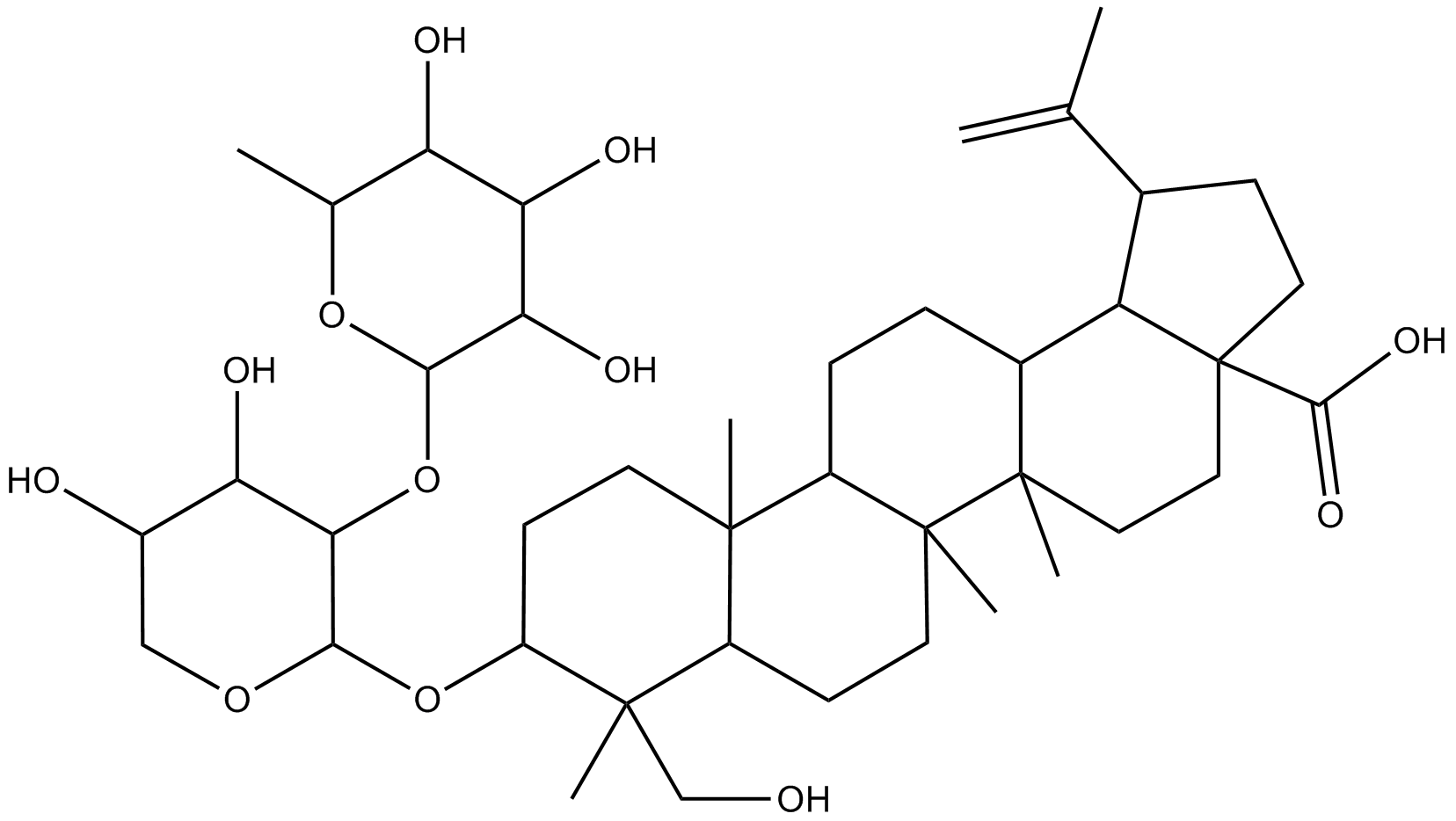
Cas No.: 129724-84-1
Sample solution is provided at 25 µL, 10mM.
_1-3.$$$39978408@51.jpg');)
_1-9.$$$38538795@65.jpg');)
_1-9.$$$39112701@51.jpg');)
_1-7.$$$37316672@70.jpg');)
_366-372.$$$36198801@70.jpg');)
.$$$38565142@65.jpg');)
_1867-1883.$$$33248023@67.jpg');)
_eads6055.$$$39977546@45.jpg');)
_eadm9805.$$$40080571@45.jpg');)
_eadj3020.$$$39666821@45.jpg');)
_1-20.$$$39757301@28.jpg');)
_1-24.$$$38898113@28.jpg');)
_273-287.$$$36806353@46.jpg');)
_1-16.$$$37156877@44.jpg');)
_1-19.$$$37460805@44.jpg');)
_1291-1307.$$$34518654@46.jpg');)
Pulchinenoside A (Anemoside A3) is a natural triterpenoid saponin derived from Pulsatilla chinensis. Pulchinenoside A improves cognitive function by enhancing hippocampal synaptic plasticity and modulating NMDA receptors[1-2]. Pulchinenoside A is applicable for research related to neurodegenerative diseases, cerebral ischemia/stroke, and tumors[3-4].
In vitro, K562 cells were treated with Pulchinenoside A (0-300μM) for 48 hours. Pulchinenoside A significantly inhibited cell proliferation[5]. Mouse bone marrow-derived macrophages (BMDMs) were pretreated with Pulchinenoside A for 24 hours, followed by stimulation with IL-4 (20ng/mL) to induce M2 polarization. Pulchinenoside A significantly suppressed the expression of the M2 macrophage surface marker CD206 and downregulated the mRNA levels of M2 signature genes, including ARG-1, Fizz1, and Ym1[6].
In vivo, C57BL/6 mice were treated with Pulchinenoside A (100mg/kg; oral; daily) for 2 weeks. Pulchinenoside A significantly enhanced theta-burst stimulation-induced long-term potentiation in the hippocampal CA3-CA1 pathway and improved spatial reference memory formation in the Morris water maze test. In Sprague-Dawley rats subjected to middle cerebral artery occlusion, a single oral administration of Pulchinenoside A (100mg/kg) at 6 hours post-ischemia significantly reduced brain infarct volume and improved neurological deficit scores[7]. 10-week-old female C57BL/6 mice with experimental autoimmune encephalomyelitis (EAE) were treated daily with Pulchinenoside A (100mg/kg; oral) from day 2 post-induction until the end of the experiment (12 days). Pulchinenoside A significantly reduced the clinical disease score and decreased inflammatory infiltration and demyelination in the spinal cord[8].
References:
[1] Zhang DM, Lin SM, Lau CW, et al. Anemoside A3-induced relaxation in rat renal arteries: role of endothelium and Ca2+ channel inhibition. Planta Med. 2010 Nov;76(16):1814-9.
[2] Gao XD, Ye WC, Yu AC, et al. Pulsatilloside A and anemoside A3 protect PC12 cells from apoptosis induced by sodium cyanide and glucose deprivation. Planta Med. 2003 Feb;69(2):171-4.
[3] Yin L, Fan Z, Liu P, et al. Anemoside A3 activates TLR4-dependent M1-phenotype macrophage polarization to represses breast tumor growth and angiogenesis. Toxicol Appl Pharmacol. 2021 Dec 1;432:115755.
[4] Wang CM, Lin ZH, Lin ZQ, et al. Anemoside A3 rapidly reverses depression-like behaviors and weakening of excitatory synaptic transmission in mouse models of depression. J Psychopharmacol. 2019 Jan;33(1):37-50.
[5] Liu M, Zhao X, Xiao L, et al. Cytotoxicity of the compounds isolated from Pulsatilla chinensis saponins and apoptosis induced by 23-hydroxybetulinic acid. Pharm Biol. 2015 Jan;53(1):1-9.
[6] Liu P, Liu Y, Chen L, et al. Anemoside A3 Inhibits Macrophage M2-Like Polarization to Prevent Triple-Negative Breast Cancer Metastasis. Molecules. 2023 Feb 7;28(4):1611.
[7] Ip FC, Fu WY, Cheng EY, et al. Anemoside A3 Enhances Cognition through the Regulation of Synaptic Function and Neuroprotection. Neuropsychopharmacology. 2015 Jul;40(8):1877-87.
[8] Ip FCF, Ng YP, Or TCT, et al. Anemoside A3 ameliorates experimental autoimmune encephalomyelitis by modulating T helper 17 cell response. PLoS One. 2017 Jul 31;12(7):e0182069.
| Cell experiment [1]: | |
Cell lines | K562 cells (human chronic myelogenous leukemia cell line) |
Preparation Method | K562 cells were treated with Pulchinenoside A (0-300μM) for 48 hours, and cell viability was assessed by the MTT assay. |
Reaction Conditions | 0-300μM; 48h. |
Applications | Pulchinenoside A significantly inhibited the proliferation of K562 cells. |
| Animal experiment [2]: | |
Animal models | 10-week-old female C57BL/6 mice |
Preparation Method | Mice were immunized with MOG35-55peptide to induce experimental autoimmune encephalomyelitis (EAE). Starting from the day after immunization (day 0), mice were treated daily with Pulchinenoside A via oral gavage until the end of the experiment. |
Dosage form | 100mg/kg; oral gavage; daily administration for 12 days. |
Applications | Pulchinenoside A treatment significantly reduced the clinical severity of EAE and decreased inflammatory infiltrates and demyelination in the spinal cord. |
References: | |
| Cas No. | 129724-84-1 | SDF | |
| Synonyms | Anemoside A3 | ||
| Chemical Name | (3beta,4alpha)-3-[[2-O-(6-Deoxy-alpha-L-mannopyranosyl)-alpha-L-arabinopyranosyl]oxy]-23-hydroxylup-20(29)-en-28-oic acid;Pulchinenoside A | ||
| Canonical SMILES | CC1C(C(C(C(O1)OC2C(C(COC2OC3CCC4(C5CCC6C7C(CCC7(CCC6(C5(CCC4C3(C)CO)C)C)C(=O)O)C(=C)C)C)O)O)O)O)O | ||
| Formula | C41H66O12 | M.Wt | 750 |
| Solubility | ≥ 3.75mg/mL in EtOH with ultrasonic and warming | Storage | Store at 2-8°C,protect from light |
| General tips | Please select the appropriate solvent to prepare the stock solution according to the
solubility of the product in different solvents; once the solution is prepared, please store it in
separate packages to avoid product failure caused by repeated freezing and thawing.Storage method
and period of the stock solution: When stored at -80°C, please use it within 6 months; when stored
at -20°C, please use it within 1 month. To increase solubility, heat the tube to 37°C and then oscillate in an ultrasonic bath for some time. |
||
| Shipping Condition | Evaluation sample solution: shipped with blue ice. All other sizes available: with RT, or with Blue Ice upon request. | ||
| Prepare stock solution | |||

|
1 mg | 5 mg | 10 mg |
| 1 mM | 1.3333 mL | 6.6667 mL | 13.3333 mL |
| 5 mM | 266.7 μL | 1.3333 mL | 2.6667 mL |
| 10 mM | 133.3 μL | 666.7 μL | 1.3333 mL |
Step 1: Enter information below (Recommended: An additional animal making an allowance for loss during the experiment)
 g
μL
g
μL
Step 2: Enter the in vivo formulation (This is only the calculator, not formulation. Please contact us first if there is no in vivo formulation at the solubility Section.)
Calculation results:
Working concentration: mg/ml;
Method for preparing DMSO master liquid: mg drug pre-dissolved in μL DMSO ( Master liquid concentration mg/mL, Please contact us first if the concentration exceeds the DMSO solubility of the batch of drug. )
Method for preparing in vivo formulation: Take μL DMSO master liquid, next addμL PEG300, mix and clarify, next addμL Tween 80, mix and clarify, next add μL saline, mix and clarify.
Method for preparing in vivo formulation: Take μL DMSO master liquid, next add μL Corn oil, mix and clarify.
Note: 1. Please make sure the liquid is clear before adding the next solvent.
2. Be sure to add the solvent(s) in order. You must ensure that the solution obtained, in the previous addition, is a clear solution before proceeding to add the next solvent. Physical methods such as vortex, ultrasound or hot water bath can be used to aid dissolving.
3. All of the above co-solvents are available for purchase on the GlpBio website.
Quality Control & SDS
- View current batch:
- Purity: >98.00% Appearance: A solid
- COA (Certificate of Analysis)
- SDS (Safety Data Sheet)
- Datasheet
Average Rating: 5 (Based on Reviews and 30 reference(s) in Google Scholar.)