

BIO 1211 |
Catalog No.GC17560
 One-Click Copy Product Info
|

BIO 1211 is an α4β1 (VLA-4) integrin inhibitor, which inhibits α4β1 (IC₅₀=4nM) and α4β7 (IC₅₀=2µM) .
Products are for research use only. Not for human use. We do not sell to patients.
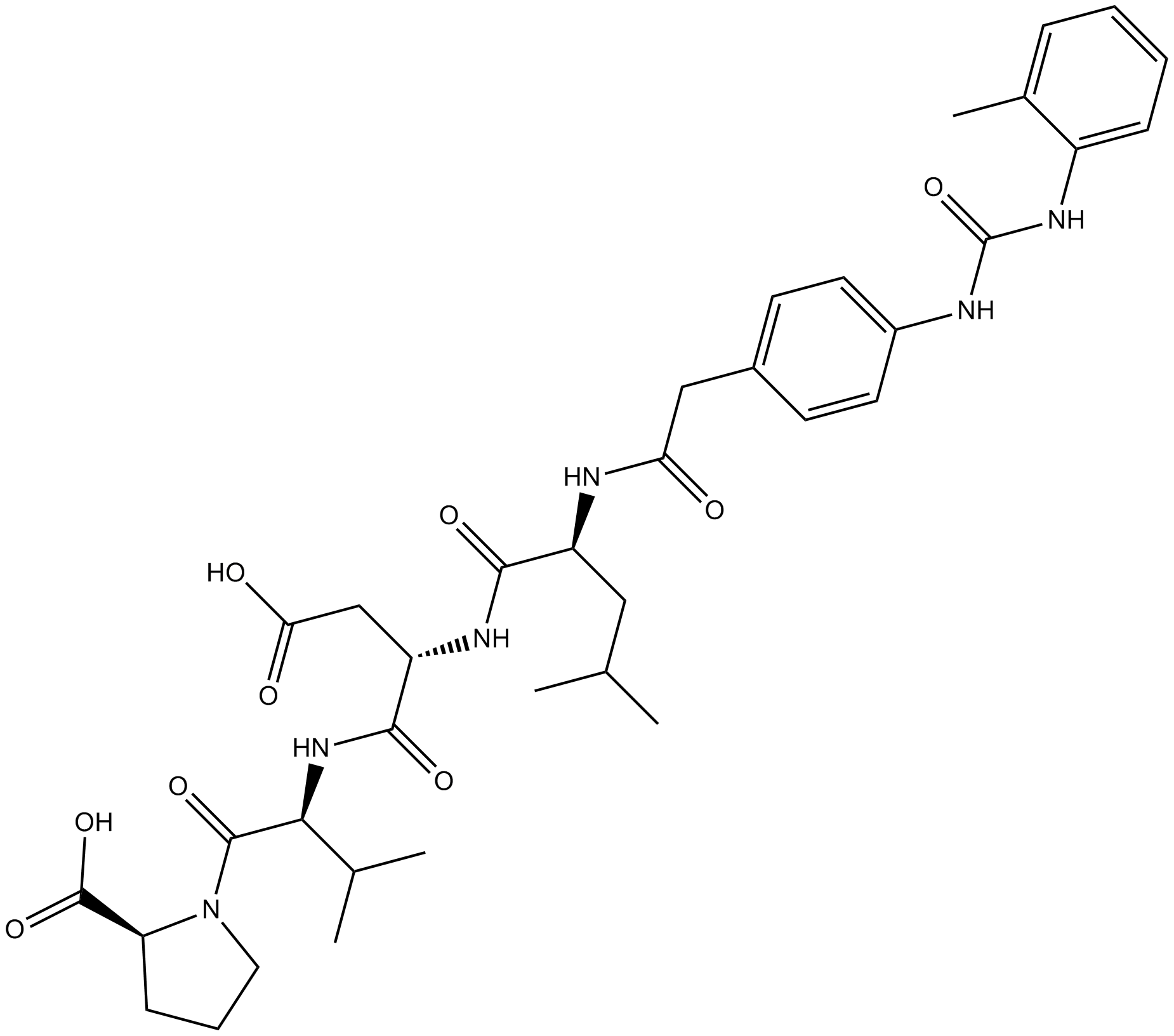
Cas No.: 187735-94-0
Sample solution is provided at 25 µL, 10mM.
_1-3.$$$39978408@51.jpg');)
_1-9.$$$38538795@65.jpg');)
_1-9.$$$39112701@51.jpg');)
_1-7.$$$37316672@70.jpg');)
_366-372.$$$36198801@70.jpg');)
.$$$38565142@65.jpg');)
_1867-1883.$$$33248023@67.jpg');)
_eads6055.$$$39977546@45.jpg');)
_eadm9805.$$$40080571@45.jpg');)
_eadj3020.$$$39666821@45.jpg');)
_1-20.$$$39757301@28.jpg');)
_1-24.$$$38898113@28.jpg');)
_273-287.$$$36806353@46.jpg');)
_1-16.$$$37156877@44.jpg');)
_1-19.$$$37460805@44.jpg');)
_1291-1307.$$$34518654@46.jpg');)
BIO 1211 is an α4β1 (VLA-4) integrin inhibitor, which inhibits α4β1 (IC₅₀=4nM) and α4β7 (IC₅₀=2µM)[1-2]. BIO 1211 reduces leukocyte migration and inflammatory cytokine expression by inhibiting the VLA-4/VCAM-1 interaction. BIO 1211 can be used in research related to inflammatory diseases such as multiple sclerosis (experimental autoimmune encephalomyelitis model) and asthma[3-4].
In vitro, BIO 1211 (50µM) was co-cultured with patient-derived B-ALL bone marrow mononuclear cells and two stromal cell populations (adipogenic progenitor cells and early mesenchymal progenitor cells) for 7 days, effectively reducing the viability of leukemic cells in the co-culture system[5]. IMR-32, CHP-134, and Kelly neuroblastoma cell lines were treated with BIO 1211 (1-5µM) for 72 hours. BIO 1211 significantly decreased cell survival and reduced cell attachment; when combined with the anti-GD2 antibody 14G2a (20 µg/ml), BIO 1211 further enhanced cytotoxicity in IMR-32 cells[6].
In vivo, BIO 1211 (1, 3, 10mg/ml; 2min) was administered via aerosol inhalation to treat SD rats sensitized with albumin. BIO 1211 dose-dependently significantly inhibited the increase in lung resistance and the decrease in dynamic lung compliance caused by antigen challenge[7]. BIO 1211 (1, 3, 10mg/kg) was administered via a single intraperitoneal injection to treat SD rats after glucan gel-induced inflammation. BIO 1211 dose-dependently significantly inhibited the aggregation of peritoneal eosinophils[8].
References:
[1] Bolger GT. BIO-1211 (Biogen). IDrugs. 2000 May;3(5):536-40.
[2] Hagmann WK. The discovery and potential of N-sulfonylated dipeptide VLA-4 antagonists. Curr Top Med Chem. 2004;4(14):1461-71.
[3] Dattoli SD, De Marco R, Baiula M,et al. Synthesis and assay of retro-α4β1 integrin-targeting motifs. Eur J Med Chem. 2014 Feb 12;73:225-32.
[4] Drin G, Cottin S, Blanc E, et al. Studies on the internalization mechanism of cationic cell-penetrating peptides. J Biol Chem. 2003 Aug 15;278(33):31192-201.
[5] Ferrao Blanco MN, Kazybay B, Belderbos M, et al. Distinct stromal cell populations define the B-cell acute lymphoblastic leukemia microenvironment. Leukemia. 2025 Nov;39(11):2622-2639.
[6] Horwacik I, Rokita H. Modulation of interactions of neuroblastoma cell lines with extracellular matrix proteins affects their sensitivity to treatment with the anti-GD2 ganglioside antibody 14G2a. Int J Oncol. 2017 May;50(5):1899-1914.
[7] Dong XW, Du XG, Zhang SJ, et al. Inhibitory effects of BIO-1211 on bronchoconstriction and neutrophil adhesion in rats. Zhejiang Da Xue Xue Bao Yi Xue Ban. 2008 Jul;37(4):340-4.
[8] Zhao XY, Chen JQ, Xie QM, et al. Effects of BIO-1211 on eosinophil chemotaxis, recruitment and mediator release. Zhejiang Da Xue Xue Bao Yi Xue Ban. 2003 Aug;32(4):279-82, 291.
| Cell experiment [1]: | |
Cell lines | IMR-32, CHP-134, and Kelly human neuroblastoma cell lines |
Preparation Method | Cells were cultured on fibronectin-coated plates. They were treated with BIO 1211 (1-5μM) alone or in combination with the anti-GD2 monoclonal antibody 14G2a (20μg/ml). |
Reaction Conditions | 1-5μM; 72 hours. |
Applications | BIO 1211 (5μM) induced evident changes in the morphology of IMR-32 cells (e.g., cell rounding) and reduced cell attachment on fibronectin-coated surfaces. Treatment with BIO 1211 (1-5μM) for 72 hours significantly decreased cellular ATP levels (a measure of cell survival) in IMR-32 cells in a concentration-dependent manner, with the most pronounced effect at 5μM. When combined with the 14G2a antibody, BIO 1211 further reduced the survival of IMR-32 cells compared to treatment with the antibody alone. The effects of BIO 1211 on CHP-134 and Kelly cell survival and attachment were minimal. |
| Animal experiment [2]: | |
Animal models | SD rats |
Preparation Method | Rats were intraperitoneally administered a single dose of BIO 1211 (1, 3, 10mg/kg). Two hours later, eosinophil inflammation was induced by a single intraperitoneal injection of Sephadex. Peritoneal lavage fluid was collected 24 hours after Sephadex administration for cell count analysis. |
Dosage form | 1, 3, 10mg/kg; i.p..; single administration. |
Applications | BIO 1211 administration inhibited Sephadex-induced peritoneal eosinophil recruitment in a dose-dependent manner. BIO 1211 did not inhibit eosinophil peroxidase (EPO) release. |
References: | |
| Cas No. | 187735-94-0 | SDF | |
| Chemical Name | (2S)-1-[(2S)-2-[[(2S)-3-carboxy-2-[[(2S)-4-methyl-2-[[2-[4-[(2-methylphenyl)carbamoylamino]phenyl]acetyl]amino]pentanoyl]amino]propanoyl]amino]-3-methylbutanoyl]pyrrolidine-2-carboxylic acid | ||
| Canonical SMILES | CC1=CC=CC=C1NC(=O)NC2=CC=C(C=C2)CC(=O)NC(CC(C)C)C(=O)NC(CC(=O)O)C(=O)NC(C(C)C)C(=O)N3CCCC3C(=O)O | ||
| Formula | C36H48N6O9 | M.Wt | 708.8 |
| Solubility | Soluble to 2 mg/ml in 0.2M PBS | Storage | Store at -20°C, sealed storage, away from moisture and light |
| General tips | Please select the appropriate solvent to prepare the stock solution according to the
solubility of the product in different solvents; once the solution is prepared, please store it in
separate packages to avoid product failure caused by repeated freezing and thawing.Storage method
and period of the stock solution: When stored at -80°C, please use it within 6 months; when stored
at -20°C, please use it within 1 month. To increase solubility, heat the tube to 37°C and then oscillate in an ultrasonic bath for some time. |
||
| Shipping Condition | Evaluation sample solution: shipped with blue ice. All other sizes available: with RT, or with Blue Ice upon request. | ||
| Prepare stock solution | |||

|
1 mg | 5 mg | 10 mg |
| 1 mM | 1.4108 mL | 7.0542 mL | 14.1084 mL |
| 5 mM | 282.2 μL | 1.4108 mL | 2.8217 mL |
| 10 mM | 141.1 μL | 705.4 μL | 1.4108 mL |
Step 1: Enter information below (Recommended: An additional animal making an allowance for loss during the experiment)
 g
μL
g
μL
Step 2: Enter the in vivo formulation (This is only the calculator, not formulation. Please contact us first if there is no in vivo formulation at the solubility Section.)
Calculation results:
Working concentration: mg/ml;
Method for preparing DMSO master liquid: mg drug pre-dissolved in μL DMSO ( Master liquid concentration mg/mL, Please contact us first if the concentration exceeds the DMSO solubility of the batch of drug. )
Method for preparing in vivo formulation: Take μL DMSO master liquid, next addμL PEG300, mix and clarify, next addμL Tween 80, mix and clarify, next add μL saline, mix and clarify.
Method for preparing in vivo formulation: Take μL DMSO master liquid, next add μL Corn oil, mix and clarify.
Note: 1. Please make sure the liquid is clear before adding the next solvent.
2. Be sure to add the solvent(s) in order. You must ensure that the solution obtained, in the previous addition, is a clear solution before proceeding to add the next solvent. Physical methods such as vortex, ultrasound or hot water bath can be used to aid dissolving.
3. All of the above co-solvents are available for purchase on the GlpBio website.
Quality Control & SDS
- View current batch:
- Purity: >98.00% Appearance: A solid
- COA (Certificate of Analysis)
- SDS (Safety Data Sheet)
- Datasheet
Average Rating: 5 (Based on Reviews and 32 reference(s) in Google Scholar.)