

Biotin-azide (Synonyms: Azido-biotin, Click Tag Biotin-azide) |
Catalog No.GC12570
 One-Click Copy Product Info
|

Biotin-azide is a biotin derivative with an azide group, widely used for biomolecule labeling and probe design.
Products are for research use only. Not for human use. We do not sell to patients.
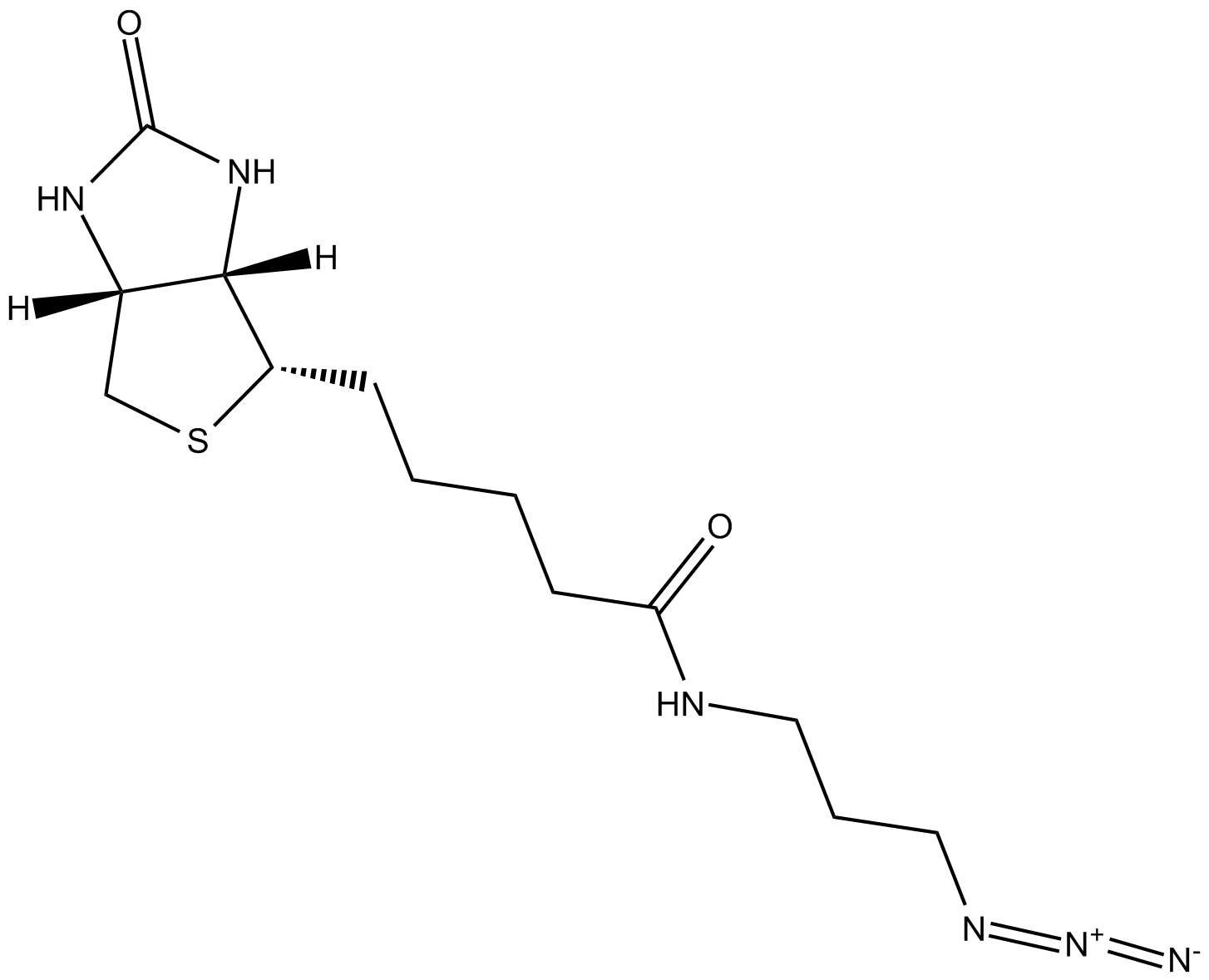
Cas No.: 908007-17-0
Sample solution is provided at 25 µL, 10mM.
_1-3.$$$39978408@51.jpg');)
_1-9.$$$38538795@65.jpg');)
_1-9.$$$39112701@51.jpg');)
_1-7.$$$37316672@70.jpg');)
_366-372.$$$36198801@70.jpg');)
.$$$38565142@65.jpg');)
_1867-1883.$$$33248023@67.jpg');)
_eads6055.$$$39977546@45.jpg');)
_eadm9805.$$$40080571@45.jpg');)
_eadj3020.$$$39666821@45.jpg');)
_1-20.$$$39757301@28.jpg');)
_1-24.$$$38898113@28.jpg');)
_273-287.$$$36806353@46.jpg');)
_1-16.$$$37156877@44.jpg');)
_1-19.$$$37460805@44.jpg');)
_1291-1307.$$$34518654@46.jpg');)
Biotin-azide is a biotin derivative with an azide group, widely used for biomolecule labeling and probe design[1]. Due to its azide group, Biotin-azide can undergo an azide-alkyne click chemistry reaction with molecules containing an alkyne group, forming a covalent bond. The speed, specificity, and mild reaction conditions of this reaction make it a powerful tool for biolabeling, especially for labeling biomolecules like proteins, DNA, and RNA[2-4].
In experiments, Biotin-azide can be used to link biotin to target molecules, facilitating subsequent capture, detection, and purification[5-7]. Biotin–azide probe-mediated click chemical functionalization after crosslinking enabled the isolation of transcriptional protein complexes from yeast cells[8].
References:
[1]. Goodge K, Frey M. Biotin-Conjugated Cellulose Nanofibers Prepared via Copper-Catalyzed Alkyne-Azide Cycloaddition (CuAAC) "Click" Chemistry. Nanomaterials (Basel). 2020 Jun 16;10(6):1172. doi: 10.3390/nano10061172. PMID: 32560117; PMCID: PMC7353318.
[2]. Tsuji T, Fujimoto T. Ultrastructural localization of de novo synthesized phosphatidylcholine in yeast cells by freeze-fracture electron microscopy. STAR Protoc. 2021 Dec 6;2(4):100990. doi: 10.1016/j.xpro.2021.100990. PMID: 34934959; PMCID: PMC8654986.
[3]. Guo T, Zhou L, et,al. N-homocysteinylation of DJ-1 promotes neurodegeneration in Parkinson's disease. Aging Cell. 2024 May;23(5):e14124. doi: 10.1111/acel.14124. Epub 2024 Feb 21. PMID: 38380563; PMCID: PMC11113254.
[4]. Bruckman MA, Czapar AE, et,al. Tobacco mosaic virus-based protein nanoparticles and nanorods for chemotherapy delivery targeting breast cancer. J Control Release. 2016 Jun 10;231:103-13. doi: 10.1016/j.jconrel.2016.02.045. Epub 2016 Mar 3. PMID: 26941034; PMCID: PMC5207211.
[5]. Zhou L, Guo T, et,al. N-homocysteinylation of α-synuclein promotes its aggregation and neurotoxicity. Aging Cell. 2023 Mar;22(3):e13745. doi: 10.1111/acel.13745. Epub 2022 Nov 27. PMID: 36437524; PMCID: PMC10014048.
[6]. Bruckman MA, Czapar AE, et,al. Tobacco mosaic virus-based protein nanoparticles and nanorods for chemotherapy delivery targeting breast cancer. J Control Release. 2016 Jun 10;231:103-13. doi: 10.1016/j.jconrel.2016.02.045. Epub 2016 Mar 3. PMID: 26941034; PMCID: PMC5207211.
[7]. Kim HY, Tallman KA, et,al. An azido-biotin reagent for use in the isolation of protein adducts of lipid-derived electrophiles by streptavidin catch and photorelease. Mol Cell Proteomics. 2009 Sep;8(9):2080-9. doi: 10.1074/mcp.M900121-MCP200. Epub 2009 May 30. PMID: 19483245; PMCID: PMC2742437.
[8]. Zheng S, Lin J, et,al. Aberrant Cholesterol Metabolism and Wnt/β-Catenin Signaling Coalesce via Frizzled5 in Supporting Cancer Growth. Adv Sci (Weinh). 2022 Oct;9(28):e2200750. doi: 10.1002/advs.202200750. Epub 2022 Aug 17. PMID: 35975457; PMCID: PMC9534957.
Ⅰ. Protocol for Biotin-azide Click Chemistry and Pull-Down Assay [1]:
1. Cells were treated with 50µM palmitic acid analog Alk-16 for 5h and collected and lysed in 1% NP-40 lysis buffer (25mM Tris-HCl pH 8.0, 150mM NaCl, 10% glycerol, 1% NP-40) with protease inhibitor cocktail.
2. The supernatant was collected after centrifugation at 14000rpm for 20min at 4 °C. The protein concentration was determined by BCA assay.
3. Click chemistry reagents were added to the beads in the following order: 1µL of 10mm Biotin-azide, 1.2µL of 10mM tris[(1-benzyl-1H-1,2,3-triazol-4-yl)methyl]amine (TBTA), 1µL of 40mM CuSO4, and 1µL of 40 mM tris(2-carboxyethyl)phosphine HCl (TCEP hydrochloride).
4. The reaction mixtures were mixed thoroughly and incubated for 30min in the dark at RT. 10µL of 0.5M EDTA was added to quench the reaction and the sample was briefly vortexed.
5. The pellet was resuspended in 50µL TEA buffer and vortexed for 10min at RT. Once the pellet was resuspended, 450µL TEA buffer was added and vortexed briefly.
6. 15µL of Pierce Streptavidin Agarose was washed three times with TEA buffer and added to the supernatant from each sample and the mixture was incubated at RT with end-over-end rotation for 90min.
7. The beads were washed with 1mL 1% SDS in PBS three times. Each sample was resuspended in 50µL lysis buffer and then heated for 5min at 95 ℃.
8. 15µL of the sample was analyzed by Western Blot.
This program only provides a guide, please modify according to your specific needs.
References:
[1]. Zheng S, Lin J, et,al. Aberrant Cholesterol Metabolism and Wnt/β-Catenin Signaling Coalesce via Frizzled5 in Supporting Cancer Growth. Adv Sci (Weinh). 2022 Oct;9(28):e2200750. doi: 10.1002/advs.202200750. Epub 2022 Aug 17. PMID: 35975457; PMCID: PMC9534957.
| Cas No. | 908007-17-0 | SDF | |
| Synonyms | Azido-biotin, Click Tag Biotin-azide | ||
| Chemical Name | N-(3-azidopropyl)-5-((3aS,4S,6aR)-2-oxohexahydro-1H-thieno[3,4-d]imidazol-4-yl)pentanamide | ||
| Canonical SMILES | O=C1N[C@@]([H])(CS[C@H]2CCCCC(NCCCN=[N+]=[N-])=O)[C@]2([H])N1 | ||
| Formula | C13H22N6O2S | M.Wt | 326.42 |
| Solubility | ≥ 32.6mg/mL in DMSO, ≥ 2.51 mg/mL in EtOH with ultrasonic | Storage | Store at -20°C |
| General tips | Please select the appropriate solvent to prepare the stock solution according to the
solubility of the product in different solvents; once the solution is prepared, please store it in
separate packages to avoid product failure caused by repeated freezing and thawing.Storage method
and period of the stock solution: When stored at -80°C, please use it within 6 months; when stored
at -20°C, please use it within 1 month. To increase solubility, heat the tube to 37°C and then oscillate in an ultrasonic bath for some time. |
||
| Shipping Condition | Evaluation sample solution: shipped with blue ice. All other sizes available: with RT, or with Blue Ice upon request. | ||
| Prepare stock solution | |||

|
1 mg | 5 mg | 10 mg |
| 1 mM | 3.0635 mL | 15.3177 mL | 30.6354 mL |
| 5 mM | 612.7 μL | 3.0635 mL | 6.1271 mL |
| 10 mM | 306.4 μL | 1.5318 mL | 3.0635 mL |
Step 1: Enter information below (Recommended: An additional animal making an allowance for loss during the experiment)
 g
μL
g
μL
Step 2: Enter the in vivo formulation (This is only the calculator, not formulation. Please contact us first if there is no in vivo formulation at the solubility Section.)
Calculation results:
Working concentration: mg/ml;
Method for preparing DMSO master liquid: mg drug pre-dissolved in μL DMSO ( Master liquid concentration mg/mL, Please contact us first if the concentration exceeds the DMSO solubility of the batch of drug. )
Method for preparing in vivo formulation: Take μL DMSO master liquid, next addμL PEG300, mix and clarify, next addμL Tween 80, mix and clarify, next add μL saline, mix and clarify.
Method for preparing in vivo formulation: Take μL DMSO master liquid, next add μL Corn oil, mix and clarify.
Note: 1. Please make sure the liquid is clear before adding the next solvent.
2. Be sure to add the solvent(s) in order. You must ensure that the solution obtained, in the previous addition, is a clear solution before proceeding to add the next solvent. Physical methods such as vortex, ultrasound or hot water bath can be used to aid dissolving.
3. All of the above co-solvents are available for purchase on the GlpBio website.
Quality Control & SDS
- View current batch:
- Purity: >99.50% Appearance: A solid
- COA (Certificate of Analysis)
- SDS (Safety Data Sheet)
- Datasheet
Average Rating: 5 (Based on Reviews and 25 reference(s) in Google Scholar.)