

CHIR-090 (Synonyms: CHIR 090;CHIR090) |
Catalog No.GC14386
 One-Click Copy Product Info
|

CHIR-090 is a potent, slow, and tight-binding LpxC deacetylase inhibitor, with a Ki value of 4.0nM for binding to Escherichia coli LpxC.
Products are for research use only. Not for human use. We do not sell to patients.
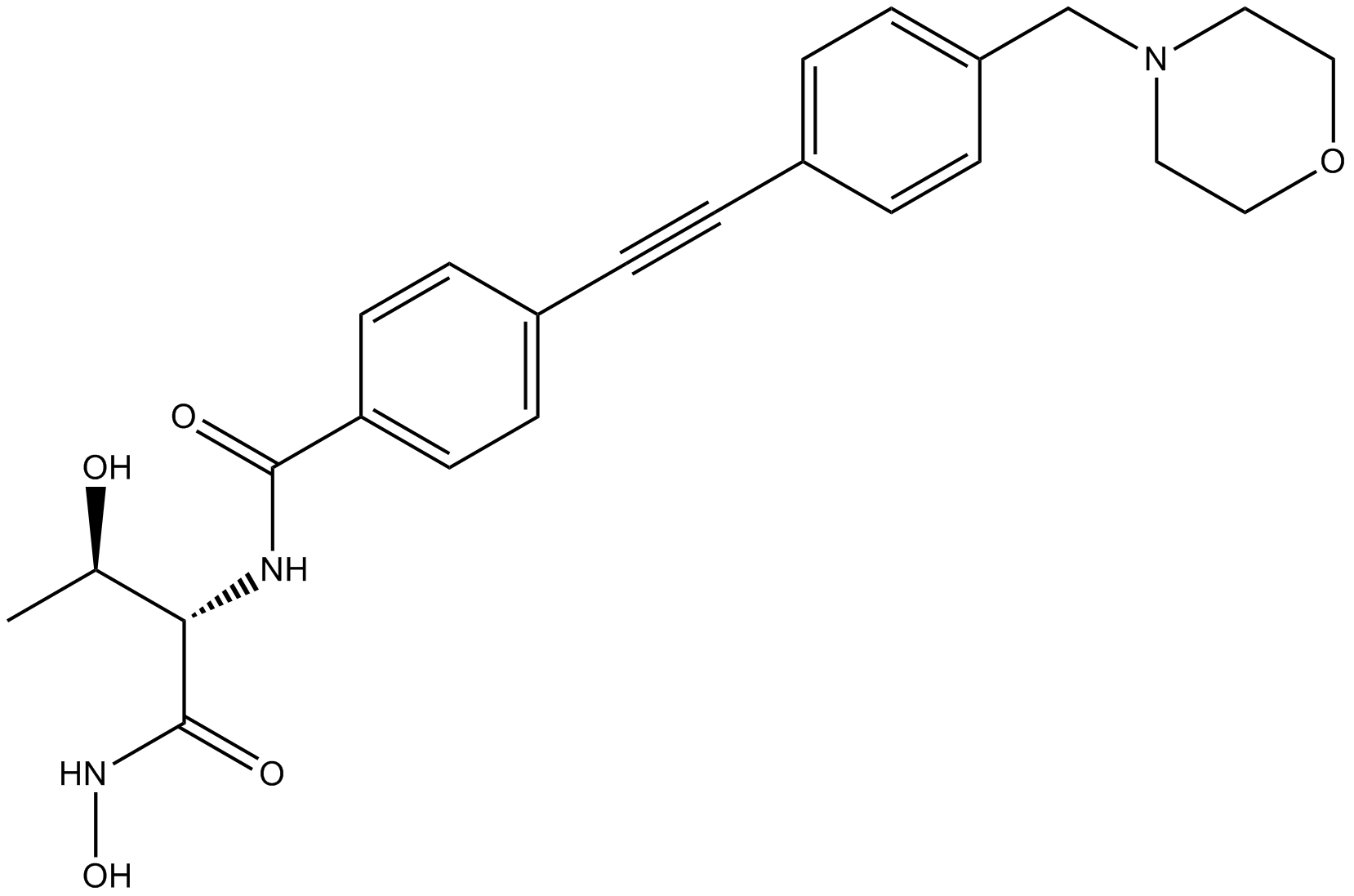
Cas No.: 728865-23-4
Sample solution is provided at 25 µL, 10mM.
_1-3.$$$39978408@51.jpg');)
_1-9.$$$38538795@65.jpg');)
_1-9.$$$39112701@51.jpg');)
_1-7.$$$37316672@70.jpg');)
_366-372.$$$36198801@70.jpg');)
.$$$38565142@65.jpg');)
_1867-1883.$$$33248023@67.jpg');)
_eads6055.$$$39977546@45.jpg');)
_eadm9805.$$$40080571@45.jpg');)
_eadj3020.$$$39666821@45.jpg');)
_1-20.$$$39757301@28.jpg');)
_1-24.$$$38898113@28.jpg');)
_273-287.$$$36806353@46.jpg');)
_1-16.$$$37156877@44.jpg');)
_1-19.$$$37460805@44.jpg');)
_1291-1307.$$$34518654@46.jpg');)
CHIR-090 is a potent, slow, and tight-binding LpxC deacetylase inhibitor, with a Ki value of 4.0nM for binding to Escherichia coli LpxC[1-2]. By specifically inhibiting LpxC, CHIR-090 blocks lipid A biosynthesis, thereby exerting excellent antibiotic activity, and can be used in research targeting Gram-negative bacteria[3-4].
In vitro, CHIR-090 (4μg/ml) was used to treat Pseudomonas aeruginosa, which screened for various resistant mutants, including overexpression mutants of the efflux pump systems MexAB-OprM, MexCD-OprJ, and MexEF-OprN, as well as amino acid substitution mutations in the target LpxC (LpxC L18V) or LpxC overexpression caused by ribosomal binding site mutations[5]. When CHIR-090 (0.1-100μg/ml) was applied to the Burkholderia cepacia complex, CHIR-090 significantly reduced the survival of B. multivorans but showed no inhibitory activity against some strains of B. cenocepacia[6].
In vivo, CHIR-090 (4mg/kg) was administered intraperitoneally to a mouse model implanted with Pseudomonas aeruginosa PAO1 biofilm (single dose). CHIR-090 monotherapy reduced the bacterial load in implants and spleens by approximately 2log10, while combination therapy with polymyxin (10mg/kg) further reduced the bacterial load by 4log10 and inhibited bacterial dissemination to the spleen[7].
References:
[1] Barb AW, Jiang L, Raetz CR, et al. Structure of the deacetylase LpxC bound to the antibiotic CHIR-090: Time-dependent inhibition and specificity in ligand binding. Proc Natl Acad Sci U S A. 2007 Nov 20;104(47):18433-8.
[2] Cole KE, Gattis SG, Angell HD, et al. Structure of the metal-dependent deacetylase LpxC from Yersinia enterocolitica complexed with the potent inhibitor CHIR-090 . Biochemistry. 2011 Jan 18;50(2):258-65.
[3] Amudala S, Sumit, Aidhen IS. LpxC inhibition: Potential and opportunities with carbohydrate scaffolds. Carbohydr Res. 2024 Mar;537:109057.
[4] Niu Z, Lei P, Wang Y, et al. Small molecule LpxC inhibitors against gram-negative bacteria: Advances and future perspectives. Eur J Med Chem. 2023 May 5;253:115326.
[5] Caughlan RE, Jones AK, Delucia AM, et al. Mechanisms decreasing in vitro susceptibility to the LpxC inhibitor CHIR-090 in the gram-negative pathogen Pseudomonas aeruginosa. Antimicrob Agents Chemother. 2012 Jan;56(1):17-27.
[6] Bodewits K, Raetz CR, Govan JR, et al. Antimicrobial activity of CHIR-090, an inhibitor of lipopolysaccharide biosynthesis, against the Burkholderia cepacia complex. Antimicrob Agents Chemother. 2010 Aug;54(8):3531-3.
[7] Tan JH, Vidaillac C, Yam JKH, et al. In Vitro and In Vivo Efficacy of an LpxC Inhibitor, CHIR-090, Alone or Combined with Colistin against Pseudomonas aeruginosa Biofilm. Antimicrob Agents Chemother. 2017 Jun 27;61(7):e02223-16.
| Cell experiment [1]: | |
Cell lines | Pseudomonas aeruginosa (Gram-negative pathogen), Burkholderia cepacia complex strains (including B. multivorans, B. cenocepacia, and other clinical isolates). |
Preparation Method | Bacterial strains were cultured in LB broth or Mueller-Hinton broth under standard aerobic conditions at 37°C. Susceptibility testing was performed using broth micro dilution(CHIR-090; 0.1-100μg/ml) methods. |
Reaction Conditions | 0.1-100μg/ml; 18-24h |
Applications | CHIR-090 significantly inhibited growth of B. multivorans and B. dolosa (e.g., MIC =0.1–6.25µg/mL for B. multivorans strains), but showed no activity against smooth-LPS B. cenocepacia strains (K56-2). The compound’s efficacy correlated with LpxC inhibition, disrupting outer membrane integrity via lipid A biosynthesis blockade. |
| Animal experiment [2]: | |
Animal models | BALB/c mice |
Preparation Method | Mice were subcutaneously inoculated with Pseudomonas aeruginosa PAO1 biofilm-producing strain encapsulated in agar beads (approximately 106CFU per implant) at the dorsal subcutaneous tissue. Treatments began 24h post-infection (CHIR-090; 4mg/kg/dose; intraperitoneal injection; Polymyxin B; 10mg/kg/dose; intraperitoneal injection). |
Dosage form | 4mg/kg/dose; i.p.; single injection |
Applications | CHIR-090 monotherapy significantly reduced bacterial burden in implants and spleens by approximately 2-log10CFU compared to untreated controls. Combination therapy with polymyxin B enhanced efficacy, achieving up to 4-log10CFU reduction in bacterial load and preventing systemic dissemination to the spleen. These findings demonstrate CHIR-090's therapeutic potential in treating Gram-negative biofilm-associated infections in vivo. |
References: | |
| Cas No. | 728865-23-4 | SDF | |
| Synonyms | CHIR 090;CHIR090 | ||
| Chemical Name | N-[(2S,3R)-3-hydroxy-1-(hydroxyamino)-1-oxobutan-2-yl]-4-[2-[4-(morpholin-4-ylmethyl)phenyl]ethynyl]benzamide | ||
| Canonical SMILES | CC(C(C(=O)NO)NC(=O)C1=CC=C(C=C1)C#CC2=CC=C(C=C2)CN3CCOCC3)O | ||
| Formula | C24H27N3O5 | M.Wt | 437.49 |
| Solubility | ≥ 21.85 mg/mL in DMSO | Storage | Store at -20°C |
| General tips | Please select the appropriate solvent to prepare the stock solution according to the
solubility of the product in different solvents; once the solution is prepared, please store it in
separate packages to avoid product failure caused by repeated freezing and thawing.Storage method
and period of the stock solution: When stored at -80°C, please use it within 6 months; when stored
at -20°C, please use it within 1 month. To increase solubility, heat the tube to 37°C and then oscillate in an ultrasonic bath for some time. |
||
| Shipping Condition | Evaluation sample solution: shipped with blue ice. All other sizes available: with RT, or with Blue Ice upon request. | ||
| Prepare stock solution | |||

|
1 mg | 5 mg | 10 mg |
| 1 mM | 2.2858 mL | 11.4288 mL | 22.8577 mL |
| 5 mM | 457.2 μL | 2.2858 mL | 4.5715 mL |
| 10 mM | 228.6 μL | 1.1429 mL | 2.2858 mL |
Step 1: Enter information below (Recommended: An additional animal making an allowance for loss during the experiment)
 g
μL
g
μL
Step 2: Enter the in vivo formulation (This is only the calculator, not formulation. Please contact us first if there is no in vivo formulation at the solubility Section.)
Calculation results:
Working concentration: mg/ml;
Method for preparing DMSO master liquid: mg drug pre-dissolved in μL DMSO ( Master liquid concentration mg/mL, Please contact us first if the concentration exceeds the DMSO solubility of the batch of drug. )
Method for preparing in vivo formulation: Take μL DMSO master liquid, next addμL PEG300, mix and clarify, next addμL Tween 80, mix and clarify, next add μL saline, mix and clarify.
Method for preparing in vivo formulation: Take μL DMSO master liquid, next add μL Corn oil, mix and clarify.
Note: 1. Please make sure the liquid is clear before adding the next solvent.
2. Be sure to add the solvent(s) in order. You must ensure that the solution obtained, in the previous addition, is a clear solution before proceeding to add the next solvent. Physical methods such as vortex, ultrasound or hot water bath can be used to aid dissolving.
3. All of the above co-solvents are available for purchase on the GlpBio website.
Quality Control & SDS
- View current batch:
- Purity: >99.00% Appearance: A solid
- COA (Certificate of Analysis)
- SDS (Safety Data Sheet)
- Datasheet
Average Rating: 5 (Based on Reviews and 30 reference(s) in Google Scholar.)