

Cyanine 5 Tyramide |
Catalog No.GC50458
 One-Click Copy Product Info
|

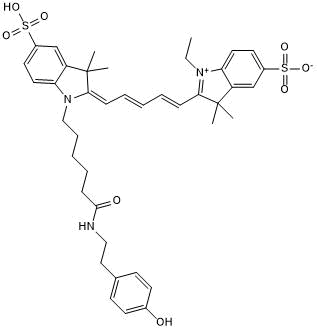
Cyanine 5 Tyramide is a fluorescent signal amplification reagent formed by the chemical conjugation of the Cyanine5 fluorophore with tyramine (ex/em=645/670nm).
Products are for research use only. Not for human use. We do not sell to patients.
Cas No.: 1431148-26-3
Sample solution is provided at 25 µL, 10mM.
_1-3.$$$39978408@51.jpg');)
_1-9.$$$38538795@65.jpg');)
_1-9.$$$39112701@51.jpg');)
_1-7.$$$37316672@70.jpg');)
_366-372.$$$36198801@70.jpg');)
.$$$38565142@65.jpg');)
_1867-1883.$$$33248023@67.jpg');)
_eads6055.$$$39977546@45.jpg');)
_eadm9805.$$$40080571@45.jpg');)
_eadj3020.$$$39666821@45.jpg');)
_1-20.$$$39757301@28.jpg');)
_1-24.$$$38898113@28.jpg');)
_273-287.$$$36806353@46.jpg');)
_1-16.$$$37156877@44.jpg');)
_1-19.$$$37460805@44.jpg');)
_1291-1307.$$$34518654@46.jpg');)
Cyanine 5 Tyramide is a fluorescent signal amplification reagent formed by the chemical conjugation of the Cyanine5 fluorophore with tyramine (ex/em=645/670nm). In the presence of horseradish peroxidase (HRP) catalysis, the tyramine moiety of Cyanine 5 Tyramide is oxidized to generate highly reactive radicals, which covalently bind to tyrosine residues of proteins near the target site, thereby achieving significant signal amplification. Cyanine 5 Tyramide is used in bioimaging research such as immunohistochemistry (IHC), immunofluorescence (IF), and fluorescence in situ hybridization (FISH)[1].
References:
[1] Huang X, Wang J, Liu H, et al. Quantum dot-based FRET for sensitive determination of hydrogen peroxide and glucose using tyramide reaction. Talanta. 2013 Mar 15;106:79-84.
Application Method of Cyanine 5 Tyramide for Detecting Hydrogen Peroxide and Glucose[1]
This protocol is adapted from research data and provided for reference only. Adjustments may be necessary based on specific experimental requirements.
1. Reagent Preparation: Cyanine 5 Tyramide (900nM); Horseradish peroxidase (HRP, Sigma-Aldrich); 1-ethyl-3-(3-dimethylaminopropyl)carbodiimide (EDC) and N-hydroxysuccinimide (NHS) for conjugation; Glucose oxidase (GOx, BBI); Tris buffer (100mM, pH=7.5); Hydrogen peroxide (H₂O₂) standard solution; Glucose standard solution; Bovine serum albumin (BSA) for blocking.
2. Preparation of QD-HRP Conjugates: Mix 24pmol of 605nm QDs with 480pmol of HRP (molar ratio 1:20) in 30μL of phosphate buffer (20mM, pH=6.0). Add 48nmol of EDC and 48nmol of NHS, and incubate at room temperature for 2 hours. Then, add BSA to a final concentration of 1mg/mL and continue incubation for another hour for blocking. Purify the QD-HRP conjugates using an ultrafiltration membrane (100kDa molecular weight cutoff). The final product is stored in borate buffer (4°C). Characterize the conjugates by capillary electrophoresis (CE).
3. Hydrogen Peroxide Detection: The reaction system contains 20nM QD-HRP conjugates and 900nM Cyanine 5 Tyramide in 100mM Tris buffer (pH=7.5). Add 20μL of H₂O₂ solution at various concentrations (0-4.0μM) to 180μL of the reaction mixture and incubate at room temperature for 10 minutes. Measure the fluorescence spectrum using a fluorescence spectrophotometer with an excitation wavelength of 488nm, recording the fluorescence intensity at 605nm (QDs emission) and 670nm (Cy5 emission). The Cy5 fluorescence intensity shows a linear relationship with H₂O₂ concentration in the range of 10-100nM, with a detection limit of 10nM.
4. Glucose Detection: The reaction system contains 20nM QD-HRP conjugates, 900nM Cyanine 5 Tyramide, and 5U/mL glucose oxidase in 100mM Tris buffer (pH=7.5). Add 20μL of glucose solution at various concentrations (0-20.0μM) to 180μL of the reaction mixture and incubate at 37°C for 5 minutes. Measure the fluorescence spectrum. The Cy5 fluorescence intensity shows a linear relationship with glucose concentration in the range of 50-500nM, with a detection limit of 50nM.
Precautions:
(1) A reaction time of 10 minutes is sufficient. Detection should be performed promptly after incubation.
(2) For your safety and health, please wear a lab coat and disposable gloves during operation.
References:
[1] Huang X, Wang J, Liu H, et al. Quantum dot-based FRET for sensitive determination of hydrogen peroxide and glucose using tyramide reaction. Talanta. 2013 Mar 15;106:79-84.
| Cas No. | 1431148-26-3 | SDF | |
| Canonical SMILES | CC[N+]1=C(C(C)(C2=CC(S([O-])(=O)=O)=CC=C12)C)/C=C/C=C/C=C3N(C4=CC=C(S(O)(=O)=O)C=C4C/3(C)C)CCCCCC(NCCC5=CC=C(C=C5)O)=O | ||
| Formula | C41H49N3O8S2 | M.Wt | 775.97 |
| Solubility | DMSO : 62.5 mg/mL (80.54 mM; Need ultrasonic and warming) | Storage | Store at -20°C |
| General tips | Please select the appropriate solvent to prepare the stock solution according to the
solubility of the product in different solvents; once the solution is prepared, please store it in
separate packages to avoid product failure caused by repeated freezing and thawing.Storage method
and period of the stock solution: When stored at -80°C, please use it within 6 months; when stored
at -20°C, please use it within 1 month. To increase solubility, heat the tube to 37°C and then oscillate in an ultrasonic bath for some time. |
||
| Shipping Condition | Evaluation sample solution: shipped with blue ice. All other sizes available: with RT, or with Blue Ice upon request. | ||
| Prepare stock solution | |||

|
1 mg | 5 mg | 10 mg |
| 1 mM | 1.2887 mL | 6.4435 mL | 12.8871 mL |
| 5 mM | 257.7 μL | 1.2887 mL | 2.5774 mL |
| 10 mM | 128.9 μL | 644.4 μL | 1.2887 mL |
Step 1: Enter information below (Recommended: An additional animal making an allowance for loss during the experiment)
 g
μL
g
μL
Step 2: Enter the in vivo formulation (This is only the calculator, not formulation. Please contact us first if there is no in vivo formulation at the solubility Section.)
Calculation results:
Working concentration: mg/ml;
Method for preparing DMSO master liquid: mg drug pre-dissolved in μL DMSO ( Master liquid concentration mg/mL, Please contact us first if the concentration exceeds the DMSO solubility of the batch of drug. )
Method for preparing in vivo formulation: Take μL DMSO master liquid, next addμL PEG300, mix and clarify, next addμL Tween 80, mix and clarify, next add μL saline, mix and clarify.
Method for preparing in vivo formulation: Take μL DMSO master liquid, next add μL Corn oil, mix and clarify.
Note: 1. Please make sure the liquid is clear before adding the next solvent.
2. Be sure to add the solvent(s) in order. You must ensure that the solution obtained, in the previous addition, is a clear solution before proceeding to add the next solvent. Physical methods such as vortex, ultrasound or hot water bath can be used to aid dissolving.
3. All of the above co-solvents are available for purchase on the GlpBio website.
Quality Control & SDS
- View current batch:
- Purity: >95.00% Appearance: A solid
- COA (Certificate of Analysis)
- SDS (Safety Data Sheet)
- Datasheet
Average Rating: 5 (Based on Reviews and 20 reference(s) in Google Scholar.)