

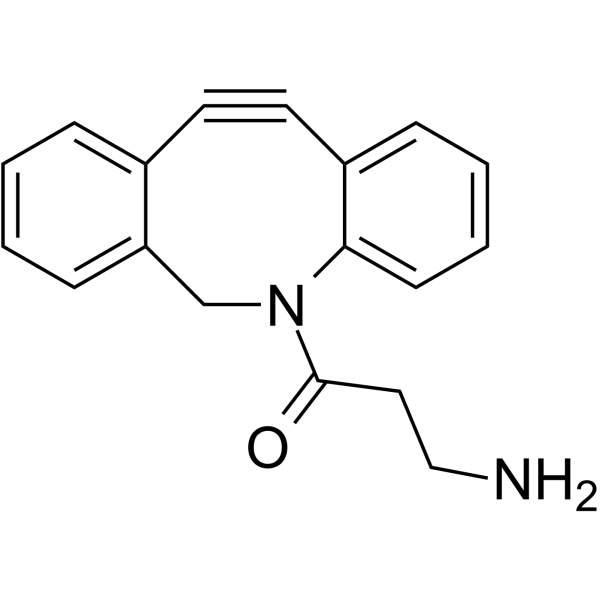
DBCO-amine |
Catalog No.GC63331
 One-Click Copy Product Info
|

DBCO-amine features a highly strained cyclooctyne structure and is commonly used in free-copper click chemistry reactions.
Products are for research use only. Not for human use. We do not sell to patients.
Cas No.: 1255942-06-3
Sample solution is provided at 25 µL, 10mM.
_1-3.$$$39978408@51.jpg');)
_1-9.$$$38538795@65.jpg');)
_1-9.$$$39112701@51.jpg');)
_1-7.$$$37316672@70.jpg');)
_366-372.$$$36198801@70.jpg');)
.$$$38565142@65.jpg');)
_1867-1883.$$$33248023@67.jpg');)
_eads6055.$$$39977546@45.jpg');)
_eadm9805.$$$40080571@45.jpg');)
_eadj3020.$$$39666821@45.jpg');)
_1-20.$$$39757301@28.jpg');)
_1-24.$$$38898113@28.jpg');)
_273-287.$$$36806353@46.jpg');)
_1-16.$$$37156877@44.jpg');)
_1-19.$$$37460805@44.jpg');)
_1291-1307.$$$34518654@46.jpg');)
DBCO-amine features a highly strained cyclooctyne structure and is commonly used in free-copper click chemistry reactions[1]. The amino terminus of DBCO-amine can react with functional groups such as carboxyl groups to form amide bonds, which are utilized for conjugating biological molecules including proteins, antibodies, and nucleic acids[2].
References:
[1] Ackermann U, Jäger L, Rigopoulos A, et al. 18F-labeling and initial in vivo evaluation of a Hitomi peptide for imaging tissue transglutaminase 2. Nucl Med Biol. 2023 Jan-Feb;116-117:108308.
[2] Fuku R, Liu Y, Giuliana P, et al. Efficient Dual Surface Modification of Cellulose Nanocrystals with Hydrophobic Moieties and Functional Polymers via a Grafting-to Approach. Biomacromolecules. 2025 Sep 8;26(9):6233-6243.
Formation of Chelate by DBCO-amine
This protocol is adapted from research data and provided for reference only. Adjustments may be necessary based on specific experimental requirements.
(1) Metalation of Diethylenetriaminepentaacetic Acid (DTPA): Dissolve 10mM DTPA in 100mM MES buffer (pH=5.5) and heat to 75°C to promote dissolution. Add 10mM TbCl₃ and incubate at 75°C for 10 minutes to allow Tb³⁺ to chelate with DTPA, forming the DTPA:Tb complex.
(2) Click Reaction Coupling: Dissolve DBCO-amine in DMSO (final concentration 8.33%) and mix with 10mM DTPA:Tb in 100mM MES buffer (pH=5.5), ensuring the final concentration of DBCO-amine is 50mM. Add 50mM 1-ethyl-3-(3-dimethylaminopropyl)carbodiimide (EDC) and react at room temperature under gentle shaking in the dark for 120 minutes. This facilitates the formation of an amide bond between the amino group of DBCO-amine and the central carboxyl group of DTPA:Tb, yielding the lanthanide chelator (CLC).
(3) Purification and Verification: Load the reaction mixture onto a pre-equilibrated Sephadex G10 size exclusion column and elute with 100mM MES buffer (pH=5.5). Collect fractions with a molecular weight ≥700Da (containing CLC). Verify the formation and purity of CLC using fluorescence spectroscopy (excitation at 350nm, detection at characteristic emission peaks such as 429nm and 544nm) and UPLC-MS (m/z = 806.2).
Precautions:
(1) DBCO-amine is light-sensitive. All steps should be performed in the dark to maintain reagent stability.
(2) For safety and health, wear a lab coat and disposable gloves during operation.
References:
[1] Bishop SC, Winefield R, Anbanandam A, et al. Aqueous synthesis of a small-molecule lanthanide chelator amenable to copper-free click chemistry. PLoS One. 2019 Mar 27;14(3):e0209726.
| Cas No. | 1255942-06-3 | SDF | |
| Formula | C18H16N2O | M.Wt | 276.33 |
| Solubility | Storage | Store at -20°C,protect from light | |
| General tips | Please select the appropriate solvent to prepare the stock solution according to the
solubility of the product in different solvents; once the solution is prepared, please store it in
separate packages to avoid product failure caused by repeated freezing and thawing.Storage method
and period of the stock solution: When stored at -80°C, please use it within 6 months; when stored
at -20°C, please use it within 1 month. To increase solubility, heat the tube to 37°C and then oscillate in an ultrasonic bath for some time. |
||
| Shipping Condition | Evaluation sample solution: shipped with blue ice. All other sizes available: with RT, or with Blue Ice upon request. | ||
| Prepare stock solution | |||

|
1 mg | 5 mg | 10 mg |
| 1 mM | 3.6189 mL | 18.0943 mL | 36.1886 mL |
| 5 mM | 723.8 μL | 3.6189 mL | 7.2377 mL |
| 10 mM | 361.9 μL | 1.8094 mL | 3.6189 mL |
Step 1: Enter information below (Recommended: An additional animal making an allowance for loss during the experiment)
 g
μL
g
μL
Step 2: Enter the in vivo formulation (This is only the calculator, not formulation. Please contact us first if there is no in vivo formulation at the solubility Section.)
Calculation results:
Working concentration: mg/ml;
Method for preparing DMSO master liquid: mg drug pre-dissolved in μL DMSO ( Master liquid concentration mg/mL, Please contact us first if the concentration exceeds the DMSO solubility of the batch of drug. )
Method for preparing in vivo formulation: Take μL DMSO master liquid, next addμL PEG300, mix and clarify, next addμL Tween 80, mix and clarify, next add μL saline, mix and clarify.
Method for preparing in vivo formulation: Take μL DMSO master liquid, next add μL Corn oil, mix and clarify.
Note: 1. Please make sure the liquid is clear before adding the next solvent.
2. Be sure to add the solvent(s) in order. You must ensure that the solution obtained, in the previous addition, is a clear solution before proceeding to add the next solvent. Physical methods such as vortex, ultrasound or hot water bath can be used to aid dissolving.
3. All of the above co-solvents are available for purchase on the GlpBio website.
Quality Control & SDS
- View current batch:
- Purity: >98.00% Appearance: A solid
- COA (Certificate of Analysis)
- SDS (Safety Data Sheet)
- Datasheet
Average Rating: 5 (Based on Reviews and 15 reference(s) in Google Scholar.)