
Startseite>>Natural Products>>DiO

DiO (Synonyms: DiOC18(3); 3,3'-Dioctadecyloxacarbocyanine perchlorate)

Katalog-Nr.GC19515

3,3′-Dioctadecyloxacarbocyaninperchlorat ist ein grÜn fluoreszierender lipophiler Tracer, der in Wasser schwach fluoresziert, aber stark fluoresziert und ziemlich photostabil ist, wenn er in Membranen eingebaut wird.

Products are for research use only. Not for human use. We do not sell to patients.
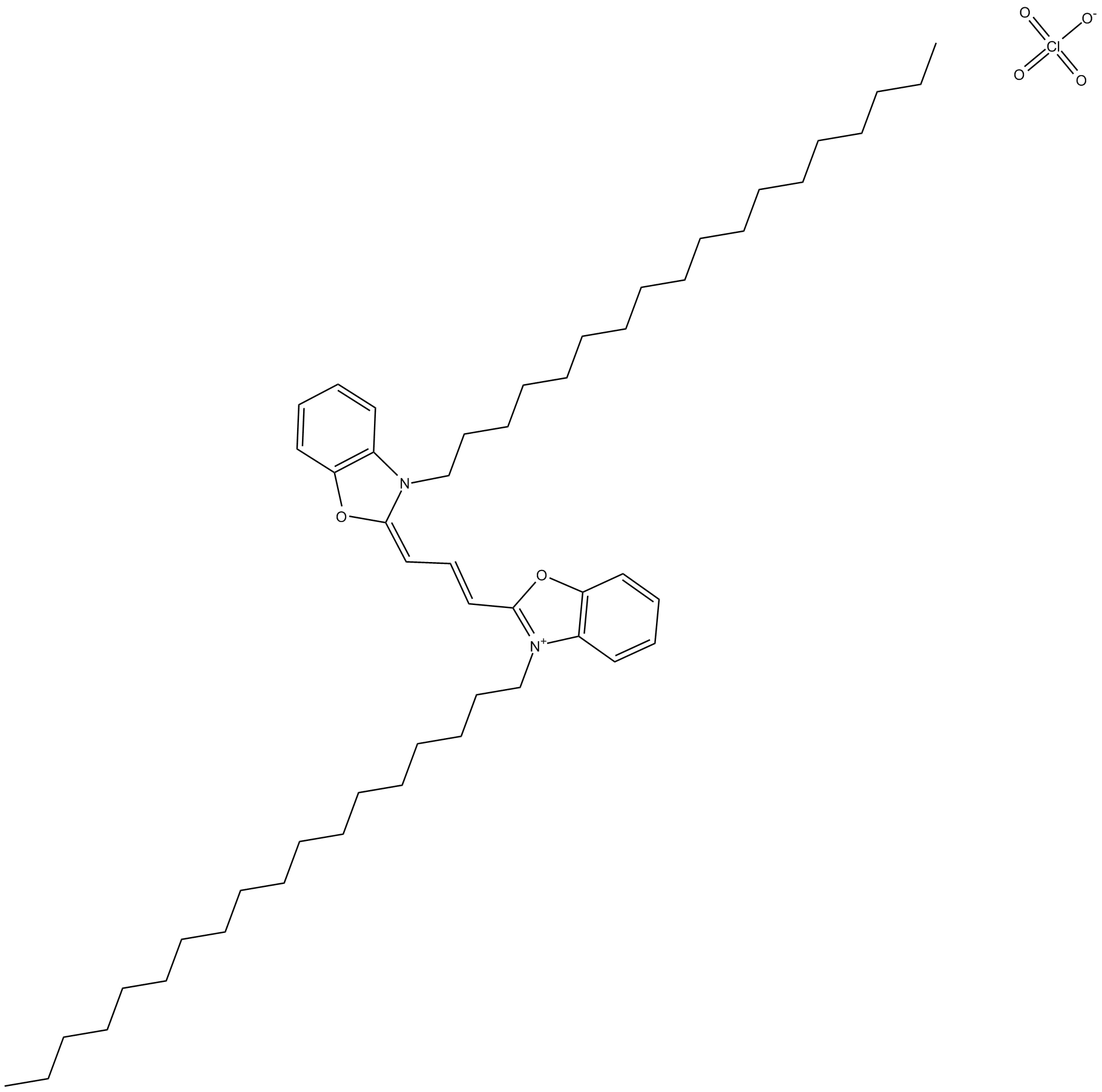
DiO Chemische Struktur

Cas No.: 34215-57-1

Größe Preis Lagerbestand Menge
1mg
26,00 $
Auf Lager
5mg
70,00 $
Auf Lager
10mg
84,00 $
Auf Lager
25mg
154,00 $
Auf Lager
50mg
231,00 $
Auf Lager
100mg
328,00 $
Auf Lager

Tel:(909) 407-4943 Email: sales@glpbio.com


Kundenbewertungen

Basiert auf Kundenrezensionen.

Sample solution is provided at 25 µL, 10mM.

Description of DiO

DiO (3,3′-Dioctadecyloxacarbocyanine perchlorate) is a lipophilic long-chain carbocyanine fluorescent dye that is widely used as Di to label cells, organelles, liposomes, viruses and lipoproteins. 3,3′-Octadecyloxacarbocyanine perchlorate is a green fluorescent lipophilic tracer that is weakly fluorescent in water but highly fluorescent and comparable when incorporated into membranes Photostability. 3,3′-Octadecyloxacarbocyanine perchlorate is used as a fluorescent marker for living cells and as a lipophilic dye for labeling zebrafish embryos[1].

Long-chain carbocyanines include DiO, DiI, DiD, DiR, and the dialkylaminostyrene dye DiA for labeling membranes and other hydrophobic structures. DiO fluorochrome exhibits pronounced fluorescence, which facilitates multicolor imaging and flow cytometry analysis of living cells[2]. DiO can be used with standard FITC filters.

References:

[1]. Anat Samuel, et al. Six3 regulates optic nerve development via multiple mechanisms. 2016 Jan 29;6:20267. doi: 10.1038/srep20267.

[2]. Bhowmik BB, et al. Photophysical studies of 3,3' dioctadecyloxacarbocyanine dye in model biological membranes and different solvents. Chem Phys Lipids. 2001 Feb;109(2):175-83.

Protocol of DiO

This protocol provides a guide only and should be modified according to your specific needs.

1. DiO cell membrane staining solution

(1). Prepare DMSO or EtOH storage solution: use DMSO or EtOH as the storage solution with a concentration of 1-5mM.

Note: Store the unused stock solution in aliquots at -20°C in the dark and avoid repeated freezing and thawing.

(2). Preparation of working solution: Dilute the stock solution with a suitable buffer (such as: serum-free medium, HBSS or PBS) to prepare a working solution with a concentration of 0.5-5 μM.

Note: The final concentration of the working solution is prepared according to the experiences of different cells and experiments. Optimum conditions can be found from more than ten times the recommended concentration.


2. Suspension Cell Staining

(1). Centrifuge the suspended cells at 1000g for 3-5 minutes at 4°C and discard the supernatant. Wash twice with PBS for 5 minutes each.

(2). Add 1mL of DiO working solution and incubate at room temperature for 5-30 minutes. The optimal incubation time is different for different cells.

(3). Centrifuge the stained cell test tube at 1000~1500 rpm for 5 minutes.

(4). Centrifuge at 400g for 3-4 minutes at 4°C and discard the supernatant. Pour off the supernatant and add PBS to wash twice, 5 minutes each time.

(5). Resuspend the cells with serum-free cell culture medium or PBS. Observed by fluorescence microscopy or flow cytometry.


3. Staining of Adhesive Cells

(1). Culture adherent cells on sterile coverslips.

(2). Remove the cover slip from the medium, suck out the excess medium, and place the cover slip in a humid environment.

(3). Add 100uL of dye working solution from one corner of the cover slip and shake gently to make the dye evenly cover all the cells.

(4). Incubate at room temperature for 5-30 minutes, and the optimal incubation time is different for different cells.

(5). Discard the dye working solution and wash the coverslip 2~3 times with the culture medium.

4. Microscopic examination: the excitation/emission light of DiO is 484/501nm respectively.


Note:

1) Fluorescent dyes have quenching problems, please try to avoid light to slow down fluorescence quenching.

2) For your safety and health, please wear a lab coat and disposable gloves for operation.

Chemical Properties of DiO

Cas No. 34215-57-1 SDF
Überlieferungen DiOC18(3); 3,3'-Dioctadecyloxacarbocyanine perchlorate
Canonical SMILES O=Cl(=O)([O-])=O.CCCCCCCCCCCCCCCCCCN1C(C=CC=C2)=C2O/C1=C/C=C/C(OC3=C4C=CC=C3)=[N+]4CCCCCCCCCCCCCCCCCC
Formula C₅₃H₈₅ClN₂O₆ M.Wt 881.7
Löslichkeit DMF : 10 mg/mL (11.34 mM; Need ultrasonic); DMSO : 5 mg/mL (5.67 mM; ultrasonic and warming and heat to 60°C) Storage Store at 4°C, protect from light
General tips Please select the appropriate solvent to prepare the stock solution according to the solubility of the product in different solvents; once the solution is prepared, please store it in separate packages to avoid product failure caused by repeated freezing and thawing.Storage method and period of the stock solution: When stored at -80°C, please use it within 6 months; when stored at -20°C, please use it within 1 month.
To increase solubility, heat the tube to 37°C and then oscillate in an ultrasonic bath for some time.
Shipping Condition Evaluation sample solution: shipped with blue ice. All other sizes available: with RT, or with Blue Ice upon request.

Complete Stock Solution Preparation Table of DiO

Prepare stock solution
1 mg 5 mg 10 mg
1 mM 1.1342 mL 5.6709 mL 11.3417 mL
5 mM 226.8 μL 1.1342 mL 2.2683 mL
10 mM 113.4 μL 567.1 μL 1.1342 mL
  • Molaritätsrechner

  • Verdünnung-Rechner

  • Molecular Weight Calculator

Gewicht
=
Konzentration
x
Inhalt
x
MW*


**Bei der Herstellung von Stammlösungen ist immer das chargenspezifische Molekulargewicht von

Berechnen

In vivo Formulation Calculator (Clear solution) of DiO

Step 1: Enter information below (Recommended: An additional animal making an allowance for loss during the experiment)

mg/kg g μL

Step 2: Enter the in vivo formulation (This is only the calculator, not formulation. Please contact us first if there is no in vivo formulation at the solubility Section.)

% DMSO % % Tween 80 % ddH2O
%DMSO %

Calculation results:

Working concentration: mg/ml;

Method for preparing DMSO master liquid: mg drug pre-dissolved in μL DMSO ( Master liquid concentration mg/mL, Please contact us first if the concentration exceeds the DMSO solubility of the batch of drug. )

Method for preparing in vivo formulation: Take μL DMSO master liquid, next addμL PEG300, mix and clarify, next addμL Tween 80, mix and clarify, next add μL ddH2O, mix and clarify.

Method for preparing in vivo formulation: Take μL DMSO master liquid, next add μL Corn oil, mix and clarify.

Note: 1. Please make sure the liquid is clear before adding the next solvent.
2. Be sure to add the solvent(s) in order. You must ensure that the solution obtained, in the previous addition, is a clear solution before proceeding to add the next solvent. Physical methods such as vortex, ultrasound or hot water bath can be used to aid dissolving.
3. All of the above co-solvents are available for purchase on the GlpBio website.

Product Documents

Quality Control & SDS

View current batch:

Related Video of DiO

    Cell and cell membrane - GlpBio

Bewertungen

Review for DiO

Average Rating: 5 ★★★★★ (Based on Reviews and 11 reference(s) in Google Scholar.)

5 Star
100%
4 Star
0%
3 Star
0%
2 Star
0%
1 Star
0%
Review for DiO

GLPBIO products are for RESEARCH USE ONLY. Please make sure your review or question is research based.

Required fields are marked with *

You may receive emails regarding this submission. Any emails will include the ability to opt-out of future communications.