

Ezetimibe (Synonyms: Ezetrol, SCH 58235) |
Katalog-Nr.GC15605
 One-Click Copy Product Info
|

Ezetimib (SCH 58235) ist ein starker Hemmer der Cholesterinabsorption.
Products are for research use only. Not for human use. We do not sell to patients.
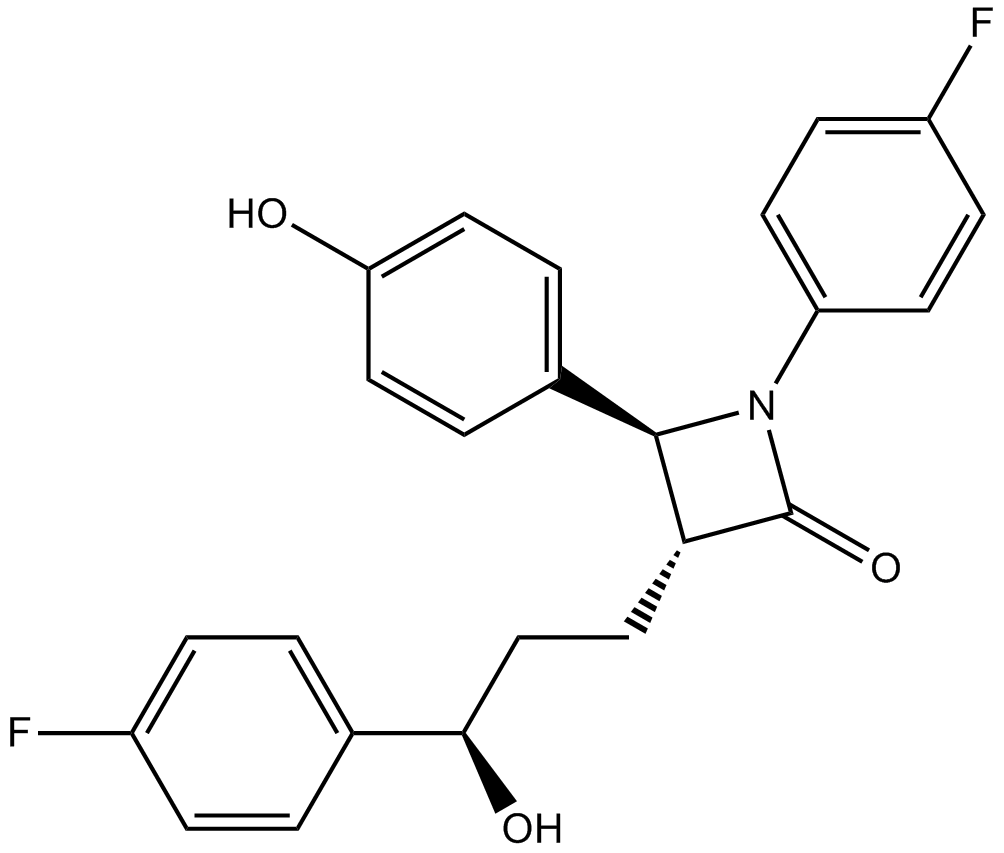
Cas No.: 163222-33-1
Sample solution is provided at 25 µL, 10mM.
_1-3.$$$39978408@51.jpg');)
_1-9.$$$38538795@65.jpg');)
_1-9.$$$39112701@51.jpg');)
_1-7.$$$37316672@70.jpg');)
_366-372.$$$36198801@70.jpg');)
.$$$38565142@65.jpg');)
_1867-1883.$$$33248023@67.jpg');)
_eads6055.$$$39977546@45.jpg');)
_eadm9805.$$$40080571@45.jpg');)
_eadj3020.$$$39666821@45.jpg');)
_1-20.$$$39757301@28.jpg');)
_1-24.$$$38898113@28.jpg');)
_273-287.$$$36806353@46.jpg');)
_1-16.$$$37156877@44.jpg');)
_1-19.$$$37460805@44.jpg');)
_1291-1307.$$$34518654@46.jpg');)
Ezetimibe is a selective cholesterol absorption inhibitor with IC50 values of 50µM for lung cancer cell (A549), human embryonic kidney cells (HEK293) and 30µM for melanoma cell (A375) for 48h[1]. Ezetimibe primarily acts by blocking the Niemann-Pick C1-Like 1 (NPC1L1) protein in the small intestine, reducing the intestinal absorption of dietary and biliary cholesterol, which leads to a decrease in low-density lipoprotein cholesterol (LDL-C) levels [2].
In vitro, Hepa1c1c7 (mouse hepatoma) and MEF (mouse embryonic fibroblast) cells were treated with Ezetimibe (50μM) for 18h. Ezetimibe enhanced transactivation of Nrf2, as revealed by a luciferase reporter assay. Ezetimibe also upregulated Nrf2 target genes, including GSTA1, heme oxygenase-1 (HO-1) and Nqo-1 in a p62-dependent manner. Saturated fatty acids such as PA lead to ROS-mediated apoptotic cell death. Hepa1c1c7 cells pretreated with Ezetimibe (50μM) for 1h and incubated in the presence of PA for 18h have reduced cell death, apoptotic cell death, and TUNEL positive cells. Ezetimibe prevented against PA-induced apoptotic cell death through p62 phosphorylation-mediated Nrf2 activation[3]. The sodium taurocholate co-transporting polypeptide (NTCP), a hepatic bile acid transporter, facilitates α-amanitin entry into hepatocytes. Human normal hepatocytes cells (L-02) and human hepatocellular carcinoma cells (HepG2) were cultured with Ezetimibe (1–6μM) for 48h. Ezetimibe significantly increased the viability of α-amanitin-stimulated hepatocytes and reduced inflammatory factor levels by inhibiting NTCP. Ezetimibe treatment also significantly reduced oxidative stress, with increased serum superoxide dismutase (SOD) and catalase (CAT) levels and decreased malondialdehyde (MDA) levels, suggesting alleviation of α-amanitin-induced oxidative stress[4].
In vivo, albino mice received Ezetimibe at a dose of 2.5mg/kg p.o or a dispersion of the physical mixture of atorvastatin (5mg/kg; p.o) and Ezetimibe (2.5mg/kg; p.o) on daily basis for 2 weeks. Co-administration of both drugs in the form of physical mixture resulted in additional reduction in cholesterol concentration compared with each drug individually and this can be attributed to the synergetic pharmacological effect of atorvastatin and Ezetimibe. This synergistic pharmacological effect was reported as atorvastatin is able to inhibit HMG-CoA reductase (the rate-limiting enzyme in cholesterol biosynthesis in liver) and Ezetimibe that inhibits cholesterol absorption from small intestine[5]. The Wistar rats were randomly assigned to an Ezetimibe or control group at 6 weeks of age. The control group received an high fat diet (60 Kcal%), whereas the Ezetimibe group received an high fat diet (60 Kcal%) containing 160mg/kg Ezetimibe for 14 weeks. The use of Ezetimibe reduced the sizes of adipocytes in visceral fat. Ezetimibe also reduced the accumulation of pro-inflammatory cytokines and induced the production of anti-inflammatory cytokines within adipocytes, leading to increased fatty acid oxidation; reduced levels of free fatty acids and improved insulin resistance[6]. Male obese and diabetic OLETF rats were administered either PBS or Ezetimibe (10mg/kg per day) via stomach gavage for 20 weeks. Ezetimibe significantly decreased liver weight and lipid parameters including triglycerides (TG), free fatty acids (FFA), and total cholesterol (TC) in liver tissue. Autophagy-related mRNA expression including ATG5, ATG6, and ATG7 and the protein level of microtubule-associated protein light chain 3 (LC3) were significantly increased in the liver in rats that received Ezetimibe[7].
References:
[1] Twala C, Malindisa S, Munnik C, Sooklal S, Ntwasa M. Ezetimibe Anticancer Activity via the p53/Mdm2 Pathway. Biomedicines. 2025 Jan 14;13(1):195.
[2] Olmastroni E, Scotti S, Galimberti F, Xie S, Casula M. Ezetimibe: Integrating Established Use with New Evidence - A Comprehensive Review. Curr Atheroscler Rep. 2024 Nov 25;27(1):10.
[3] Lee D H, Han D H, Nam K T, et al. Ezetimibe, an NPC1L1 inhibitor, is a potent Nrf2 activator that protects mice from diet-induced nonalcoholic steatohepatitis. Free Radic Biol Med. 2016 Sep 12;99:520-532.
[4] Xue J F, Lou X R, Ning D Y, et al. Ezetimibe protects against alpha-amanitin-induced hepatotoxicity by targeting the NTCP receptor: Mechanistic insights from in vitro and in vivo models. Toxicon. 2025 Sep:264:108423.
[5] Arafa M F, Alshaikh R A, Abdelquader M M, Maghraby G M E. Co-processing of Atorvastatin and Ezetimibe for Enhanced Dissolution Rate: In Vitro and In Vivo Correlation. AAPS PharmSciTech. 2021 Jan 31;22(2):59.
[6] Cho Y Q, Kim R H, Park H K, et al. Effect of Ezetimibe on Glucose Metabolism and Inflammatory Markers in Adipose Tissue. Biomedicines. 2020 Nov 18;8(11):512.
[7] Chang E, Kim L, Park S E. et al. Ezetimibe improves hepatic steatosis in relation to autophagy in obese and diabetic rats. World J Gastroenterol. 2015 Jul 7;21(25):7754-63.
| Cell experiment [1]: | |
Cell lines | Human normal hepatocytes cells (L-02) and human hepatocellular carcinoma cells (HepG2) |
Preparation Method | Human normal hepatocytes cells (L-02) and human hepatocellular carcinoma cells (HepG2) were cultured with Ezetimibe (1–6μM) for 48h. |
Reaction Conditions | 1–6μM; 48h |
Applications | Ezetimibe significantly increased the viability of α-amanitin-stimulated hepatocytes and reduced inflammatory factor levels by inhibiting NTCP. Ezetimibe treatment also significantly reduced oxidative stress, with increased serum superoxide dismutase (SOD) and catalase (CAT) levels and decreased malondialdehyde (MDA) levels, suggesting alleviation of α-amanitin-induced oxidative stress. |
| Animal experiment [2]: | |
Animal models | OLETF rats |
Preparation Method | Male obese and diabetic OLETF rats were administered either PBS or Ezetimibe (10mg/kg per day) via stomach gavage for 20 weeks. |
Dosage form | 10mg/kg; stomach gavage; daily for 20 weeks |
Applications | In the OLETF rats that received Ezetimibe, liver weight were significantly decreased by 20%. Lipid parameters including TG, FFA, and TC in liver tissue were dramatically decreased at least by 30%. Autophagy-related mRNA expression including ATG5, ATG6, and ATG7 and the protein level of microtubule-associated protein light chain 3 (LC3) were significantly increased in the liver in rats that received Ezetimibe. |
References: | |
| Cas No. | 163222-33-1 | SDF | |
| Überlieferungen | Ezetrol, SCH 58235 | ||
| Chemical Name | (3R,4S)-1-(4-fluorophenyl)-3-[(3S)-3-(4-fluorophenyl)-3-hydroxypropyl]-4-(4-hydroxyphenyl)azetidin-2-one | ||
| Canonical SMILES | C1=CC(=CC=C1C2C(C(=O)N2C3=CC=C(C=C3)F)CCC(C4=CC=C(C=C4)F)O)O | ||
| Formula | C24H21F2NO3 | M.Wt | 409.4 |
| Löslichkeit | ≥ 20.45mg/mL in DMSO | Storage | Store at -20°C |
| General tips | Please select the appropriate solvent to prepare the stock solution according to the
solubility of the product in different solvents; once the solution is prepared, please store it in
separate packages to avoid product failure caused by repeated freezing and thawing.Storage method
and period of the stock solution: When stored at -80°C, please use it within 6 months; when stored
at -20°C, please use it within 1 month. To increase solubility, heat the tube to 37°C and then oscillate in an ultrasonic bath for some time. |
||
| Shipping Condition | Evaluation sample solution: shipped with blue ice. All other sizes available: with RT, or with Blue Ice upon request. | ||
| Prepare stock solution | |||

|
1 mg | 5 mg | 10 mg |
| 1 mM | 2.4426 mL | 12.213 mL | 24.426 mL |
| 5 mM | 488.5 μL | 2.4426 mL | 4.8852 mL |
| 10 mM | 244.3 μL | 1.2213 mL | 2.4426 mL |
Step 1: Enter information below (Recommended: An additional animal making an allowance for loss during the experiment)
 g
μL
g
μL
Step 2: Enter the in vivo formulation (This is only the calculator, not formulation. Please contact us first if there is no in vivo formulation at the solubility Section.)
Calculation results:
Working concentration: mg/ml;
Method for preparing DMSO master liquid: mg drug pre-dissolved in μL DMSO ( Master liquid concentration mg/mL, Please contact us first if the concentration exceeds the DMSO solubility of the batch of drug. )
Method for preparing in vivo formulation: Take μL DMSO master liquid, next addμL PEG300, mix and clarify, next addμL Tween 80, mix and clarify, next add μL saline, mix and clarify.
Method for preparing in vivo formulation: Take μL DMSO master liquid, next add μL Corn oil, mix and clarify.
Note: 1. Please make sure the liquid is clear before adding the next solvent.
2. Be sure to add the solvent(s) in order. You must ensure that the solution obtained, in the previous addition, is a clear solution before proceeding to add the next solvent. Physical methods such as vortex, ultrasound or hot water bath can be used to aid dissolving.
3. All of the above co-solvents are available for purchase on the GlpBio website.
Quality Control & SDS
- View current batch:
- Purity: >99.00% Appearance: A solid
- COA (Certificate of Analysis)
- SDS (Safety Data Sheet)
- Datasheet
Average Rating: 5 (Based on Reviews and 24 reference(s) in Google Scholar.)