

Flavopiridol hydrochloride (Synonyms: Alvocidib, HL 275, HMR 1275, L868,275) |
Katalog-Nr.GC16425
 One-Click Copy Product Info
|

Flavopiridolhydrochlorid (Alvocidibhydrochlorid) ist ein breiter Inhibitor von CDK, der mit ATP konkurriert, um CDKs einschließlich CDK1, CDK2, CDK4 mit IC50-Werten von 30, 170 bzw. 100 nM zu hemmen.
Products are for research use only. Not for human use. We do not sell to patients.
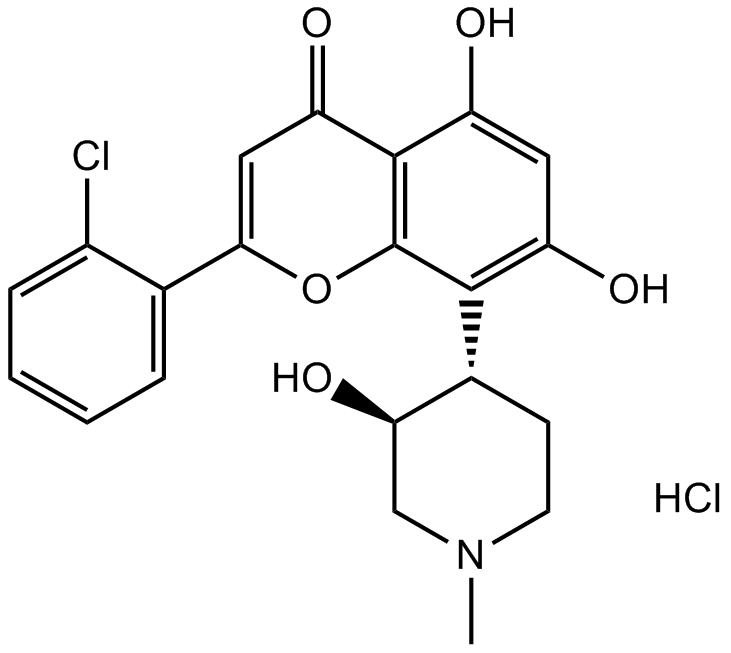
Cas No.: 131740-09-5
Sample solution is provided at 25 µL, 10mM.
_1-3.$$$39978408@51.jpg');)
_1-9.$$$38538795@65.jpg');)
_1-9.$$$39112701@51.jpg');)
_1-7.$$$37316672@70.jpg');)
_366-372.$$$36198801@70.jpg');)
.$$$38565142@65.jpg');)
_1867-1883.$$$33248023@67.jpg');)
_eads6055.$$$39977546@45.jpg');)
_eadm9805.$$$40080571@45.jpg');)
_eadj3020.$$$39666821@45.jpg');)
_1-20.$$$39757301@28.jpg');)
_1-24.$$$38898113@28.jpg');)
_273-287.$$$36806353@46.jpg');)
_1-16.$$$37156877@44.jpg');)
_1-19.$$$37460805@44.jpg');)
_1291-1307.$$$34518654@46.jpg');)
Flavopiridol hydrochloride is a selective inhibitor of CDK1, CDK2, CDK4 and CDK6 with IC50 value all ~41 nM as well as CDK7 with 300nM [1] [2] [3].
CDKs are protein kinase families which involve in the process of regulating transcription, mRNA processing, cell differentiation and cell cycle. It has been shown that CDKs are abnormally expressed in a variety of cells [3].
Flavopiridol hydrochloride is a potent CDK inhibitor and is different from UCN-01. When tested with breast carcinoma cell line MCF-7, flavopiridol hydrochloride treatment showed high inhibitory ability to arrest cell cycle at G1 phase through inhibiting CDK2 and CDK4 [1]. Treated seven lymphoma cell lines with flavopiridol hydrochloride at the concentration of 400 nM, it showed that flavopiridol hydrochloride induced cells apoptosis by inhibiting CDK4, CDK6, CDK7 or CDK9 which in turn inhibited Rb phosphorylation, anti-apoptotic preteins (Mcl-1 and XIAP) [4].
In mouse model with HL-60 subcutaneous xenograft, administration of flavopiridol hydrochloride (7.5 mg/kg) intravenously induced advanced stage animals complete regression with 91.67% and remained disease-free several months after one course of flavopiridol treatment [5].
It has also been reported that flavopiridol hydrochloride inhibited epidermal growth factoe receptor and protein kinase A with IC50 value of 21 and 122 μM, respectively [3].
References:
[1]. Carlson, B.A., et al., Flavopiridol induces G1 arrest with inhibition of cyclin-dependent kinase (CDK) 2 and CDK4 in human breast carcinoma cells. Cancer Res, 1996. 56(13): p. 2973-8.
[2]. Losiewicz, M.D., et al., Potent inhibition of CDC2 kinase activity by the flavonoid L86-8275. Biochem Biophys Res Commun, 1994. 201(2): p. 589-95.
[3]. Senderowicz, A.M., The cell cycle as a target for cancer therapy: basic and clinical findings with the small molecule inhibitors flavopiridol and UCN-01. Oncologist, 2002. 7 Suppl 3: p. 12-9.
[4]. Ema, Y., et al., Investigation of the cytotoxic effect of flavopiridol in canine lymphoma cell lines. Vet Comp Oncol, 2015.
[5]. Arguello, F., et al., Flavopiridol induces apoptosis of normal lymphoid cells, causes immunosuppression, and has potent antitumor activity In vivo against human leukemia and lymphoma xenografts. Blood, 1998. 91(7): p. 2482-90.
|
Kinase experiment: |
Briefly, lysates containing approximately 3×10⁶ cells are incubated with 50 μM LEVD-AFC (caspase 4 substrate) or LETD-AFC (caspase 8 substrate) containing 10 mM dithiothretiol (DTT). Caspase 4 activity is measured one hour after addition of substrate and caspase 8 activity is measured 30 minutes after addition of substrate. Release of free AFC is measured with a Beckman-Coulter DTX 880 multimode detector. |
|
Cell experiment: |
The cells treated with flavopiridol are washed after 4 hours with PBS and resuspended in regular growth medium (RPMI 1640) supplemented with 10% human serum and antibiotics for the remainder of the incubation time. In the case of flavopiridol/chloroquine samples, chloroquine is re-added in the fresh media after flavopiridol is washed at 4 hours. For all the other conditions, cells are incubated with the respective drugs for 24 hours continuously. |
|
References: [1]. Mahoney E, et al. ER stress and autophagy: new discoveries in the mechanism of action and drug resistance of the cyclin-dependent kinase inhibitor flavopiridol.Blood. 2012 Aug 9;120(6):1262-1273. |
|
| Cas No. | 131740-09-5 | SDF | |
| Überlieferungen | Alvocidib, HL 275, HMR 1275, L868,275 | ||
| Chemical Name | 2-(2-chlorophenyl)-5,7-dihydroxy-8-[(3S,4R)-3-hydroxy-1-methylpiperidin-4-yl]chromen-4-one;hydrochloride | ||
| Canonical SMILES | CN1CCC(C(C1)O)C2=C(C=C(C3=C2OC(=CC3=O)C4=CC=CC=C4Cl)O)O.Cl | ||
| Formula | C21H21Cl2NO5 | M.Wt | 438.3 |
| Löslichkeit | ≥ 21.9mg/mL in DMSO | Storage | Store at -20°C |
| General tips | Please select the appropriate solvent to prepare the stock solution according to the
solubility of the product in different solvents; once the solution is prepared, please store it in
separate packages to avoid product failure caused by repeated freezing and thawing.Storage method
and period of the stock solution: When stored at -80°C, please use it within 6 months; when stored
at -20°C, please use it within 1 month. To increase solubility, heat the tube to 37°C and then oscillate in an ultrasonic bath for some time. |
||
| Shipping Condition | Evaluation sample solution: shipped with blue ice. All other sizes available: with RT, or with Blue Ice upon request. | ||
| Prepare stock solution | |||

|
1 mg | 5 mg | 10 mg |
| 1 mM | 2.2815 mL | 11.4077 mL | 22.8154 mL |
| 5 mM | 456.3 μL | 2.2815 mL | 4.5631 mL |
| 10 mM | 228.2 μL | 1.1408 mL | 2.2815 mL |
Step 1: Enter information below (Recommended: An additional animal making an allowance for loss during the experiment)
 g
μL
g
μL
Step 2: Enter the in vivo formulation (This is only the calculator, not formulation. Please contact us first if there is no in vivo formulation at the solubility Section.)
Calculation results:
Working concentration: mg/ml;
Method for preparing DMSO master liquid: mg drug pre-dissolved in μL DMSO ( Master liquid concentration mg/mL, Please contact us first if the concentration exceeds the DMSO solubility of the batch of drug. )
Method for preparing in vivo formulation: Take μL DMSO master liquid, next addμL PEG300, mix and clarify, next addμL Tween 80, mix and clarify, next add μL saline, mix and clarify.
Method for preparing in vivo formulation: Take μL DMSO master liquid, next add μL Corn oil, mix and clarify.
Note: 1. Please make sure the liquid is clear before adding the next solvent.
2. Be sure to add the solvent(s) in order. You must ensure that the solution obtained, in the previous addition, is a clear solution before proceeding to add the next solvent. Physical methods such as vortex, ultrasound or hot water bath can be used to aid dissolving.
3. All of the above co-solvents are available for purchase on the GlpBio website.
Quality Control & SDS
- View current batch:
- Purity: >98.00% Appearance: A solid
- COA (Certificate of Analysis)
- SDS (Safety Data Sheet)
- Datasheet
Average Rating: 5 (Based on Reviews and 32 reference(s) in Google Scholar.)