

Inosinic acid (IMP) |
Katalog-Nr.GC19718
 One-Click Copy Product Info
|

IMP ist ein kÖrpereigener Metabolit.
Products are for research use only. Not for human use. We do not sell to patients.
Cas No.: 131-99-7
Sample solution is provided at 25 µL, 10mM.
_1-3.$$$39978408@51.jpg');)
_1-9.$$$38538795@65.jpg');)
_1-9.$$$39112701@51.jpg');)
_1-7.$$$37316672@70.jpg');)
_366-372.$$$36198801@70.jpg');)
.$$$38565142@65.jpg');)
_1867-1883.$$$33248023@67.jpg');)
_eads6055.$$$39977546@45.jpg');)
_eadm9805.$$$40080571@45.jpg');)
_eadj3020.$$$39666821@45.jpg');)
_1-20.$$$39757301@28.jpg');)
_1-24.$$$38898113@28.jpg');)
_273-287.$$$36806353@46.jpg');)
_1-16.$$$37156877@44.jpg');)
_1-19.$$$37460805@44.jpg');)
_1291-1307.$$$34518654@46.jpg');)
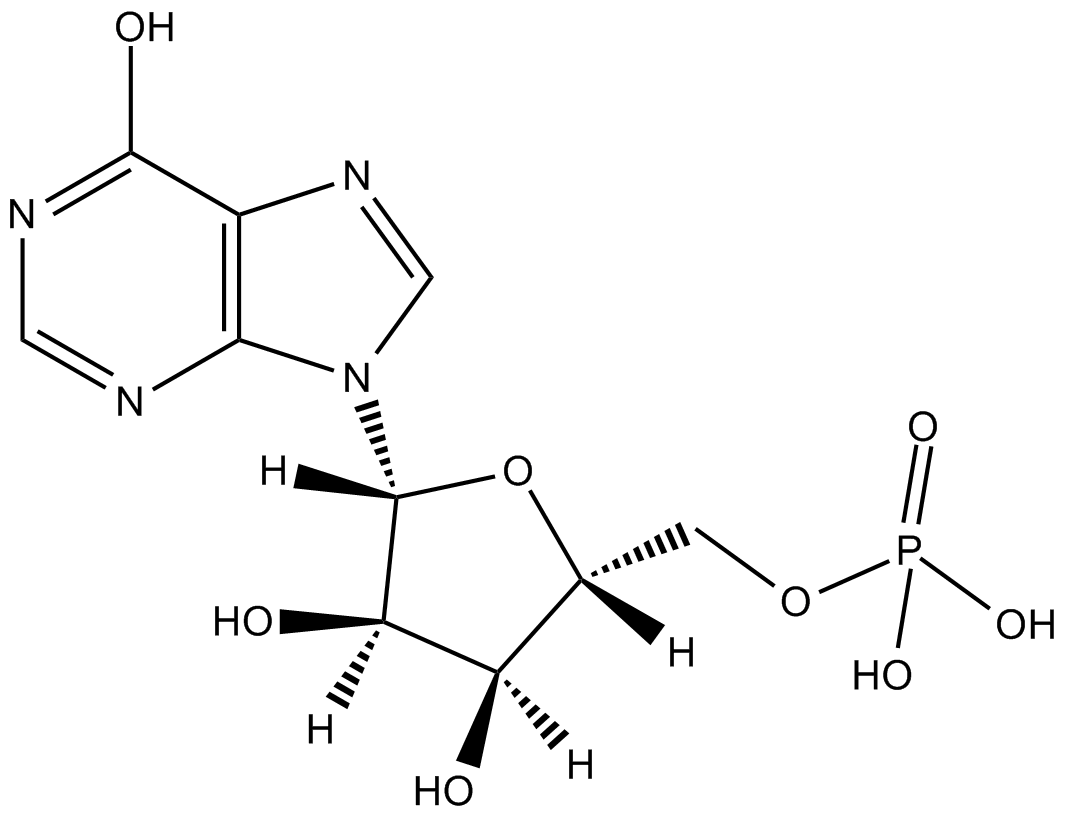
Inosinic acid (IMP) is a nucleotide that plays a central role in purine metabolism and is also an important flavor enhancer in food[1]. Inosinic acid can be further converted into adenosine monophosphate (AMP) and guanosine monophosphate (GMP), and it participates in the energy metabolism process within cells[2]. Inosinic acid is commonly used as a food additive (E630), and when used in combination with monosodium glutamate (MSG), Inosinic acid significantly enhances the umami flavor of food and is widely used in feed additives[3]. Inosinic acid also shows potential research value in immune regulation and neuroprotection[4].
In vitro, treatment of lineage⁻/low bone marrow cells with Inosinic acid (15mM) for 15–30 minutes activates the pAkt and pS6 signaling pathways, stimulating the upregulation of cKit membrane expression and promoting the proliferation of granulocyte-macrophage progenitors (GMP) and the generation of Gr-1⁺ granulocytes[5].
In vivo, Inosinic acid (45mg/kg) was intraperitoneally injected 15 minutes after X-ray irradiation to treat male Kv:SHK strain mice that had undergone 7Gy total body irradiation. Inosinic acid significantly increased the survival rate after a lethal dose of irradiation, alleviated radiation-induced leukopenia and thrombocytopenia, and reduced the level of DNA damage in bone marrow and thymus cells[6]. Inosinic acid (1000mg/kg) was intraperitoneally injected into 10- to 12-week-old C57BL/6J mice with sepsis. Inosinic acid significantly inhibited TNF-α production in sepsis and enhanced IL-10 levels[7].
References:
[1] Dewulf JP, Marie S, Nassogne MC. Disorders of purine biosynthesis metabolism. Mol Genet Metab. 2022 Jul;136(3):190-198.
[2] Takahashi H, Tokura M, Kawarasaki S, et al. Metabolomics reveals inosine 5'-monophosphate is increased during mice adipocyte browning. J Biol Chem. 2022 Oct;298(10):102456.
[3] Zhang GQ, Ma QG, Ji C. Effects of dietary inosinic acid on carcass characteristics, meat quality, and deposition of inosinic acid in broilers. Poult Sci. 2008 Jul;87(7):1364-9.
[4] Duong-Ly KC, Kuo YM, Johnson MC, et al. T cell activation triggers reversible inosine-5'-monophosphate dehydrogenase assembly. J Cell Sci. 2018 Sep 5;131(17):jcs223289.
[5] Luo XM, Lam SM, Dong Y, et al. The purine metabolite inosine monophosphate accelerates myelopoiesis and acute pancreatitis progression. Commun Biol. 2022 Oct 12;5(1):1088.
[6] Asadullina NR, Usacheva AM, Gudkov SV. Protection of mice against X-ray injuries by the post-irradiation administration of inosine-5'-monophosphate. J Radiat Res. 2012;53(2):211-6.
[7] Lovászi M, Németh ZH, Gause WC, et al. Inosine monophosphate and inosine differentially regulate endotoxemia and bacterial sepsis. FASEB J. 2021 Nov;35(11):e21935.
| Cell experiment [1]: | |
Cell lines | Lineage-/low bone marrow cells (murine hematopoietic progenitor cells) |
Preparation Method | Lineage-/low cells were isolated from wild-type C57BL/6 mouse bone marrow using a lineage cell depletion kit. Cells were cultured in SFEM medium supplemented with 10ng/mL stem cell factor, 10ng/mL thrombopoietin, and 10ng/mL IL-3 at 37°C, 5% CO₂. Cells were treated with Inosinic acid at concentrations of 0-15mM for 24-72 hours. |
Reaction Conditions | 0-15mM; 24-72h. |
Applications | Inosinic acid treatment significantly stimulated granulocyte-monocyte progenitor (GMP) cell proliferation and Gr-1+ granulocyte production in a dose-dependent manner. Inosinic acid enhanced BrdU incorporation into GMP cells by 1.3-fold and increased the proportion of Gr-1+ cells by 1.4-fold compared to control cells. |
| Animal experiment [2]: | |
Animal models | C57BL/6 mice |
Preparation Method | Mice were intraperitoneally administered Inosinic acid (1000mg/kg) 30 minutes prior to LPS (10mg/kg, i.p.) challenge. Plasma and organ samples (spleen, liver, lung) were collected 90 minutes post-LPS for cytokine analysis. For bacterial sepsis models, Inosinic acid (1000mg/kg, i.p.) was administered 1 hour before cecal ligation and puncture (CLP) or intranasal bacterial infection (Streptococcus pneumoniae and Escherichia coli). |
Dosage form | 1000mg/kg; i.p. |
Applications | Inosinic acid significantly suppressed TNF-α production and augmented IL-10 levels in endotoxemic mice. |
References: | |
| Cas No. | 131-99-7 | SDF | |
| Canonical SMILES | O[C@]([C@](O)([H])[C@]1([H])N2C=NC3=C2N=CN=C3O)([H])[C@@](O1)([H])COP(O)(O)=O | ||
| Formula | C10H13N4O8P | M.Wt | 348.21 |
| Löslichkeit | insoluble in EtOH; >70 mg/mL in Water | Storage | Store at -20°C |
| General tips | Please select the appropriate solvent to prepare the stock solution according to the
solubility of the product in different solvents; once the solution is prepared, please store it in
separate packages to avoid product failure caused by repeated freezing and thawing.Storage method
and period of the stock solution: When stored at -80°C, please use it within 6 months; when stored
at -20°C, please use it within 1 month. To increase solubility, heat the tube to 37°C and then oscillate in an ultrasonic bath for some time. |
||
| Shipping Condition | Evaluation sample solution: shipped with blue ice. All other sizes available: with RT, or with Blue Ice upon request. | ||
| Prepare stock solution | |||

|
1 mg | 5 mg | 10 mg |
| 1 mM | 2.8718 mL | 14.3592 mL | 28.7183 mL |
| 5 mM | 574.4 μL | 2.8718 mL | 5.7437 mL |
| 10 mM | 287.2 μL | 1.4359 mL | 2.8718 mL |
Step 1: Enter information below (Recommended: An additional animal making an allowance for loss during the experiment)
 g
μL
g
μL
Step 2: Enter the in vivo formulation (This is only the calculator, not formulation. Please contact us first if there is no in vivo formulation at the solubility Section.)
Calculation results:
Working concentration: mg/ml;
Method for preparing DMSO master liquid: mg drug pre-dissolved in μL DMSO ( Master liquid concentration mg/mL, Please contact us first if the concentration exceeds the DMSO solubility of the batch of drug. )
Method for preparing in vivo formulation: Take μL DMSO master liquid, next addμL PEG300, mix and clarify, next addμL Tween 80, mix and clarify, next add μL saline, mix and clarify.
Method for preparing in vivo formulation: Take μL DMSO master liquid, next add μL Corn oil, mix and clarify.
Note: 1. Please make sure the liquid is clear before adding the next solvent.
2. Be sure to add the solvent(s) in order. You must ensure that the solution obtained, in the previous addition, is a clear solution before proceeding to add the next solvent. Physical methods such as vortex, ultrasound or hot water bath can be used to aid dissolving.
3. All of the above co-solvents are available for purchase on the GlpBio website.
Quality Control & SDS
- View current batch:
- Purity: >98.00% Appearance: A solid
- COA (Certificate of Analysis)
- SDS (Safety Data Sheet)
- Datasheet
Average Rating: 5 (Based on Reviews and 18 reference(s) in Google Scholar.)