

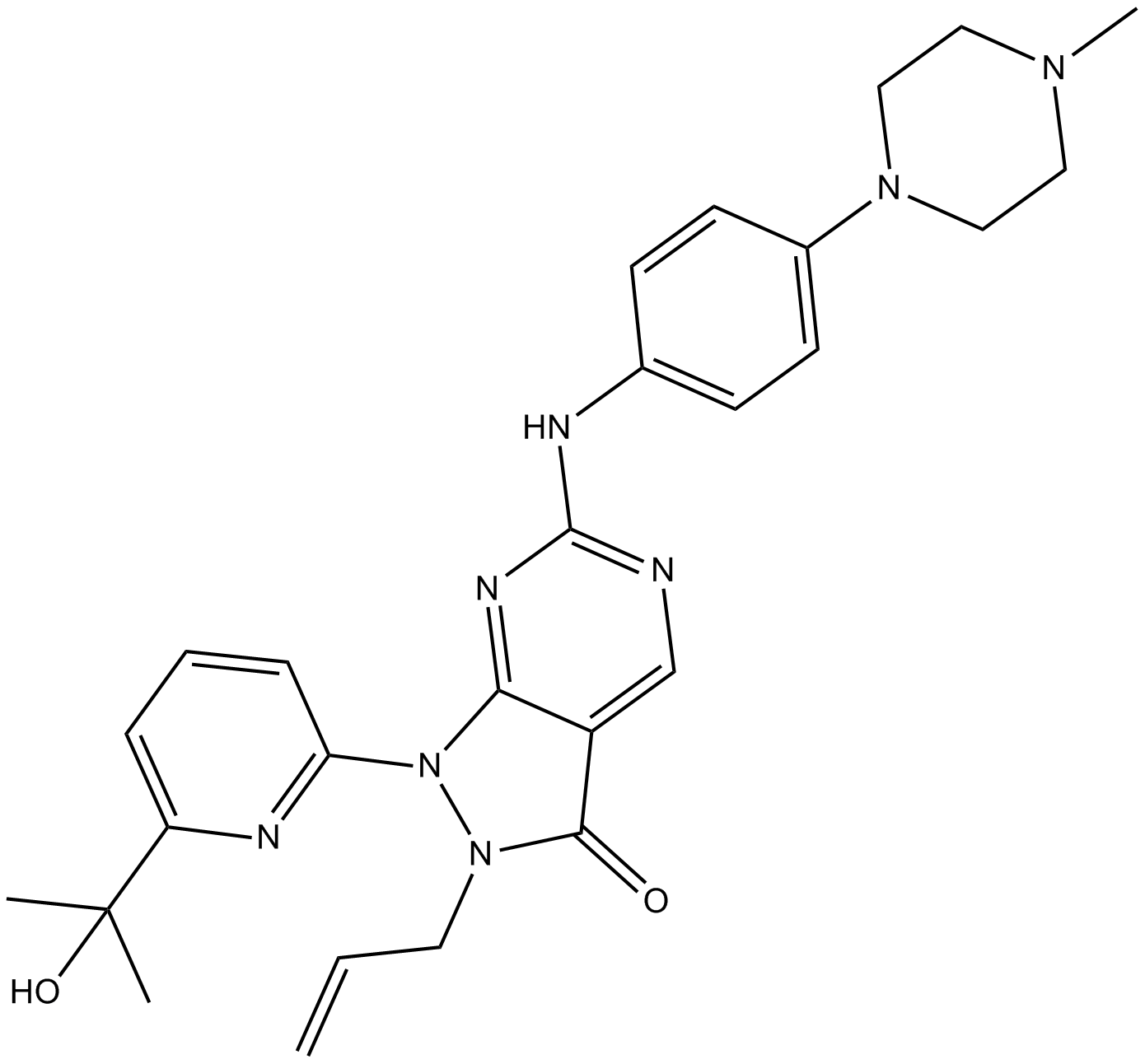
MK-1775 (Synonyms: MK1775,MK 1775) |
Katalog-Nr.GC16030
 One-Click Copy Product Info
|

MK-1775 ist ein potenter und selektiver niedermolekularer Inhibitor der Wee1-Kinase mit einem IC50-Wert von 5.2 nM.
Products are for research use only. Not for human use. We do not sell to patients.
Cas No.: 955365-80-7
Sample solution is provided at 25 µL, 10mM.
_1-3.$$$39978408@51.jpg');)
_1-9.$$$38538795@65.jpg');)
_1-9.$$$39112701@51.jpg');)
_1-7.$$$37316672@70.jpg');)
_366-372.$$$36198801@70.jpg');)
.$$$38565142@65.jpg');)
_1867-1883.$$$33248023@67.jpg');)
_eads6055.$$$39977546@45.jpg');)
_eadm9805.$$$40080571@45.jpg');)
_eadj3020.$$$39666821@45.jpg');)
_1-20.$$$39757301@28.jpg');)
_1-24.$$$38898113@28.jpg');)
_273-287.$$$36806353@46.jpg');)
_1-16.$$$37156877@44.jpg');)
_1-19.$$$37460805@44.jpg');)
_1291-1307.$$$34518654@46.jpg');)
MK-1775 ist ein potenter und selektiver niedermolekularer Inhibitor der Wee1-Kinase mit einem IC50-Wert von 5.2 nM. Mit einem IC50-Wert von 14 nM ist MK-1775 zwei- bis dreimal weniger wirksam gegen Yes[1].
In-vitro-Wirksamkeitstests zeigten, dass MK-1775 die Phosphorylierung von CDC2 an Tyr15 mit einem EC50-Wert von 85 nM in mit Gemcitabin vorbehandelten Zellen hemmte. Die Behandlung mit MK-1775 induzierte pHH3 dosisabhängig mit einem EC50-Wert von 81 nM[1]. In-vitro-Wirksamkeitstests zeigten, dass bei einer Behandlung mit 10 nM Panobinostat in Kombination mit 250 nM oder 500 nM MK-1775 in U937-Zellen die Kombinationsindexwerte(CI) 0.95 und 0.73 waren, während die Werte bei mit 20 nM Panobinostat in Kombination mit 250 nM oder 500 nM MK-1775 behandelten U937-Zellen 0.39 bzw. 0.40 waren[3]. In vitro induzierte eine Behandlung mit 0.1, 0.3, 1 μM MK-1775 über 48 Stunden in LSCC-Zellen und TU212- und KB-3-1-Zellen dosisabhängig eine frühe Apoptose(Annexin V+/PI-) und späte Apoptose(Annexin V+/PI+). Außerdem stiegen nach der Behandlung mit MK-1775 die Proteinspiegel des Apoptosemarkers gespaltenes PARP dosisabhängig an[5].
In vivo verstärkte die orale Gabe von 60 mg/kg MK-1775 das Ansprechen von H1299-Xenograft-Tumoren auf fraktionierte Strahlentherapie bei Nacktmäusen[2]. In-vivo-Experimente zeigten, dass die Behandlung mit MK-1775 (20 mg/kg) oder Panobinostat(10 mg/kg) allein bei Mäusen mit BxPC-3-Xenograft-Tumoren eine moderate Verzögerung des extern messbaren Tumorwachstums(30.9% bzw. 37.8% am 20. Tag)bewirkte. Aber die Kombination von MK-1775 (20 mg/kg) mit Panobinostat(10 mg/kg) konnte das Tumorwachstum deutlich verzögern, mit einer Tumorwachstumshemmung von 58.7% am 20. Tag[4]. In vivo wurden Nacktmäuse oral mit 50 mg/kg MK-1775 behandelt. MK-1775 hemmte das Wachstum von KB-3-1-Xenotransplantaten mit einer Hemmrate von 30.04%, dadurch dass es Tumorvolumen und -gewicht reduzierte. MK-1775 kann in der angegebenen Dosis bei Mäusen auch toxisch wirken[6].
References:
[1]Hirai H, et al. MK-1775, a small molecule Wee1 inhibitor, enhances anti-tumor efficacy of various DNA-damaging agents, including 5-fluorouracil. Cancer Biol Ther. 2010 Apr 1;9(7):514-22.
[2]Bridges KA, et al. MK-1775, a novel Wee1 kinase inhibitor, radiosensitizes p53-defective human tumor cells. Clin Cancer Res. 2011 Sep 1;17(17):5638-48.
[3]Qi W, et al. Synergistic anti-leukemic interactions between panobinostat and MK-1775 in acute myeloid leukemia ex vivo. Cancer Biol Ther. 2015;16(12):1784-93.
[4]Wang G, et al. Synergistic antitumor interactions between MK-1775 and panobinostat in preclinical models of pancreatic cancer. Cancer Lett. 2015 Jan 28;356(2 Pt B):656-68.
[5]Yuan ML, et al Inhibition of WEE1 Suppresses the Tumor Growth in Laryngeal Squamous Cell Carcinoma. Front Pharmacol. 2018 Sep 28;9:1041.
[6]Yuan ML, et al. Inhibition of WEE1 Suppresses the Tumor Growth in Laryngeal Squamous Cell Carcinoma. Front Pharmacol. 2018 Sep 28;9:1041.
| Zellexperiment [1]: | |
Zelllinien | H1299-Zellen |
Vorbereitungsmethode | H1299-Zellen wurden 1 Stunde lang mit 200 nM MK-1775 behandelt, mit 7.5 Gy bestrahlt, weitere 18 Stunden in MK-1775 inkubiert und 24, 48 und 72 Stunden nach der Bestrahlung zur Beurteilung der Apoptose geerntet. |
Reaktionsbedingungen | 200 nM, 1 Stunde |
Anwendungen | Die Dosis von 7.5 Gy induzierte zu jedem Zeitpunkt ein Apoptoseniveau, das nur etwa 5% über dem Kontrollniveau lag, und das Apoptoseniveau wurde durch MK-1775 nicht erheblich erhöht. |
| Tierversuch [2]: | |
Tiermodelle | 6 Wochen alte weibliche nu/nu athymische Mäuse |
Vorbereitungsmethode | Als die Tumore ein Volumen von ~200 mm3 erreichten, wurden die Mäuse einzeln identifiziert und zufällig Behandlungsgruppen mit jeweils 5–6 Mäusen(8-10 auswertbare Tumoren) in jeder Gruppe zugewiesen: 1) Kontrolle; 2) MK-1775(30 mg/kg. p.o., einmal täglich für 4 Wochen); 3) GEM(100 mg/kg, i.p., zweimal wöchentlich an den Tagen 1 und 3) für 4 Wochen; 4) GEM, 24 Stunden später gefolgt von MK-1775 in der oben genannten Dosis. |
Dosierungsform | 30 mg/kg. p.o. |
Anwendungen | Die Behandlung mit dem Einzelwirkstoff MK-1775 führte bei zwei Xenotransplantaten(PANC286 und PANC198) zu einer Hemmung des Tumorwachstums um mehr als 50%. |
References: | |
| Cas No. | 955365-80-7 | SDF | |
| Überlieferungen | MK1775,MK 1775 | ||
| Chemical Name | 1-[6-(2-hydroxypropan-2-yl)pyridin-2-yl]-6-[4-(4-methylpiperazin-1-yl)anilino]-2-prop-2-enylpyrazolo[3,4-d]pyrimidin-3-one | ||
| Canonical SMILES | CC(C)(C1=NC(=CC=C1)N2C3=NC(=NC=C3C(=O)N2CC=C)NC4=CC=C(C=C4)N5CCN(CC5)C)O | ||
| Formula | C27H32N8O2 | M.Wt | 500.6 |
| Löslichkeit | ≥ 25.03mg/mL in DMSO | Storage | Store at -20°C |
| Shipping Condition | Evaluation sample solution: shipped with blue ice. All other sizes available: with RT, or with Blue Ice upon request. | ||
| Prepare stock solution | |||

|
1 mg | 5 mg | 10 mg |
| 1 mM | 1.9976 mL | 9.988 mL | 19.976 mL |
| 5 mM | 399.5 μL | 1.9976 mL | 3.9952 mL |
| 10 mM | 199.8 μL | 998.8 μL | 1.9976 mL |
Step 1: Enter information below (Recommended: An additional animal making an allowance for loss during the experiment)
 g
μL
g
μL
Step 2: Enter the in vivo formulation (This is only the calculator, not formulation. Please contact us first if there is no in vivo formulation at the solubility Section.)
Calculation results:
Working concentration: mg/ml;
Method for preparing DMSO master liquid: mg drug pre-dissolved in μL DMSO ( Master liquid concentration mg/mL, Please contact us first if the concentration exceeds the DMSO solubility of the batch of drug. )
Method for preparing in vivo formulation: Take μL DMSO master liquid, next addμL PEG300, mix and clarify, next addμL Tween 80, mix and clarify, next add μL saline, mix and clarify.
Method for preparing in vivo formulation: Take μL DMSO master liquid, next add μL Corn oil, mix and clarify.
Note: 1. Please make sure the liquid is clear before adding the next solvent.
2. Be sure to add the solvent(s) in order. You must ensure that the solution obtained, in the previous addition, is a clear solution before proceeding to add the next solvent. Physical methods such as vortex, ultrasound or hot water bath can be used to aid dissolving.
3. All of the above co-solvents are available for purchase on the GlpBio website.
Quality Control & SDS
- View current batch:
- Purity: >99.50% Appearance: A solid
- COA (Certificate of Analysis)
- SDS (Safety Data Sheet)
- Datasheet
Average Rating: 5 (Based on Reviews and 10 reference(s) in Google Scholar.)