

Fluzoparib |
Catalog No.GC62121
 One-Click Copy Product Info
|

Fluzoparib (SHR3162) is a potent and orally active PARP1 inhibitor (IC50=1.46±0.72 nM, a cell‐free enzymatic assay) with superior antitumor activity. Fluzoparib selectively inhibits the proliferation of homologous recombination repair (HR)‐deficient cells, and sensitizes both HR‐deficient and HR‐proficient cells to cytotoxic agents. Fluzoparib exhibits good pharmacokinetic properties in vivo and can be used for BRCA1/2-mutant relapsed ovarian cancer research.
Products are for research use only. Not for human use. We do not sell to patients.
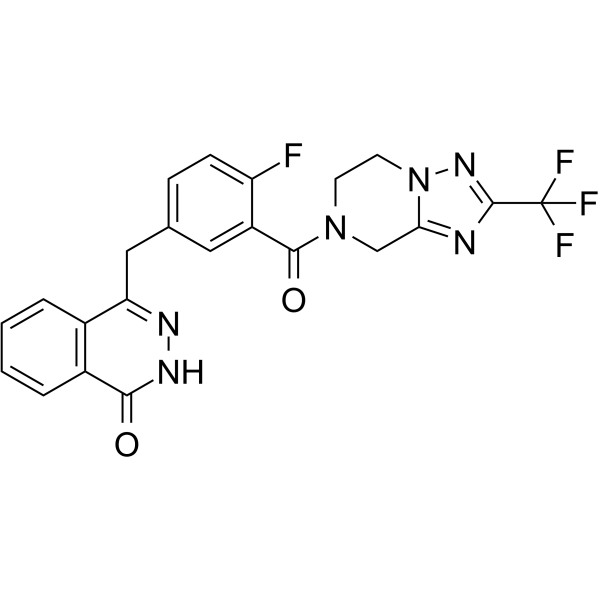
Cas No.: 1358715-18-0
Sample solution is provided at 25 µL, 10mM.
_1-3.$$$39978408@51.jpg');)
_1-9.$$$38538795@65.jpg');)
_1-9.$$$39112701@51.jpg');)
_1-7.$$$37316672@70.jpg');)
_366-372.$$$36198801@70.jpg');)
.$$$38565142@65.jpg');)
_1867-1883.$$$33248023@67.jpg');)
_eads6055.$$$39977546@45.jpg');)
_eadm9805.$$$40080571@45.jpg');)
_eadj3020.$$$39666821@45.jpg');)
_1-20.$$$39757301@28.jpg');)
_1-24.$$$38898113@28.jpg');)
_273-287.$$$36806353@46.jpg');)
_1-16.$$$37156877@44.jpg');)
_1-19.$$$37460805@44.jpg');)
_1291-1307.$$$34518654@46.jpg');)
Fluzoparib (SHR3162) is a potent and orally active PARP1 inhibitor (IC50=1.46±0.72 nM, a cell‐free enzymatic assay) with superior antitumor activity. Fluzoparib selectively inhibits the proliferation of homologous recombination repair (HR)‐deficient cells, and sensitizes both HR‐deficient and HR‐proficient cells to cytotoxic agents. Fluzoparib exhibits good pharmacokinetic properties in vivo and can be used for BRCA1/2-mutant relapsed ovarian cancer research[1].
Fluzoparib (30 μM; 24 hour) increases the levels of γH2AX in a concentration‐dependent manner in both BRCA2‐deficient V‐C8 cells and BRCA1‐deficient MDA‐MB‐436 cells, but not in BRCA‐proficient V‐C8#13‐5 cells[1].Fluzoparib (10 μM; 24 hour) increases levels of both pCDK1 and cyclin B, indicating activation of the G2/M checkpoint in MDA‐MB‐436 cells[1].Fluzoparib (10 μM; 72 hour) increases the processing of caspase‐3, ‐8, and ‐9 concentration‐dependently, it induces G2/M arrest and apoptosis in HR‐deficient MDA‐MB‐436 cells cells[1].Fluzoparib is preferentially efficacious against HR‐deficient cells, such as BRCA1‐deficient (UWB1.289), MDA‐MB‐436, BRCA2‐deficient (V‐C8), BRCA1‐deficientBRCA2‐mutated (MX‐1) and BRCA1 hypermethylated (OVCAR‐8) cells with IC50 values of 0.51 μM, 1.57 μM, 0.053 μM, 1.57 μM, and 1.43 μM, respectively. The IC50 values for HR‐proficient cells (V‐C8#13‐5 and UWB1.289 BRCA1) are both >10 μM[1].
Fluzoparib (oral gavage; 0.3, 1, or 3 mg/kg; single dose) exhibits a good pharmacokinetic profile in Female Balb/cA nude mice (5‐6 weeks old) mice bearing MDA‐MB‐436. After a single oral dose, fluzoparib is rapidly absorbed and rapidly cleared from blood at all dose levels; plasma concentrations of fluzoparib quickly reaches maximum within 2 hours. In contrast, concentrations of fluzoparib in tumor remains at high levels even at 24 hours after dosing (57.9 ng/g , 39.3 ng/g, and 85.6 ng/g for doses of 0.3, 1, and 3 mg/kg, respectively)[1].Fluzoparib (oral gavage; 30 mg/kg; 21 days) apparently inhibits the growth of tumor with an inhibition rate of 59% (day 21) at 30 mg/kg, and it does not cause significant loss of body weight in Nude mice bearing MDA‐MB‐436 (BRCA1‐deficient) model[1].Fluzoparib (3mg/kg) combines with Cisplatin, Paclitaxel, or Apatinib (oral gavage; BID; 21 days) causes growth inhibition with rates of 61.4%, 55.3%, and 72.8%, respectively.Fluzoparib, Cisplatin, and Apatinib combination or Fluzoparib, Paclitaxel, and Apatinib combination can cause growth inhibition with rates of 84.9% and 75.6% (day 21), respectively in vivo.The 2‐drug combination of Fluzoparib with cisplatin and The 3‐drug Fluzoparib, Cisplatin, and Apatinib combination lead to loss of body weight, whereas no apparent toxicity was observed in other combinations[1].
[1]. Lei Wang, et al. Pharmacologic characterization of fluzoparib, a novel poly(ADP-ribose) polymerase inhibitor undergoing clinical trials. Cancer Sci. 2019 Mar;110(3):1064-1075.
[2]. Huiping Li, et al. Phase I dose-escalation and expansion study of PARP inhibitor, fluzoparib (SHR3162), in patients with advanced solid tumors. Chin J Cancer Res. 2020 Jun;32(3):370-382.
| Cas No. | 1358715-18-0 | SDF | |
| Formula | C22H16F4N6O2 | M.Wt | 472.4 |
| Solubility | DMSO : 50 mg/mL (105.84 mM; Need ultrasonic) | Storage | Store at -20°C |
| General tips | Please select the appropriate solvent to prepare the stock solution according to the
solubility of the product in different solvents; once the solution is prepared, please store it in
separate packages to avoid product failure caused by repeated freezing and thawing.Storage method
and period of the stock solution: When stored at -80°C, please use it within 6 months; when stored
at -20°C, please use it within 1 month. To increase solubility, heat the tube to 37°C and then oscillate in an ultrasonic bath for some time. |
||
| Shipping Condition | Evaluation sample solution: shipped with blue ice. All other sizes available: with RT, or with Blue Ice upon request. | ||
| Prepare stock solution | |||

|
1 mg | 5 mg | 10 mg |
| 1 mM | 2.1169 mL | 10.5843 mL | 21.1685 mL |
| 5 mM | 423.4 μL | 2.1169 mL | 4.2337 mL |
| 10 mM | 211.7 μL | 1.0584 mL | 2.1169 mL |
Step 1: Enter information below (Recommended: An additional animal making an allowance for loss during the experiment)
 g
μL
g
μL
Step 2: Enter the in vivo formulation (This is only the calculator, not formulation. Please contact us first if there is no in vivo formulation at the solubility Section.)
Calculation results:
Working concentration: mg/ml;
Method for preparing DMSO master liquid: mg drug pre-dissolved in μL DMSO ( Master liquid concentration mg/mL, Please contact us first if the concentration exceeds the DMSO solubility of the batch of drug. )
Method for preparing in vivo formulation: Take μL DMSO master liquid, next addμL PEG300, mix and clarify, next addμL Tween 80, mix and clarify, next add μL saline, mix and clarify.
Method for preparing in vivo formulation: Take μL DMSO master liquid, next add μL Corn oil, mix and clarify.
Note: 1. Please make sure the liquid is clear before adding the next solvent.
2. Be sure to add the solvent(s) in order. You must ensure that the solution obtained, in the previous addition, is a clear solution before proceeding to add the next solvent. Physical methods such as vortex, ultrasound or hot water bath can be used to aid dissolving.
3. All of the above co-solvents are available for purchase on the GlpBio website.
Quality Control & SDS
- View current batch:
- Purity: >98.00% Appearance: A solid
- COA (Certificate of Analysis)
- SDS (Safety Data Sheet)
- Datasheet
Average Rating: 5 (Based on Reviews and 3 reference(s) in Google Scholar.)