

Boc-Gln-Ala-Arg-AMC . HCl |
Catalog No.GA20991
 One-Click Copy Product Info
|

Boc-Gln-Ala-Arg-AMC·HCl is a fluorescent substrate commonly used for the detection of trypsin activity, as well as for measuring the proteolytic activity of TMPRSS2.
Products are for research use only. Not for human use. We do not sell to patients.
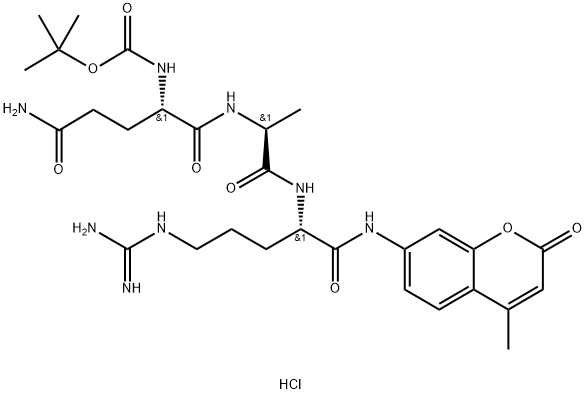
Cas No.: 201849-55-0
Sample solution is provided at 25 µL, 10mM.
Boc-Gln-Ala-Arg-AMC·HCl is a fluorescent substrate commonly used for the detection of trypsin activity, as well as for measuring the proteolytic activity of TMPRSS2[1]. When specific enzymes act on this substrate, the fluorescent group 7-amido-4-methylcoumarin (AMC) is released. By measuring the fluorescence intensity of AMC, the activity of the enzyme can be quantitatively analyzed. The excitation wavelength of AMC is 380 nm, and its emission wavelength is 460 nm[2].
References:
[1]Mosztbacher D, et al. Measuring digestive protease activation in the mouse pancreas. Pancreatology. 2020 Mar;20(2):288-292.
[2]Fang, Ye, Shuang, et al.3‐Cl‐AHPC inhibits pro‐HGF maturation by inducing matriptase/HAI‐1 complex formation[J].Journal of Cellular & Molecular Medicine, 2018 Oct.
This plan only provides a guide, please modify it to meet your specific needs.
1.Solution Preparation
(1) Prepare stock solution: Equilibrate the cryopreserved solid to room temperature, use DMSO to dissolve Boc-Gln-Ala-Arg-AMC. HCl, and prepare a 5mM storage solution.
Note: Unused stock solution should be aliquoted and stored in the dark at -20°C or -80°C to avoid repeated freeze-thaw cycles.
(2) Prepare working solution: Before the formal experiment, dilute the stock solution to the desired working concentration, such as 200μM, using an appropriate buffer.
Note:Optimal working concentrations should be adjusted based on actual conditions or determined by consulting literature and performing gradient concentration trials. Working solutions must be prepared fresh.
2.Steps to Measure Protease-Released AMC from Synthetic Substrate[1] (Reference only)
(1) Prepare samples according to experimental requirements.
(2) The experiment was conducted in a total volume of 200 μL, containing 5 μL of concentrated sample, 5 μL of substrate Boc-Gln-Ala-Arg-AMC. HCl stock solution (5 mM), and 190 μL of Tris HCl (100 mM, pH 8.5, containing 100 μg/mL bovine serum albumin).
(3) Fluorescence spectrophotometry is used to measure the fluorescence of AMC released by the hydrolysis of Boc-Gln-Ala-Arg-AMC·HCl, with an excitation wavelength of 380 nm and emission wavelength of 460 nm.
3.Steps to Measure Pancreatic Trypsin Activity [2] (Reference only)
(1) Pancreas Preparation: Approximately 40-50mg of pancreas tissue is homogenized in 1mL of MOPS homogenization buffer (250 mM sucrose, 5 mM MOPS (pH 6.5), 1 mM MgSO₄) using a motorized homogenizer.
(2) Centrifugation: The homogenate is briefly centrifuged (1000 x g, 1min) to remove larger particles.
(3) Prepare Reaction Mixture: 20μL of the cleared homogenate is mixed with 30μL of assay buffer (50 mM Tris-HCl (pH 8.1), 150 mM NaCl, 1 mM CaCl₂, 0.1 mg/mL bovine serum albumin).
(4) Add Fluorescent Substrate: 150μL of 200μM Boc-Gln-Ala-Arg-AMC·HCl fluorescent substrate (dissolved in assay buffer) is added to the mixture.
(5) Measure Fluorescence Increase: The increase in fluorescence is tracked continuously for 3 min in a fluorescent plate reader at an excitation wavelength of 380 nm and an emission wavelength of 460 nm.
(6) Data Processing: The rate of substrate cleavage is expressed as relative fluorescent units per second (RFU/s) and is normalized to the total protein in the assay mix (RFU/s/mg protein).
Precautions: Boc-Gln-Ala-Arg-AMC·HCl is a substrate for enzymes, and appropriate temperature and time conditions for enzymatic reactions should be determined based on the characteristics and activity of the enzyme being studied.
References:
[1] Fang, Ye, Shuang, et al. 3‐Cl‐AHPC inhibits pro‐HGF maturation by inducing matriptase/HAI‐1 complex formation[J] Journal of Cellular & Molecular Medicine, 2018 Oct.
[2] Andrea Geisz, Miklós Sahin-Tóth , et al. A preclinical model of chronic pancreatitis driven by trypsinogen autoactivation[J] nature communications, 28 November 2018.
| Cas No. | 201849-55-0 | SDF | |
| Formula | C29H42N8O8 · HCl | M.Wt | 667.16 |
| Solubility | Soluble in DMSO | Storage | Store at -20°C |
| General tips | Please select the appropriate solvent to prepare the stock solution according to the
solubility of the product in different solvents; once the solution is prepared, please store it in
separate packages to avoid product failure caused by repeated freezing and thawing.Storage method
and period of the stock solution: When stored at -80°C, please use it within 6 months; when stored
at -20°C, please use it within 1 month. To increase solubility, heat the tube to 37°C and then oscillate in an ultrasonic bath for some time. |
||
| Shipping Condition | Evaluation sample solution: shipped with blue ice. All other sizes available: with RT, or with Blue Ice upon request. | ||
| Prepare stock solution | |||

|
1 mg | 5 mg | 10 mg |
| 1 mM | 1.4989 mL | 7.4945 mL | 14.9889 mL |
| 5 mM | 299.8 μL | 1.4989 mL | 2.9978 mL |
| 10 mM | 149.9 μL | 749.4 μL | 1.4989 mL |
Step 1: Enter information below (Recommended: An additional animal making an allowance for loss during the experiment)
 g
μL
g
μL
Step 2: Enter the in vivo formulation (This is only the calculator, not formulation. Please contact us first if there is no in vivo formulation at the solubility Section.)
Calculation results:
Working concentration: mg/ml;
Method for preparing DMSO master liquid: mg drug pre-dissolved in μL DMSO ( Master liquid concentration mg/mL, Please contact us first if the concentration exceeds the DMSO solubility of the batch of drug. )
Method for preparing in vivo formulation: Take μL DMSO master liquid, next addμL PEG300, mix and clarify, next addμL Tween 80, mix and clarify, next add μL saline, mix and clarify.
Method for preparing in vivo formulation: Take μL DMSO master liquid, next add μL Corn oil, mix and clarify.
Note: 1. Please make sure the liquid is clear before adding the next solvent.
2. Be sure to add the solvent(s) in order. You must ensure that the solution obtained, in the previous addition, is a clear solution before proceeding to add the next solvent. Physical methods such as vortex, ultrasound or hot water bath can be used to aid dissolving.
3. All of the above co-solvents are available for purchase on the GlpBio website.
Quality Control & SDS
- View current batch:
- Purity: >98.00% Appearance: A solid
- COA (Certificate of Analysis)
- SDS (Safety Data Sheet)
- Datasheet
Average Rating: 5 (Based on Reviews and 10 reference(s) in Google Scholar.)