

Collagen, Type I , from rat tail |
Catalog No.GC19587
 One-Click Copy Product Info
|

Type I Collagen from Rat Tail
Products are for research use only. Not for human use. We do not sell to patients.
Sample solution is provided at 25 µL, 10mM.
Rat tail collagen can be used to coat cell culture dishes, allowing the cultivation of certain cells that don't easily adhere to standard cell culture dishes. It can also be used to prepare three-dimensional gels, simulating a realistic growth environment, enabling cells to grow in a three-dimensional setting.
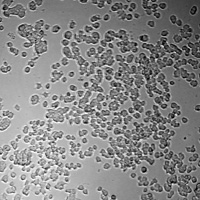
Rat tail collagen-coated
Growth of PC-12 cells in the culture dish
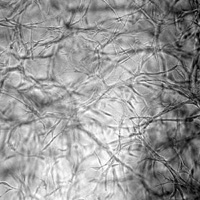
Rat tail collagen in 3D gel
Growth of NIH-3T3 cells (5 days after seeding)
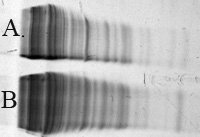
Comparison of SDS-PAGE electrophoresis with Sigma rat tail collagen (cat# C7661)
A: Sigma B: Glpbio
The surface coating of cell culture vessels: Recommended concentration: 1-5 μg/cm²
Take a coating concentration of 2 ug/cm2 as an example:
Dilute the collagen to 0.012mg/ml with sterile 0.006mol/L (0.36g/L) acetic acid. Add the volumes as indicated in Table (I) to the corresponding culture vessels:
|
|
Surface area (cm², per well or per dish) |
Volume (ul) of collagen solution added (0.012 mg/ml) |
|
96-well cell culture plate |
0.3 |
50 |
|
24-well cell culture plate |
1.9 |
300 |
|
12-well cell culture plate |
3.8 |
600 |
|
6-well cell culture plate |
9.5 |
1580 |
|
35mm cell culture dish |
8 |
1330 |
|
60mm cell culture dish |
21 |
3500 |
|
100mm cell culture dish |
55 |
9170 |
Make sure the collagen solution covers the entire surface of the container, then open the lid and let it dry overnight on the ultra-clean bench. Alternatively, it can be left at room temperature for 1 hour, washed with PBS 3-4 times, and then used directly.
The sealed containers can be preserved for at least 3 months or more at a temperature ranging from 4 to 25 degrees Celsius.
2. Preparation of three-dimensional collagen
Type I mouse tail collagen can form a three-dimensional gel with a certain strength when the concentration is above 1mg/ml and the pH is around 7. It is recommended that the gel-forming concentration be 1-2mg/ml. Hygromycin collagen dissolves in 0.006mol/L acetic acid. During the gel formation process, 0.06X volume of 0.1mol/L NaOH needs to be added to neutralize.
Required solutions (all need to be sterile and pre-cooled): 10x PBS (can contain 10 mg/L phenol red for pH indication) or 10x culture medium, 0.1 mol/L NaOH, 0.1 mol/L acetic acid (usually not used), double-distilled water
A. Preparation of three-dimensional collagen without cells (for preparing 1 ml, 1 mg/ml three-dimensional collagen): Add 200 ul of type I rat tail collagen (5 mg/ml) to a centrifuge tube placed in an ice bath, then add 690 ul of H2O. Next, add 12 ul of 0.1 mol/L NaOH (if 12 ul of 0.1 mol/L NaOH is added to the collagen solution instead, local collagen coagulation will occur due to the inability of NaOH to be thoroughly mixed quickly), and mix immediately. Then add 100 ul of 10xPBS or 10x culture medium, mix well, and immediately add to the culture dish (after mixing, the pH is about 7, if phenol red is not added to the PBS or culture medium, pH test with pH paper should be conducted before initial use). Place the culture dish at room temperature (around 25 degrees) for 20 minutes until the collagen solidifies, then transfer it to the incubator. If 10xPBS is used in the preparation, an appropriate volume of cell culture medium should be added for pre-equilibration before use.
B. Preparation of three-dimensional collagen containing cells (for preparing 1 ml, 1 mg/ml three-dimensional collagen): Prepare the cells suspended in the culture medium and place them in an ice bath. Add 200 ul of type I rat tail collagen (5 mg/ml) to 12 ul of 0.1 mol/L NaOH (if instead, 12 ul of 0.1 mol/L NaOH is added to the collagen solution, local collagen coagulation will occur due to the inability of NaOH to be thoroughly mixed quickly), and mix immediately. Then add 23 ul of 10x PBS or 10x culture medium, and mix (after mixing, the pH is around 7, if no phenol red is added to the PBS or culture medium, it is necessary to test the pH with pH paper when using for the first time). Add 760 ul of cell suspension, mix, and immediately add to the culture dish. Place the culture dish at room temperature for 20 minutes until it gels, then add an appropriate volume of cell culture medium and transfer to the incubator for cultivation.
Note: Type I collagen from mouse tail can rapidly gel at room temperature in a neutral pH environment. During the operation, it is necessary to maintain a low temperature as much as possible.
| Cas No. | SDF | ||
| Formula | M.Wt | ||
| Solubility | Storage | Store at 4℃,Do not freeze | |
| General tips | Please select the appropriate solvent to prepare the stock solution according to the
solubility of the product in different solvents; once the solution is prepared, please store it in
separate packages to avoid product failure caused by repeated freezing and thawing.Storage method
and period of the stock solution: When stored at -80°C, please use it within 6 months; when stored
at -20°C, please use it within 1 month. To increase solubility, heat the tube to 37°C and then oscillate in an ultrasonic bath for some time. |
||
| Shipping Condition | Evaluation sample solution: shipped with blue ice. All other sizes available: with RT, or with Blue Ice upon request. | ||
Step 1: Enter information below (Recommended: An additional animal making an allowance for loss during the experiment)
 g
μL
g
μL
Step 2: Enter the in vivo formulation (This is only the calculator, not formulation. Please contact us first if there is no in vivo formulation at the solubility Section.)
Calculation results:
Working concentration: mg/ml;
Method for preparing DMSO master liquid: mg drug pre-dissolved in μL DMSO ( Master liquid concentration mg/mL, Please contact us first if the concentration exceeds the DMSO solubility of the batch of drug. )
Method for preparing in vivo formulation: Take μL DMSO master liquid, next addμL PEG300, mix and clarify, next addμL Tween 80, mix and clarify, next add μL saline, mix and clarify.
Method for preparing in vivo formulation: Take μL DMSO master liquid, next add μL Corn oil, mix and clarify.
Note: 1. Please make sure the liquid is clear before adding the next solvent.
2. Be sure to add the solvent(s) in order. You must ensure that the solution obtained, in the previous addition, is a clear solution before proceeding to add the next solvent. Physical methods such as vortex, ultrasound or hot water bath can be used to aid dissolving.
3. All of the above co-solvents are available for purchase on the GlpBio website.
Average Rating: 5 (Based on Reviews and 4 reference(s) in Google Scholar.)