

Buparvaquone (Synonyms: BW 720C) |
Catalog No.GC35569
 One-Click Copy Product Info
|

An electron transport chain inhibitor
Products are for research use only. Not for human use. We do not sell to patients.
Cas No.: 88426-33-9
Sample solution is provided at 25 µL, 10mM.
_1-3.$$$39978408@51.jpg');)
_1-9.$$$38538795@65.jpg');)
_1-9.$$$39112701@51.jpg');)
_1-7.$$$37316672@70.jpg');)
_366-372.$$$36198801@70.jpg');)
.$$$38565142@65.jpg');)
_1867-1883.$$$33248023@67.jpg');)
_eads6055.$$$39977546@45.jpg');)
_eadm9805.$$$40080571@45.jpg');)
_eadj3020.$$$39666821@45.jpg');)
_1-20.$$$39757301@28.jpg');)
_1-24.$$$38898113@28.jpg');)
_273-287.$$$36806353@46.jpg');)
_1-16.$$$37156877@44.jpg');)
_1-19.$$$37460805@44.jpg');)
_1291-1307.$$$34518654@46.jpg');)
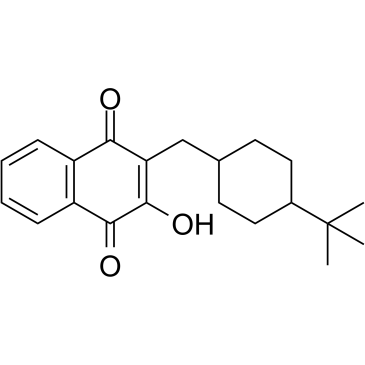
Buparvaquone is a hydroxynaphthoquinone antiprotozoal drug related to parvaquone and atovaquone.
In 4-day proliferation assays, buparvaquone efficiently inhibits N. caninum tachyzoite replication(IC50=4.9 nM; IC100=100 nM)[1]. Buparvaquone is significantly selective against L. (L.) infantum chagasi intracellular amastigotes, with an IC50 value of 1.5 μM. Other cutaneous species are also susceptible to buparvaquone, with IC50 values in the range 1-4 μM[2].
Treatment of N. caninum infected mice with buparvaquone (100 mg/kg) either by intraperitoneal injection or gavage prevents neosporosis symptoms in 4 out of 6 mice in the intraperitoneally treated group, and in 6 out of 7 mice in the group receiving oral treatment[1]. Both a hydrous gel and water-in-oil emulsion of buparvaquone significantly reduce cutaneous parasite burden and lesion size, compared with the untreated control[3].
[1]. MÜller J, et al. Buparvaquone is active against Neospora caninum in vitro and in experimentally infected mice. Int J Parasitol Drugs Drug Resist. 2015 Feb 13;5(1):16-25. [2]. Reim•o JQ, et al. Effectiveness of liposomal buparvaquone in an experimental hamster model of Leishmania (L.) infantum chagasi. Exp Parasitol. 2012 Mar;130(3):195-9. [3]. Garnier T, et al. In vivo studies on the antileishmanial activity of buparvaquone and its prodrugs. J Antimicrob Chemother. 2007 Oct;60(4):802-10.
Cell experiment: | To study whether pretreatment of host cells prior to invasion had any effect on parasite proliferation, confluent HFF grown in 6-well plates are treated with 1 µM buparvaquone in medium for 1 h or 5 h, and controls are exposed to the corresponding amounts of DMSO. Subsequently, the drug-containing medium is removed and monolayers are ished 4 times with Hank's Balanced Salt Solution, and are infected with Nc-Liv tachyzoites in 5 mL medium without any drug or solvent. After 2 days, cells are collected with a cell scraper, centrifuged, ished once more in PBS, and the pellet is stored at −20 °C prior to quantification of N. caninum proliferation by N. caninum-specific real time PCR as outlined below[1]. |
Animal experiment: | Mice: On day 0, all mice are infected by intraperitoneal (i.p.) injection of freshly purified N. caninum tachyzoites. After 48 h, mice receive BPQ (100 mg/kg) as suspension in corn oil either by i.p. injection of a volume of 100 µl or by oral application of 100 µl by gavage. The control groups obtained the corresponding amount of the solvent only, either i.p. or orally (see Table 2). The treatments are performed 5 times on a daily basis. If not indicated otherwise, mice are inspected twice daily for clinical signs (ruffled coat, apathy, hind limb paralysis) until day 21 post infection (p.i.), at which time they are euthanized[1]. |
References: [1]. Müller J, et al. Buparvaquone is active against Neospora caninum in vitro and in experimentally infected mice. Int J Parasitol Drugs Drug Resist. 2015 Feb 13;5(1):16-25. | |
| Cas No. | 88426-33-9 | SDF | |
| Synonyms | BW 720C | ||
| Canonical SMILES | O=C1C(CC2CCC(C(C)(C)C)CC2)=C(O)C(C3=C1C=CC=C3)=O | ||
| Formula | C21H26O3 | M.Wt | 326.43 |
| Solubility | DMSO: 33.33 mg/mL (102.10 mM); DMF: 25 mg/mL (76.59 mM); Ethanol: 2 mg/mL (6.13 mM); Water: < 0.1 mg/mL (insoluble) | Storage | Store at -20°C |
| General tips | Please select the appropriate solvent to prepare the stock solution according to the
solubility of the product in different solvents; once the solution is prepared, please store it in
separate packages to avoid product failure caused by repeated freezing and thawing.Storage method
and period of the stock solution: When stored at -80°C, please use it within 6 months; when stored
at -20°C, please use it within 1 month. To increase solubility, heat the tube to 37°C and then oscillate in an ultrasonic bath for some time. |
||
| Shipping Condition | Evaluation sample solution: shipped with blue ice. All other sizes available: with RT, or with Blue Ice upon request. | ||
| Prepare stock solution | |||

|
1 mg | 5 mg | 10 mg |
| 1 mM | 3.0634 mL | 15.3172 mL | 30.6344 mL |
| 5 mM | 612.7 μL | 3.0634 mL | 6.1269 mL |
| 10 mM | 306.3 μL | 1.5317 mL | 3.0634 mL |
Step 1: Enter information below (Recommended: An additional animal making an allowance for loss during the experiment)
 g
μL
g
μL
Step 2: Enter the in vivo formulation (This is only the calculator, not formulation. Please contact us first if there is no in vivo formulation at the solubility Section.)
Calculation results:
Working concentration: mg/ml;
Method for preparing DMSO master liquid: mg drug pre-dissolved in μL DMSO ( Master liquid concentration mg/mL, Please contact us first if the concentration exceeds the DMSO solubility of the batch of drug. )
Method for preparing in vivo formulation: Take μL DMSO master liquid, next addμL PEG300, mix and clarify, next addμL Tween 80, mix and clarify, next add μL saline, mix and clarify.
Method for preparing in vivo formulation: Take μL DMSO master liquid, next add μL Corn oil, mix and clarify.
Note: 1. Please make sure the liquid is clear before adding the next solvent.
2. Be sure to add the solvent(s) in order. You must ensure that the solution obtained, in the previous addition, is a clear solution before proceeding to add the next solvent. Physical methods such as vortex, ultrasound or hot water bath can be used to aid dissolving.
3. All of the above co-solvents are available for purchase on the GlpBio website.
Quality Control & SDS
- View current batch:
- Purity: >99.50% Appearance: A solid
- COA (Certificate of Analysis)
- SDS (Safety Data Sheet)
- Datasheet
Average Rating: 5 (Based on Reviews and 24 reference(s) in Google Scholar.)