

Clopidogrel |
Catalog No.GC35710
 One-Click Copy Product Info
|

Clopidogrel is an orally active platelet inhibitor that targets P2Y12 receptor.
Products are for research use only. Not for human use. We do not sell to patients.
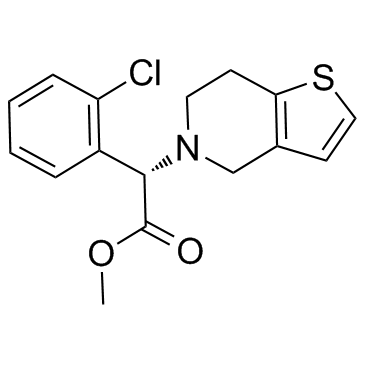
Cas No.: 113665-84-2
Sample solution is provided at 25 µL, 10mM.
_1-3.$$$39978408@51.jpg');)
_1-9.$$$38538795@65.jpg');)
_1-9.$$$39112701@51.jpg');)
_1-7.$$$37316672@70.jpg');)
_366-372.$$$36198801@70.jpg');)
.$$$38565142@65.jpg');)
_1867-1883.$$$33248023@67.jpg');)
_eads6055.$$$39977546@45.jpg');)
_eadm9805.$$$40080571@45.jpg');)
_eadj3020.$$$39666821@45.jpg');)
_1-20.$$$39757301@28.jpg');)
_1-24.$$$38898113@28.jpg');)
_273-287.$$$36806353@46.jpg');)
_1-16.$$$37156877@44.jpg');)
_1-19.$$$37460805@44.jpg');)
_1291-1307.$$$34518654@46.jpg');)
Clopidogrel is a well-known and orally active platelet inhibitor that targets P2Y12 receptor. Clopidogrel is used to inhibit blood clots in coronary artery disease, peripheral vascular disease, and cerebrovascular disease. P2Y12 receptor[1].
Clopidogrel, administered during the last three months, significantly decreases blood glucose, collagen and fibronectin expression compared to vehicle-treated diabetic mice. Clopidogrel markedly ameliorates hyperglycemia-induced renal fibrosis[1]. The combination therapy of clopidogrel and aspirin (dual-antiplatelet therapy) has been shown to be significantly beneficial compared to aspirin monotherapy and has also shown to decrease sub-acute stent thrombosis as well as recurrent ischemic events following ACS[2].
[1]. Zongyu Zheng, et al. Clopidogrel Reduces Fibronectin Accumulation and Improves Diabetes-Induced Renal Fibrosis. Int J Biol Sci. 2019 Jan. [2]. An insight into the interaction between clopidogrel and proton pump inhibitors By Shah, Bhavik S.; Parmar, Sanjay A.; Mahajan, Shailaja; Mehta, Anita A. From Current Drug Metabolism (2012), 13(2),225-235.
|
Animal experiment: |
Mice[1]13-week-old C57BL/6J male mice are used throughout the study. After 1 week of acclimation, 15 mice are injected I.P. with streptozotocin (STZ) at a dosage of 55 mg/kg body weight daily for five consecutive days. Additional 15 mice as controls (Ctrl) are injected with a vehicle solution (0.1 mol/L citrate acid buffer, pH 4.3-4.5). Seven days after the last STZ administration, hyperglycemic mice (3-hour fasting blood glucose ≥250 mg/dL) are considered T1D (DM). This time point is defined as a baseline. Three months after diabetes induction, five diabetic and five control mice are sacrificed and blood and kidneys harvested. The remaining animals are divided in four groups: Normal control with vehicle (Ctrl), Normal control with Clopidogrel (Ctrl+ Clo), T1D (DM) with vehicle, and DM with Clopidogrel treatment (DM+Clo) and are treated with 20 mg/kg b.w./day Clopidogrel or with vehicle administered in their drinking water for three additional months. At the end of experiment, mice are intraperitoneally anesthetized with Avertin (tribromoethanol, 350 mg/kg) and sacrificed to collect blood and kidneys for mRNA, protein, and histological analyses[1]. |
|
References: [1]. Zongyu Zheng, et al. Clopidogrel Reduces Fibronectin Accumulation and Improves Diabetes-Induced Renal Fibrosis. Int J Biol Sci. 2019 Jan. |
|
| Cas No. | 113665-84-2 | SDF | |
| Canonical SMILES | ClC1=C(C=CC=C1)[C@H](N2CCC3=C(C2)C=CS3)C(OC)=O | ||
| Formula | C16H16ClNO2S | M.Wt | 321.82 |
| Solubility | DMSO: 50mg/ml in DMSO | Storage | Store at -20°C |
| General tips | Please select the appropriate solvent to prepare the stock solution according to the
solubility of the product in different solvents; once the solution is prepared, please store it in
separate packages to avoid product failure caused by repeated freezing and thawing.Storage method
and period of the stock solution: When stored at -80°C, please use it within 6 months; when stored
at -20°C, please use it within 1 month. To increase solubility, heat the tube to 37°C and then oscillate in an ultrasonic bath for some time. |
||
| Shipping Condition | Evaluation sample solution: shipped with blue ice. All other sizes available: with RT, or with Blue Ice upon request. | ||
| Prepare stock solution | |||

|
1 mg | 5 mg | 10 mg |
| 1 mM | 3.1073 mL | 15.5366 mL | 31.0733 mL |
| 5 mM | 621.5 μL | 3.1073 mL | 6.2147 mL |
| 10 mM | 310.7 μL | 1.5537 mL | 3.1073 mL |
Step 1: Enter information below (Recommended: An additional animal making an allowance for loss during the experiment)
 g
μL
g
μL
Step 2: Enter the in vivo formulation (This is only the calculator, not formulation. Please contact us first if there is no in vivo formulation at the solubility Section.)
Calculation results:
Working concentration: mg/ml;
Method for preparing DMSO master liquid: mg drug pre-dissolved in μL DMSO ( Master liquid concentration mg/mL, Please contact us first if the concentration exceeds the DMSO solubility of the batch of drug. )
Method for preparing in vivo formulation: Take μL DMSO master liquid, next addμL PEG300, mix and clarify, next addμL Tween 80, mix and clarify, next add μL saline, mix and clarify.
Method for preparing in vivo formulation: Take μL DMSO master liquid, next add μL Corn oil, mix and clarify.
Note: 1. Please make sure the liquid is clear before adding the next solvent.
2. Be sure to add the solvent(s) in order. You must ensure that the solution obtained, in the previous addition, is a clear solution before proceeding to add the next solvent. Physical methods such as vortex, ultrasound or hot water bath can be used to aid dissolving.
3. All of the above co-solvents are available for purchase on the GlpBio website.
Quality Control & SDS
- View current batch:
- Purity: >99.00% Appearance: A solid
- COA (Certificate of Analysis)
- SDS (Safety Data Sheet)
- Datasheet
Average Rating: 5 (Based on Reviews and 10 reference(s) in Google Scholar.)