

Neoandrographolide |
Catalog No.GC36716
 One-Click Copy Product Info
|

Neoandrographolide is a diterpenoid compound isolated from Andrographis paniculata, which exhibits anti‑inflammatory and lipid‑lowering effects.
Products are for research use only. Not for human use. We do not sell to patients.
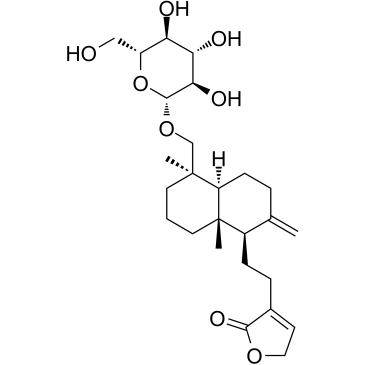
Cas No.: 27215-14-1
Sample solution is provided at 25 µL, 10mM.
_1-3.$$$39978408@51.jpg');)
_1-9.$$$38538795@65.jpg');)
_1-9.$$$39112701@51.jpg');)
_1-7.$$$37316672@70.jpg');)
_366-372.$$$36198801@70.jpg');)
.$$$38565142@65.jpg');)
_1867-1883.$$$33248023@67.jpg');)
_eads6055.$$$39977546@45.jpg');)
_eadm9805.$$$40080571@45.jpg');)
_eadj3020.$$$39666821@45.jpg');)
_1-20.$$$39757301@28.jpg');)
_1-24.$$$38898113@28.jpg');)
_273-287.$$$36806353@46.jpg');)
_1-16.$$$37156877@44.jpg');)
_1-19.$$$37460805@44.jpg');)
_1291-1307.$$$34518654@46.jpg');)
Neoandrographolide is a diterpenoid compound isolated from Andrographis paniculata, which exhibits anti‑inflammatory and lipid‑lowering effects[1-2]. Neoandrographolide is applicable for research on antiviral, antitumor, cardiovascular and cerebrovascular diseases, osteoporosis, and type 2 diabetes[3-4].
In vitro, co‑treatment of RAW 264.7 macrophages with Neoandrographolide (30–150μM) and LPS (5μg/ml) for 24–36h. Neoandrographolide significantly inhibited the production of TNF‑α and nitric oxide (NO)[5]. pretreatment of bone marrow‑derived mouse macrophages with Neoandrographolide (1.5–90μM) for 2h, followed by stimulation with LPS (5μg/ml) for 24h. Neoandrographolide markedly suppressed the expression of iNOS and COX‑2, and simultaneously reduced the generation of NO and PGE2[6].
In vivo, pretreatment of C57BL/6 mice with Neoandrographolide (10mg/kg/day) via intraperitoneal injection for 6 days prior to establishing a myocardial ischemia/reperfusion injury model. Neoandrographolide significantly improved cardiac systolic function, reduced myocardial infarct area and inflammatory cell infiltration, and inhibited cardiomyocyte apoptosis[7]. In an ovariectomy‑induced osteoporosis model, C57BL/6J mice were treated with Neoandrographolide (15mg/kg/day and 30mg/kg/day) by intraperitoneal injection for 8 weeks. Neoandrographolide significantly alleviated bone loss and improved trabecular microstructural parameters[8].
References:
[1] Ghosh N, Ghosh R, Mandal V, et al. Recent advances in herbal medicine for treatment of liver diseases. Pharm Biol. 2011 Sep;49(9):970-88.
[2] Yang T, Shi HX, Wang ZT, et al. Hypolipidemic effects of andrographolide and neoandrographolide in mice and rats. Phytother Res. 2013 Apr;27(4):618-23.
[3] Sangeetha K, Martín-Acebes MA, Saiz JC, et al. Molecular docking and antiviral activities of plant derived compounds against zika virus. Microb Pathog. 2020 Dec;149:104540.
[4] Jadhav AK, Karuppayil SM. Andrographis paniculata (Burm. F) Wall ex Nees: Antiviral properties. Phytother Res. 2021 Oct;35(10):5365-5373.
[5] Liu J, Wang ZT, Ji LL. In vivo and in vitro anti-inflammatory activities of neoandrographolide. Am J Chin Med. 2007;35(2):317-28.
[6] Liu J, Wang ZT, Ji LL, et al. Inhibitory effects of neoandrographolide on nitric oxide and prostaglandin E2 production in LPS-stimulated murine macrophage. Mol Cell Biochem. 2007 Apr;298(1-2):49-57.
[7] Liu Y, Liu Y, Zhang HL, et al. Amelioratory effect of neoandrographolide on myocardial ischemic-reperfusion injury by its anti-inflammatory and anti-apoptotic activities. Environ Toxicol. 2021 Dec;36(12):2367-2379.
[8] Tang K, Deng W, Huang Z, et al. Neoandrographolide inhibits mature osteoclast differentiation to alleviate bone loss and treat osteoporosis. Front Pharmacol. 2025 Feb 11;16:1466057.
| Cell experiment [1]: | |
Cell lines | RAW 264.7 cells (mouse monocyte-macrophage cell line) |
Preparation Method | RAW 264.7 cells were maintained in RPMI 1640 medium supplemented with 10% fetal calf serum (FCS) and 1% penicillin/streptomycin at 37°C in 5% CO₂. For respiratory burst assays, cells were adjusted to 2×10⁵ cells/mL and stimulated with phorbol-12-myristate-13-acetate (PMA; 125ng/mL). For nitric oxide (NO) and tumor necrosis factor-alpha (TNF-α) production assays, cells were adjusted to 1 × 10⁶ cells/mL and stimulated with lipopolysaccharide (LPS; 5 μg/mL). Neoandrographolide (1.5–150μM) was co-administered with the stimulators. |
Reaction Conditions | 1.5–150μM; 24-36h. |
Applications | Neoandrographolide dose-dependently suppressed PMA-stimulated respiratory bursts in RAW 264.7 macrophages at concentrations from 7.5 to 150μM. Neoandrographolide also inhibited LPS-induced production of NO and TNF-α in a dose-dependent manner (30–150μM). No cytotoxicity was observed at concentrations up to 90μM. |
| Animal experiment [2]: | |
Animal models | C57BL/6 mice |
Preparation Method | Mice were subjected to myocardial ischemia/reperfusion (MI/R) injury by 30 minutes of left anterior descending coronary artery (LAD) ligation followed by reperfusion. They were randomly divided into Sham, MI/R, and MI/R + Neoandrographolide groups. Neo was administered intraperitoneally for 6 consecutive days before the surgical procedure. |
Dosage form | 10mg/kg/day; i.p.; 6 days. |
Applications | Neoandrographolide pretreatment significantly improved heart systolic function, reduced myocardial infarct size, attenuated inflammatory cell infiltration, and decreased cardiomyocyte apoptosis in mice with MI/R. These cardioprotective effects were associated with the inhibition of the NF-κB signaling pathway and modulation of the Bax/Bcl-2 apoptotic pathway. |
References: | |
| Cas No. | 27215-14-1 | SDF | |
| Canonical SMILES | C[C@@]([C@@H]1CCC2=CCOC2=O)(CCC3)[C@@](CCC1=C)([H])[C@]3(C)CO[C@@H]([C@@H]([C@@H](O)[C@@H]4O)O)O[C@@H]4CO | ||
| Formula | C26H40O8 | M.Wt | 480.59 |
| Solubility | DMSO: ≥ 250 mg/mL (520.19 mM) | Storage | 4°C, protect from light |
| General tips | Please select the appropriate solvent to prepare the stock solution according to the
solubility of the product in different solvents; once the solution is prepared, please store it in
separate packages to avoid product failure caused by repeated freezing and thawing.Storage method
and period of the stock solution: When stored at -80°C, please use it within 6 months; when stored
at -20°C, please use it within 1 month. To increase solubility, heat the tube to 37°C and then oscillate in an ultrasonic bath for some time. |
||
| Shipping Condition | Evaluation sample solution: shipped with blue ice. All other sizes available: with RT, or with Blue Ice upon request. | ||
| Prepare stock solution | |||

|
1 mg | 5 mg | 10 mg |
| 1 mM | 2.0808 mL | 10.4039 mL | 20.8078 mL |
| 5 mM | 416.2 μL | 2.0808 mL | 4.1616 mL |
| 10 mM | 208.1 μL | 1.0404 mL | 2.0808 mL |
Step 1: Enter information below (Recommended: An additional animal making an allowance for loss during the experiment)
 g
μL
g
μL
Step 2: Enter the in vivo formulation (This is only the calculator, not formulation. Please contact us first if there is no in vivo formulation at the solubility Section.)
Calculation results:
Working concentration: mg/ml;
Method for preparing DMSO master liquid: mg drug pre-dissolved in μL DMSO ( Master liquid concentration mg/mL, Please contact us first if the concentration exceeds the DMSO solubility of the batch of drug. )
Method for preparing in vivo formulation: Take μL DMSO master liquid, next addμL PEG300, mix and clarify, next addμL Tween 80, mix and clarify, next add μL saline, mix and clarify.
Method for preparing in vivo formulation: Take μL DMSO master liquid, next add μL Corn oil, mix and clarify.
Note: 1. Please make sure the liquid is clear before adding the next solvent.
2. Be sure to add the solvent(s) in order. You must ensure that the solution obtained, in the previous addition, is a clear solution before proceeding to add the next solvent. Physical methods such as vortex, ultrasound or hot water bath can be used to aid dissolving.
3. All of the above co-solvents are available for purchase on the GlpBio website.
Quality Control & SDS
- View current batch:
- Purity: >98.00% Appearance: A solid
- COA (Certificate of Analysis)
- SDS (Safety Data Sheet)
- Datasheet
Average Rating: 5 (Based on Reviews and 32 reference(s) in Google Scholar.)