

RS102895 |
Catalog No.GC37564
 One-Click Copy Product Info
|

RS102895 is a potent CCR2 antagonist, with an IC50 of 360 nM, and shows no effect on CCR1.
Products are for research use only. Not for human use. We do not sell to patients.
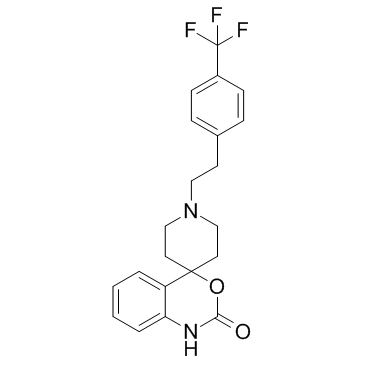
Cas No.: 300815-41-2
Sample solution is provided at 25 µL, 10mM.
_1-3.$$$39978408@51.jpg');)
_1-9.$$$38538795@65.jpg');)
_1-9.$$$39112701@51.jpg');)
_1-7.$$$37316672@70.jpg');)
_366-372.$$$36198801@70.jpg');)
.$$$38565142@65.jpg');)
_1867-1883.$$$33248023@67.jpg');)
_eads6055.$$$39977546@45.jpg');)
_eadm9805.$$$40080571@45.jpg');)
_eadj3020.$$$39666821@45.jpg');)
_1-20.$$$39757301@28.jpg');)
_1-24.$$$38898113@28.jpg');)
_273-287.$$$36806353@46.jpg');)
_1-16.$$$37156877@44.jpg');)
_1-19.$$$37460805@44.jpg');)
_1291-1307.$$$34518654@46.jpg');)
RS102895 is a potent CCR2 antagonist, with an IC50 of 360 nM, and shows no effect on CCR1. CCR2|360 nM (IC50)|CCR1|17800 nM (IC50)|Human α1a receptor|130 nM (IC50)|Human α1d receptor|320 nM (IC50)|5HT-1a receptor|470 nM (IC50)
RS102895 is a potent CCR2 antagonist, with an IC50 of 360 nM, and shows no effect on CCR1. RS102895 also inhibits human α1a and α1d receptors, rat brain cortex 5HT1a receptor in cells with IC50s of 130, 320, 470 nM, respectively. RS102895 suppresses wild type and D284N mutant MCP-1 receptor (IC50, 550 nM and 568 nM, respectively), less potently inhibits D284A MCP-1 receptor (IC50, 1892 nM), and has no effects on E291A, E291Q, D284A/E291A or D284N/E291Q (IC50, >100,000 nM)[1]. RS102895 ameliorates the increased extracellular matrix (ECM) protein expression by inhibition of CCR2 at 10 μM, and obviously blocks fibronectin and type IV collagen protein expression in high glucose (HG)-stimulated mesangial cells (MCs) at 1 or 10 μM. RS102895 (10 μM) also abrogates the increased TGF-1 levels in MCs treated with MCP-1[2].
RS102895 (3 g/L) causes progressive decrease in pain threshold in rats with bone cancer pain (BCP) at day 3-9 after surgery via intrathecal injection, but the pain threshold increases after 12 days. RS102895 also potently reverses the pattern of NR2B, nNOS, and SIGIRR expression in spinal cord[3].
[1]. Mirzadegan T, et al. Identification of the binding site for a novel class of CCR2b chemokine receptor antagonists: binding to a common chemokine receptor motif within the helical bundle. J Biol Chem. 2000 Aug 18;275(33):25562-71. [2]. Park J, et al. MCP-1/CCR2 system is involved in high glucose-induced fibronectin and type IV collagen expression in cultured mesangial cells. Am J Physiol Renal Physiol. 2008 Sep;295(3):F749-57. [3]. Ren F, et al. Analgesic Effect of Intrathecal Administration of Chemokine Receptor CCR2 Antagonist is Related to Change in Spinal NR2B, nNOS, and SIGIRR Expression in Rat with Bone Cancer Pain. Cell Biochem Biophys. 2015 Jun;72(2):611-6.
|
Cell experiment: |
Transfected mesangial cells (MCs) are serum restricted for 24 h, after which the medium is replaced by serum-free DMEM containing normal glucose (NG; 5.6 mM), NG+Mannitol (NG+M; 24.4 mM), or high glucose (HG; 30 mM). In addition, nontransfected MCs are cultured under NG, NG+M, or HG with or without RS102895 or anti-TGF-1 antibody (25 μg/mL). Nontransfected MCs are also exposed to medium containing recombinant human MCP-1 (10 ng/mL) or recombinant human TGF-1 (2 ng/mL). At 24 h after the media change, cells are harvested and the conditioned culture media are collected[2]. |
|
Animal experiment: |
Rats[3]CCR2 antagonist RS102895 is dissolved in DMSO. Rats receive daily intrathecal injection of either RS102895 (3 g/L) 10 μL or 10 % DMSO 10 μL between 9 and 20 days after operation. All rats are randomLy divided into five groups (n = 10 per group): Sham group, Sham + RS102895 group, BCP group, BCP + RS102895 group, and BCP + DMSO group. Rats are sacrificed 20 days after operation and the tissue samples from the L4-L5 spinal cord segments are rapidly removed and immediately frozen in liquid nitrogen and stored at ?80°C until use for RT-PCR and Western blot[3]. |
|
References: [1]. Mirzadegan T, et al. Identification of the binding site for a novel class of CCR2b chemokine receptor antagonists: binding to a common chemokine receptor motif within the helical bundle. J Biol Chem. 2000 Aug 18;275(33):25562-71. |
|
| Cas No. | 300815-41-2 | SDF | |
| Canonical SMILES | O=C1NC2=CC=CC=C2C3(CCN(CCC4=CC=C(C(F)(F)F)C=C4)CC3)O1 | ||
| Formula | C21H21F3N2O2 | M.Wt | 390.4 |
| Solubility | DMSO : 250 mg/mL (640.37 mM; Need ultrasonic); Ethanol : 50 mg/mL (128.07 mM; ultrasonic and warming and heat to 60°C) | Storage | Store at -20°C |
| General tips | Please select the appropriate solvent to prepare the stock solution according to the
solubility of the product in different solvents; once the solution is prepared, please store it in
separate packages to avoid product failure caused by repeated freezing and thawing.Storage method
and period of the stock solution: When stored at -80°C, please use it within 6 months; when stored
at -20°C, please use it within 1 month. To increase solubility, heat the tube to 37°C and then oscillate in an ultrasonic bath for some time. |
||
| Shipping Condition | Evaluation sample solution: shipped with blue ice. All other sizes available: with RT, or with Blue Ice upon request. | ||
| Prepare stock solution | |||

|
1 mg | 5 mg | 10 mg |
| 1 mM | 2.5615 mL | 12.8074 mL | 25.6148 mL |
| 5 mM | 512.3 μL | 2.5615 mL | 5.123 mL |
| 10 mM | 256.1 μL | 1.2807 mL | 2.5615 mL |
Step 1: Enter information below (Recommended: An additional animal making an allowance for loss during the experiment)
 g
μL
g
μL
Step 2: Enter the in vivo formulation (This is only the calculator, not formulation. Please contact us first if there is no in vivo formulation at the solubility Section.)
Calculation results:
Working concentration: mg/ml;
Method for preparing DMSO master liquid: mg drug pre-dissolved in μL DMSO ( Master liquid concentration mg/mL, Please contact us first if the concentration exceeds the DMSO solubility of the batch of drug. )
Method for preparing in vivo formulation: Take μL DMSO master liquid, next addμL PEG300, mix and clarify, next addμL Tween 80, mix and clarify, next add μL saline, mix and clarify.
Method for preparing in vivo formulation: Take μL DMSO master liquid, next add μL Corn oil, mix and clarify.
Note: 1. Please make sure the liquid is clear before adding the next solvent.
2. Be sure to add the solvent(s) in order. You must ensure that the solution obtained, in the previous addition, is a clear solution before proceeding to add the next solvent. Physical methods such as vortex, ultrasound or hot water bath can be used to aid dissolving.
3. All of the above co-solvents are available for purchase on the GlpBio website.
Quality Control & SDS
- View current batch:
- Purity: >98.00% Appearance: A solid
- COA (Certificate of Analysis)
- SDS (Safety Data Sheet)
- Datasheet
Average Rating: 5 (Based on Reviews and 16 reference(s) in Google Scholar.)