

D-Ala-Lys-AMCA hydrochloride |
Catalog No.GC38504
 One-Click Copy Product Info
|

D-Ala-Lys-AMCA hydrochloride is a proton-coupled oligopeptide transporter 1 (PEPT1) substrate with Ex/Em=350/460nm.
Products are for research use only. Not for human use. We do not sell to patients.
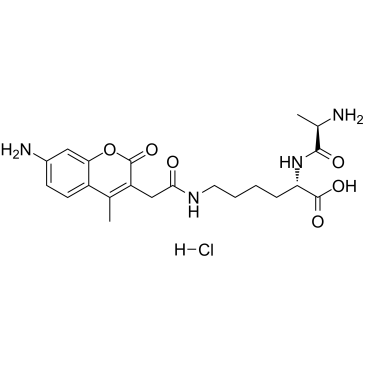
Cas No.: 2703746-41-0
Sample solution is provided at 25 µL, 10mM.
_1-3.$$$39978408@51.jpg');)
_1-9.$$$38538795@65.jpg');)
_1-9.$$$39112701@51.jpg');)
_1-7.$$$37316672@70.jpg');)
_366-372.$$$36198801@70.jpg');)
.$$$38565142@65.jpg');)
_1867-1883.$$$33248023@67.jpg');)
_eads6055.$$$39977546@45.jpg');)
_eadm9805.$$$40080571@45.jpg');)
_eadj3020.$$$39666821@45.jpg');)
_1-20.$$$39757301@28.jpg');)
_1-24.$$$38898113@28.jpg');)
_273-287.$$$36806353@46.jpg');)
_1-16.$$$37156877@44.jpg');)
_1-19.$$$37460805@44.jpg');)
_1291-1307.$$$34518654@46.jpg');)
D-Ala-Lys-AMCA hydrochloride is a proton-coupled oligopeptide transporter 1 (PEPT1) substrate with Ex/Em=350/460nm [1]. D-Ala-Lys-AMCA hydrochloride is widely used as a fluorescent reporter molecule to visualize the intestinal dipeptide transport in mammals [2].
References:
[1] Gong Y, Zhang J, Wu X, et al. Specific expression of proton-coupled oligopeptide transporter 1 in primary hepatocarcinoma‑a novel strategy for tumor-targeted therapy[J]. Oncology letters, 2017, 14(4): 4158-4166.
[2] Groneberg D A, Döring F, Eynott P R, et al. Intestinal peptide transport: ex vivo uptake studies and localization of peptide carrier PEPT1[J]. American Journal of Physiology-Gastrointestinal and Liver Physiology, 2001, 281(3): G697-G704.
Measurement of PEPT1 with D-Ala-Lys-AMCA hydrochloride
This protocol only provides a guideline, and should be modified according to your specific needs
1. Prepare dyeing solution
(1) Prepare stock solution: Prepare D-Ala-Lys-AMCA stock solution with a concentration of 10mM in high-quality anhydrous DMSO. Notice: Aliquot the unused stock solution and store it in the dark at -20°C to avoid repeated freezing and thawing.
(2) Prepare working solution: Dilute the stock solution with a suitable buffer (such as PBS) to prepare a working solution with a concentration of 100μM. Please adjust the concentration of the working fluid according to the actual situation, and prepare it now to avoid repeated freezing and thawing. Notice: The working solution must be prepared fresh on the day of the experiment.
2.Cell Labeling
(1) Cells were cultured in 24-well plates for 70-80% confluence.
(2) Wash twice with PBS.
(3) Add appropriate amount of working solution, incubate for 1-2h at 37°C.
(4) Remove dye, wash twice with PBS, and cells are examined using a fluorescence microscope (Ex/Em=350/460nm).
3. Precautions:
(1) Fluorescent dyes all have quenching problems. Please avoid light as much as possible to slow down fluorescence quenching.
(2) For your safety and health, please wear a lab coat and disposable gloves when operating
(3) D-Ala-Lys-AMCA hydrochloride should be stored in the dark throughout the experiment.
(4) This protocol and all reagents are for scientific research use only.
References:
[1] Gong Y, Zhang J, Wu X, et al. Specific expression of proton-coupled oligopeptide transporter 1 in primary hepatocarcinoma‑a novel strategy for tumor-targeted therapy[J]. Oncology letters, 2017, 14(4): 4158-4166.
| Cas No. | 2703746-41-0 | SDF | |
| Canonical SMILES | NC1=CC=C(C(C)=C(CC(NCCCC[C@H](NC([C@@H](C)N)=O)C(O)=O)=O)C(O2)=O)C2=C1.[H]Cl | ||
| Formula | C21H29ClN4O6 | M.Wt | 468.93 |
| Solubility | Water: 100 mg/mL (213.25 mM); DMSO: 14.71 mg/mL (31.37 mM) | Storage | Store at -20°C |
| General tips | Please select the appropriate solvent to prepare the stock solution according to the
solubility of the product in different solvents; once the solution is prepared, please store it in
separate packages to avoid product failure caused by repeated freezing and thawing.Storage method
and period of the stock solution: When stored at -80°C, please use it within 6 months; when stored
at -20°C, please use it within 1 month. To increase solubility, heat the tube to 37°C and then oscillate in an ultrasonic bath for some time. |
||
| Shipping Condition | Evaluation sample solution: shipped with blue ice. All other sizes available: with RT, or with Blue Ice upon request. | ||
| Prepare stock solution | |||

|
1 mg | 5 mg | 10 mg |
| 1 mM | 2.1325 mL | 10.6626 mL | 21.3251 mL |
| 5 mM | 426.5 μL | 2.1325 mL | 4.265 mL |
| 10 mM | 213.3 μL | 1.0663 mL | 2.1325 mL |
Step 1: Enter information below (Recommended: An additional animal making an allowance for loss during the experiment)
 g
μL
g
μL
Step 2: Enter the in vivo formulation (This is only the calculator, not formulation. Please contact us first if there is no in vivo formulation at the solubility Section.)
Calculation results:
Working concentration: mg/ml;
Method for preparing DMSO master liquid: mg drug pre-dissolved in μL DMSO ( Master liquid concentration mg/mL, Please contact us first if the concentration exceeds the DMSO solubility of the batch of drug. )
Method for preparing in vivo formulation: Take μL DMSO master liquid, next addμL PEG300, mix and clarify, next addμL Tween 80, mix and clarify, next add μL saline, mix and clarify.
Method for preparing in vivo formulation: Take μL DMSO master liquid, next add μL Corn oil, mix and clarify.
Note: 1. Please make sure the liquid is clear before adding the next solvent.
2. Be sure to add the solvent(s) in order. You must ensure that the solution obtained, in the previous addition, is a clear solution before proceeding to add the next solvent. Physical methods such as vortex, ultrasound or hot water bath can be used to aid dissolving.
3. All of the above co-solvents are available for purchase on the GlpBio website.
Quality Control & SDS
- View current batch:
- Purity: >98.00% Appearance: A solid
- COA (Certificate of Analysis)
- SDS (Safety Data Sheet)
- Datasheet
Average Rating: 5 (Based on Reviews and 38 reference(s) in Google Scholar.)