

HOIPIN-8 |
Catalog No.GC63004
 One-Click Copy Product Info
|

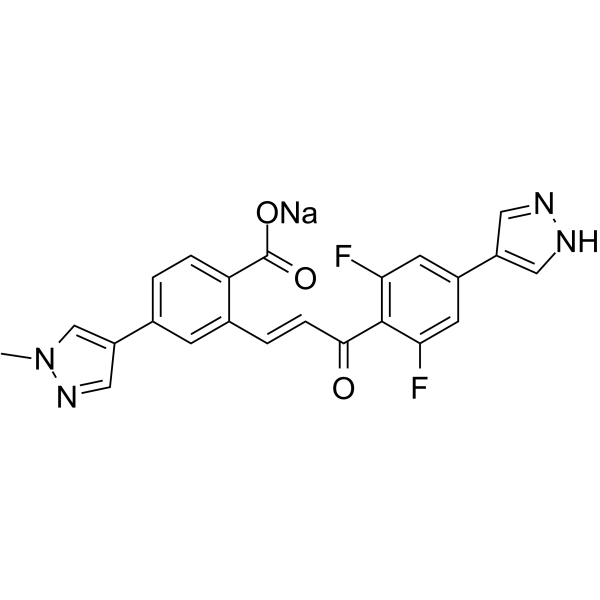
HOIPIN-8 is a potent inhibitor of the linear ubiquitin chain assembly complex (LUBAC) with an IC₅₀ of 11nM.
Products are for research use only. Not for human use. We do not sell to patients.
Sample solution is provided at 25 µL, 10mM.
_1-3.$$$39978408@51.jpg');)
_1-9.$$$38538795@65.jpg');)
_1-9.$$$39112701@51.jpg');)
_1-7.$$$37316672@70.jpg');)
_366-372.$$$36198801@70.jpg');)
.$$$38565142@65.jpg');)
_1867-1883.$$$33248023@67.jpg');)
_eads6055.$$$39977546@45.jpg');)
_eadm9805.$$$40080571@45.jpg');)
_eadj3020.$$$39666821@45.jpg');)
_1-20.$$$39757301@28.jpg');)
_1-24.$$$38898113@28.jpg');)
_273-287.$$$36806353@46.jpg');)
_1-16.$$$37156877@44.jpg');)
_1-19.$$$37460805@44.jpg');)
_1291-1307.$$$34518654@46.jpg');)
HOIPIN-8 is a potent inhibitor of the linear ubiquitin chain assembly complex (LUBAC) with an IC₅₀ of 11nM [1]. LUBAC is an E3 ubiquitin ligase complex that specifically generates M1-linked linear polyubiquitin chains. It is composed of HOIL-1L, HOIP, and SHARPIN. LUBAC activates the NF-κB pathway and inhibits apoptosis via the linear ubiquitination of various substrates[2].
HOIPIN-8 (30μM) treatment of A431, MCF-7, and MDA-MB-231 cancer cells for 2h reduced the phosphorylation levels of both IκBα and p65 compared with the DMSO-treated group, along with a significant decrease in cell proliferation rates, demonstrating HOIPIN-8's ability to inhibit both NF-κB pathway activation and cancer cell proliferation[3]. Similarly, treatment with HOIPIN-8 (100μM) for 48h significantly reduced both proliferation rates and invasive capabilities in HepG2 and Hep3B cancer cell lines[4]. The TDP-43 A315T mutation, associated with amyotrophic lateral sclerosis (ALS), enhances TDP-43 protein aggregation. In Neuro2a cells expressing TDP-43 A315T247-414-GFP, treatment with HOIPIN-8(10μM) for 20h significantly reduced protein aggregation compared to untreated controls[5].
HOIPIN-8 (30μM) treatment of human pancreatic organoids (hPOs) for 30min effectively delayed BV6-induced organoid disintegration, prevented luminal structure collapse, and extended survival duration[6].
References:
[1] Katsuya K, Oikawa D, Iio K, et al., Small-molecule inhibitors of linear ubiquitin chain assembly complex (LUBAC), HOIPINs, suppress NF-κB signaling, Biochemical and Biophysical Research Communications[J]. 2019, 509: 700-706.
[2] Tokunaga F, Iwai K, LUBAC, a novel ubiquitin ligase for linear ubiquitination, is crucial for inflammation and immune responses, Microbes and Infection[J]. 2012, 14: 563-572.
[3] Hua F, Hao W, Wang L, et al., Linear Ubiquitination Mediates EGFR-Induced NF-κB Pathway and Tumor Development, Int J Mol Sci[J]. 2021, 22: 11875.
[4] Hoshino K, Nakazawa S, Yokobori T, et al., RNF31 promotes proliferation and invasion of hepatocellular carcinoma via nuclear factor kappaB activation, Scientific Reports[J]. 2024, 14: 346.
[5] Zhang Q, Terawaki S, Oikawa D, et al., Suppression of Linear Ubiquitination Ameliorates Cytoplasmic Aggregation of Truncated TDP-43, Cells[J]. 2022, 11: 2398.
[6] Weinelt N, Wächtershäuser K N, Celik G, et al., LUBAC-mediated M1 Ub regulates necroptosis by segregating the cellular distribution of active MLKL, Cell Death & Disease[J]. 2024, 15: 77.
| Cell experiment [1]: | |
Cell lines | A431, MCF-7, and MDA-MB-231 cancer cells |
Preparation Method | Cells were seeded in a 96-well plate at a density of 400 cells/well in 100μL culture medium. Then, cells were treated with DMSO or 30μM HOIPIN-8 for 2h. Cell growth rate was determined by the MTT Cell Proliferation Kit. |
Reaction Conditions | 30μM; 2h |
Applications | HOIPIN-8 significantly inhibited cell proliferation of A431, MCF-7, and MDA-MB-231 cancer cells. |
References: | |
| Cas No. | SDF | ||
| Formula | C23H15F2N4NaO3 | M.Wt | 456.38 |
| Solubility | DMSO : 100 mg/mL (219.12 mM; Need ultrasonic) | Storage | Store at -20°C,protect from light |
| General tips | Please select the appropriate solvent to prepare the stock solution according to the
solubility of the product in different solvents; once the solution is prepared, please store it in
separate packages to avoid product failure caused by repeated freezing and thawing.Storage method
and period of the stock solution: When stored at -80°C, please use it within 6 months; when stored
at -20°C, please use it within 1 month. To increase solubility, heat the tube to 37°C and then oscillate in an ultrasonic bath for some time. |
||
| Shipping Condition | Evaluation sample solution: shipped with blue ice. All other sizes available: with RT, or with Blue Ice upon request. | ||
| Prepare stock solution | |||

|
1 mg | 5 mg | 10 mg |
| 1 mM | 2.1912 mL | 10.9558 mL | 21.9116 mL |
| 5 mM | 438.2 μL | 2.1912 mL | 4.3823 mL |
| 10 mM | 219.1 μL | 1.0956 mL | 2.1912 mL |
Step 1: Enter information below (Recommended: An additional animal making an allowance for loss during the experiment)
 g
μL
g
μL
Step 2: Enter the in vivo formulation (This is only the calculator, not formulation. Please contact us first if there is no in vivo formulation at the solubility Section.)
Calculation results:
Working concentration: mg/ml;
Method for preparing DMSO master liquid: mg drug pre-dissolved in μL DMSO ( Master liquid concentration mg/mL, Please contact us first if the concentration exceeds the DMSO solubility of the batch of drug. )
Method for preparing in vivo formulation: Take μL DMSO master liquid, next addμL PEG300, mix and clarify, next addμL Tween 80, mix and clarify, next add μL saline, mix and clarify.
Method for preparing in vivo formulation: Take μL DMSO master liquid, next add μL Corn oil, mix and clarify.
Note: 1. Please make sure the liquid is clear before adding the next solvent.
2. Be sure to add the solvent(s) in order. You must ensure that the solution obtained, in the previous addition, is a clear solution before proceeding to add the next solvent. Physical methods such as vortex, ultrasound or hot water bath can be used to aid dissolving.
3. All of the above co-solvents are available for purchase on the GlpBio website.
Quality Control & SDS
- View current batch:
- Purity: >98.00% Appearance: A solid
- COA (Certificate of Analysis)
- SDS (Safety Data Sheet)
- Datasheet
Average Rating: 5 (Based on Reviews and 40 reference(s) in Google Scholar.)